

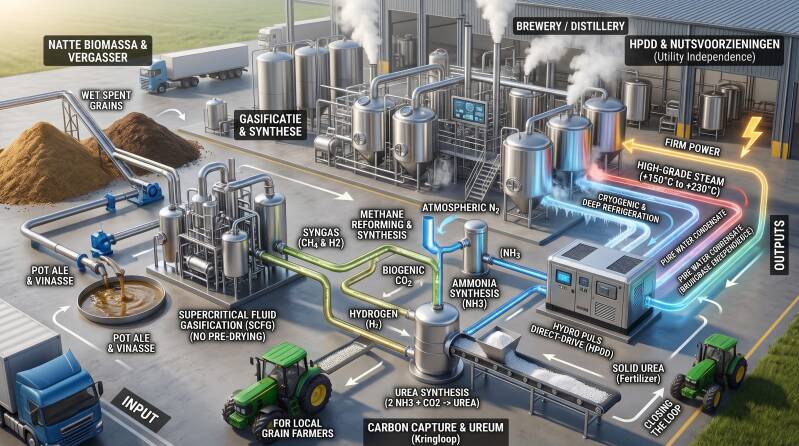
Closing the Loop in Brewing & Distilling: From Wet Spent Grains to Firm Power, Steam, Cooling, and Solid Urea
Modern breweries and distilleries face a dual challenge: massive thermal and electrical energy demands alongside mountains of wet organic byproducts (spent grains, draff, pot ale, and vinasse).
Treating wet biomass as waste creates disposal costs and logistics headaches. Running conventional boilers and chillers burns fossil gas and strains local power grids.
Integrating Hydro Puls Direct-Drive (HPDD) with Supercritical Fluid Gasification (SCFG) fundamentally transforms this balance sheet into a closed-loop polygeneration engine:
1. On-Site Wet Biomass Conversion
Directly gasifying high-moisture organic residues on site without pre-drying produces a clean syngas of biogenic methane (CH4) and hydrogen (H2).
2. Closed-Loop Synthesis & Zero-Waste Carbon Capture
• Methane reforming yields hydrogen (H2) and biogenic carbon dioxide (CO2).
• Atmospheric nitrogen (N2) is captured and combined with hydrogen to synthesize ammonia (NH3).
• Rather than venting the biogenic CO2 into the atmosphere, it reacts with ammonia to synthesize high-grade solid urea:
2 NH3 + CO2 -> NH2CONH2 + H2O
This converts brewery byproducts into commercial, agricultural-grade fertilizer for local barley and grain farmers.
3. Complete Utility Independence from One Reaction Core
The remaining ammonia stream powers the crankless, hermetically sealed HPDD platform, simultaneously generating all five utility vectors required by heavy brewing operations:
• Firm electrical power for processing, bottling lines, and facility loads.
• High-grade industrial steam (+150°C to +230°C) for mashing, wort boiling, and distillation columns.
• Direct cryogenic chilling and deep refrigeration for fermentation temperature control, lagering cellars, and wort cooling, completely eliminating the parasitic electricity drag of conventional compressors.
• Distilled pure water condensate for process integration.