

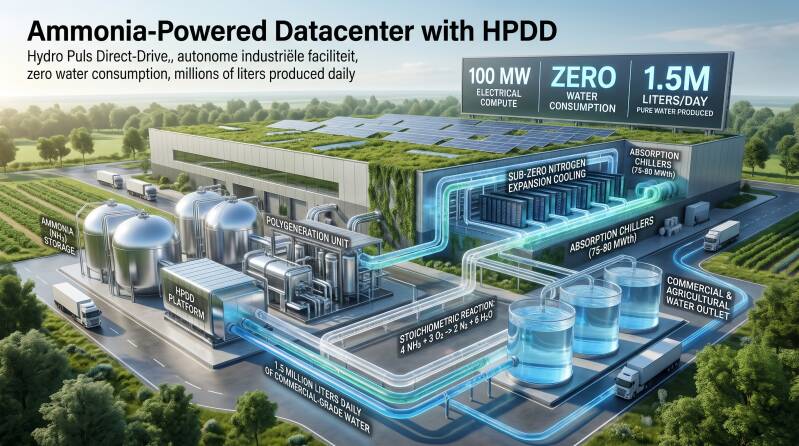
Why an ammonia-powered datacenter with HPDD consumes zero water, yet produces millions of liters of commercial-grade water daily.
The conventional datacenter model is colliding with physical limits: massive grid connection queues, soaring electricity bills for mechanical chillers, and cooling towers that evaporate millions of liters of potable water every day.
Redesigning the utility core around the closed-loop Hydro Puls Direct-Drive (HPDD) platform running on clean ammonia (NH3) fundamentally shifts the mass and exergy balance through integrated polygeneration.
The operational figures for a 100 MW electrical compute facility:
1. Zero Water Consumption and 1.5 Million Liters Produced Daily:
The stoichiometric reaction (4 NH3 + 3 O2 -> 2 N2 + 6 H2O) yields 1.58 tons of distilled water per ton of ammonia reacted. At 100 MWe, the system yields 63,500 liters of pure condensate per hour, which equals over 1.52 million liters of high-purity water every single day. Because HPDD satisfies the entire cooling load internally, evaporative cooling towers are completely eliminated. Not a single drop is evaporated on site. The generated water is not consumed; it represents a pristine, commercially sellable asset for local industrial, agricultural, or municipal networks.
2. Enormous Nitrogen Mass Flow for Direct Sub-Zero Expansion:
Combustion air supplies both the necessary oxygen and the accompanying atmospheric nitrogen. Combined with the nitrogen released from the ammonia molecule, this creates a massive dry stream of over 170 metric tons of pure nitrogen per hour under extreme pressure. Controlled expansion of this gas volume provides immediate, deep sub-zero refrigeration work.
3. Total Thermal Cooling Without Grid Reliance:
The ~100 MWth of high-grade reaction enthalpy drives industrial absorption chillers, producing 75 to 80 MWth of chilled water. Coupled with direct gas expansion cooling, this completely fulfills the 70 to 85 MWth heat rejection requirements of a 100 MW IT load without running parasitic, grid-straining electric motor chillers.
Rather than competing with local communities for scarce municipal water and constrained power lines, the facility becomes an autonomous energy, cooling, and water asset.
Sustainable high-density computing is not achieved by trimming individual kilowatts; it is achieved by capturing the full thermodynamic value of every mass and energy stream.
#DataCenters #Ammonia #HPDD #Polygeneration #CleanTech #WaterInnovation #EnergyTransition #IndustrialEngineering #NetZero