

Why the real energy breakthrough in brine management isn't the membrane, it's the drive.
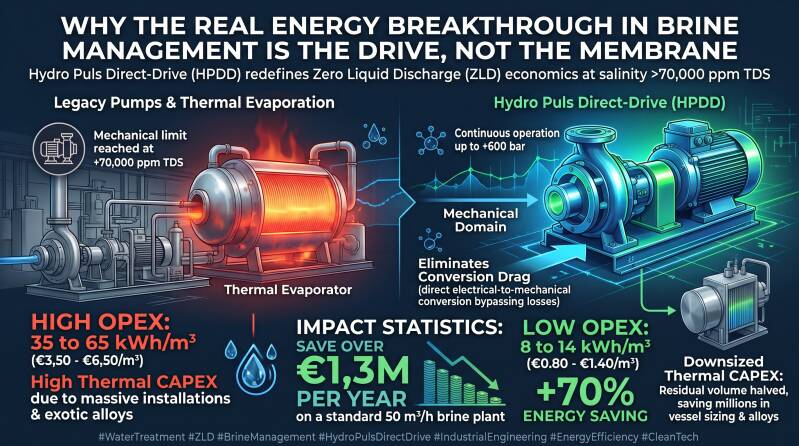
In Zero Liquid Discharge (ZLD) and high-salinity brine treatment, operational expenditure (OPEX) dictates project survival. Once salinity climbs past 70,000 ppm TDS, legacy pumps hit their mechanical limits, forcing plants into thermal evaporation at an energy penalty of 35 to 65 kWh/m³ (€3.50 to €6.50/m³).
The Hydro Puls Direct-Drive (HPDD) shifts that economic threshold:
• Pushing Mechanical Dewatering: Operating continuously up to +600 bar, HPDD keeps dewatering in the mechanical domain, consuming just 8 to 14 kWh/m³ (€0.80 to €1.40/m³) and slashing energy demand by over 70%.
• Eliminating Conversion Drag: Bypassing the multi-step electrical-to-mechanical conversion chain cuts parasitic drive losses at the source.
• Downsizing Thermal CAPEX: Halving the residual volume sent to evaporators cuts millions in thermal vessel sizing and exotic alloys.
On a standard 50 m³/h brine plant, keeping the process mechanical saves over €1.3M in annual power bills alone.
Making brine concentration bankable starts with cutting parasitic drive losses and eliminating unnecessary thermal overhead.
#WaterTreatment #ZLD #BrineManagement #HydroPulsDirectDrive #IndustrialEngineering #EnergyEfficiency #CleanTech