

The Recovered Carbon Black (rCB) Dilemma: Why Grinding Pyrolysis Char Is Not Enough
Recovering carbon black from end-of-life tires should be the ultimate circular economy business case. Instead, the rCB sector faces a persistent commercial ceiling: low market value, inconsistent dispersion quality, and relegation to non-reinforcing rubber applications.
The root cause is not the lack of demand. The root cause is interfacial surface chemistry and mineral ash entrapment.
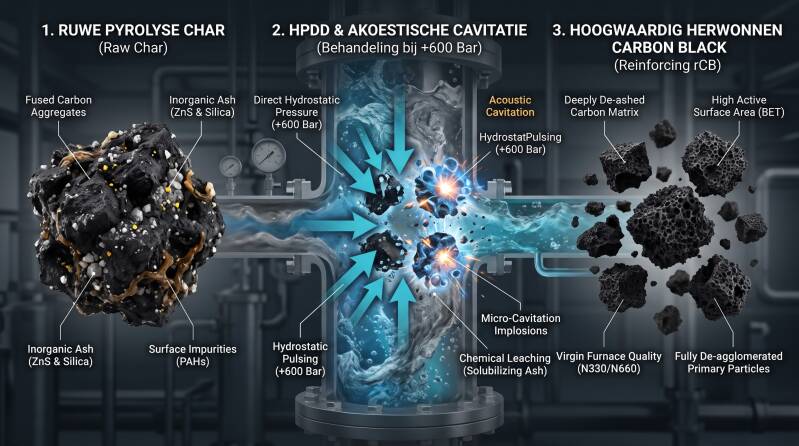
Raw char extracted from tire pyrolysis consists of tightly agglomerated carbon aggregates fused together by residual sulfur and covered with inorganic ash (primarily zinc sulfide and silica). Conventional dry mechanical milling simply reduces the aggregate cluster size. It does not cleanse the primary particle surface, it fails to optimize surface area (BET), and it leaves mineral ash structurally locked within the carbon matrix.
To compete with virgin furnace grades such as N330 or N660, recovered carbon must undergo deep chemical de-ashing, complete surface reactivation, and high-shear de-agglomeration.
This is where Hydro Puls Direct-Drive (HPDD) and acoustic cavitation redefine the process envelope:
1. Extreme Hydrostatic De-ashing (+600 Bar):
Conventional acid and caustic leaching processes are slow, energy-intensive, and require large volumes of reagents. By driving the chemical washing slurry with direct hydrostatic pressure pulses at +600 bar, HPDD forces aqueous reagents deep into the nanopores of the carbon char, rapidly solubilizing zinc and silica ash fractions without high mechanical wear.
2. Micro-Cavitation Surface Cleaning:
Integrated acoustic cavitation produces localized, high-intensity micro-implosions within the slurry. These acoustic shockwaves shear away residual polycyclic aromatic hydrocarbons (PAHs