

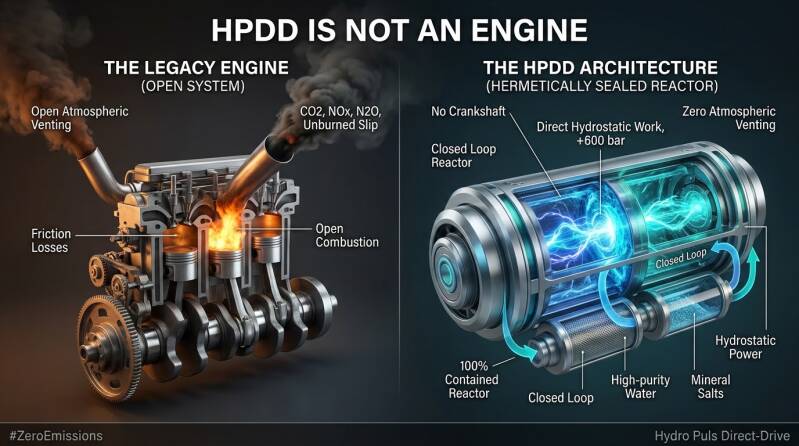
Stop comparing HPDD to an internal combustion engine. It is not one.
The industry continues to view clean power through a century-old mechanical lens: suck in air, combust fuel, rotate a crankshaft, and vent toxic byproducts (CO2, NOx, N2O) through an open tailpipe into the sky.
The Hydro Puls Direct-Drive (HPDD) architecture completely breaks this paradigm:
It is NOT an engine with an open exhaust.
It is a crankshaft-free, hermetically sealed chemical reactor.
The architectural differences are absolute:
• Zero Atmospheric Venting: Nothing is exhausted into the air. There is no open tailpipe.
• Direct Hydrostatic Work: Chemical energy is converted directly into a +600 bar fluidic boundary, eliminating rotary friction and crankshaft losses entirely.
• 100% Closed Loop: All reaction products are contained internally, condensed, or mineralized into stable liquids and solids (such as pure water or mineral salts) rather than released as plumes.
Industry skepticism around fuels like ammonia or hydrogen almost always targets open atmospheric combustion, toxic slip, thermal NOx, and open tailpipes.
That criticism is entirely valid for legacy engines. But HPDD is a sealed thermodynamic reactor. Comparing an open-air combustion engine to a closed chemical cycle is an engineering category error.
#HydroPuls #CleanTech #ZeroEmissions #ProcessEngineering #DeepTech #FutureOfEnergy #ChemicalReactor #DirectDrive