For every liter of fresh water produced by conventional seawater reverse osmosis (SWRO), an average of 1.5 liters of hypersaline reject brine is left behind. Pumping this concentrated effluent back into marine ecosystems faces mounting environmental penalties and strict permitting roadblocks.
Heavy industry is rapidly targeting Zero Liquid Discharge (ZLD) and Minimal Liquid Discharge (MLD), but operators immediately hit a fundamental thermodynamic barrier: osmotic pressure.
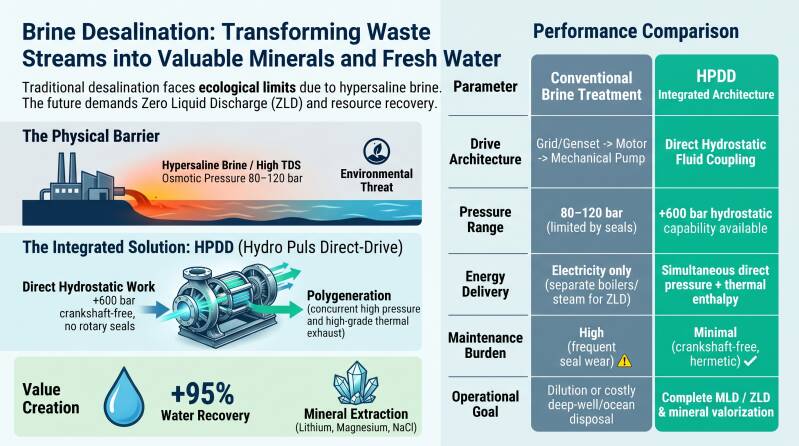
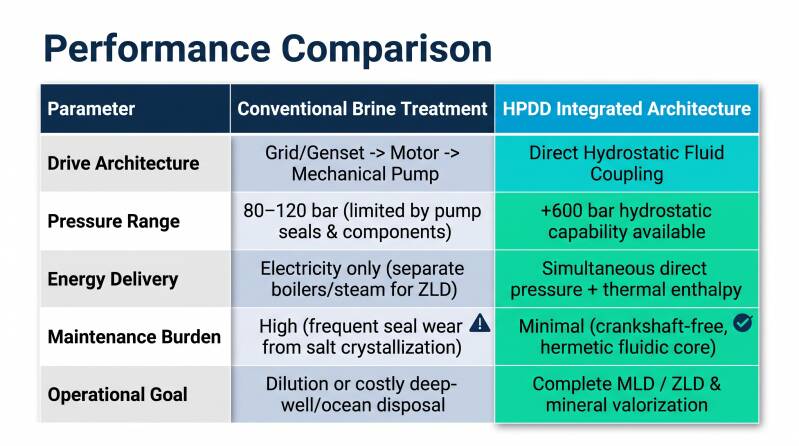
While standard seawater (~35,000 ppm TDS) requires 60 to 70 bar, concentrated brine (>100,000 ppm TDS) drives osmotic back-pressure exponentially higher. Conventional pumps and standard membrane vessels hit mechanical safety limits at 80–85 bar. Ultra-High-Pressure Reverse Osmosis (UHP-RO) and final thermal crystallization require 120 to well over 200 bar, alongside massive thermal energy inputs.
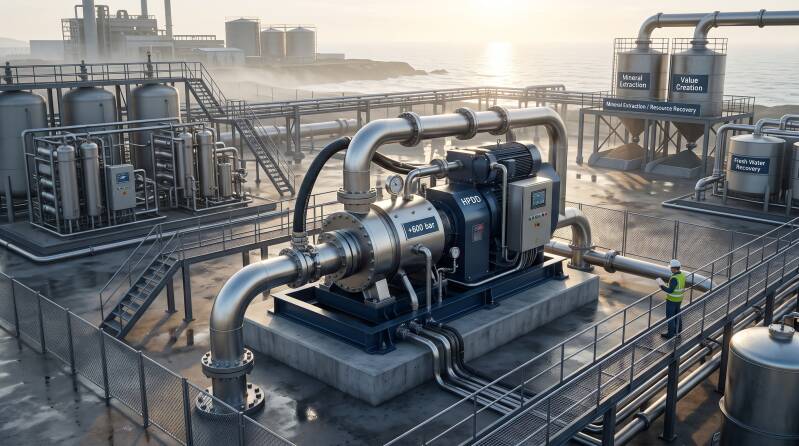
The Hydro Puls Direct-Drive (HPDD) core solves this dual physical bottleneck from a single unified energy heart:
1. Direct Hydrostatic Force (+600 bar rated capability)
Bypassing the loss-heavy conversion chain (fuel → generator → VFD → electric motor → mechanical pump). HPDD channels hydrostatic pressure directly to UHP-RO skids, dramatically lowering the specific energy consumption (kWh/m³) of high-density dewatering.
2. True Polygeneration: Simultaneous Pressure and Thermal Enthalpy
ZLD requires mechanical membrane separation followed by thermal crystallization. HPDD concurrently delivers high-pressure fluid work and high-grade thermal exhaust to run crystallizers, while generating pure process water as a synthesis by-product inside its isolated core.
3. Seal-Less Reliability in Aggressive Saline Environments
Crystallizing salt rapidly shreds dynamic shaft seals on conventional reciprocating pumps. HPDD's crankshaft-free, hermetically isolated fluidic boundary eliminates dynamic rotary seals and mechanical side-load friction completely.
The outcome: Brine is no longer an expensive disposal liability. It transforms into an economically viable resource stream for >95% water recovery and 'Brine Mining' of high-value industrial minerals like magnesium, calcium, and lithium.
The next leap in desalination is not about feeding more electricity into legacy pump skids, it is about direct fluid power engineered at the point of separation.
#Desalination #WaterTreatment #ZeroLiquidDischarge #ZLD #BrineMining #CleanTech #HydroPuls #IndustrialEngineering #CircularEconomy