

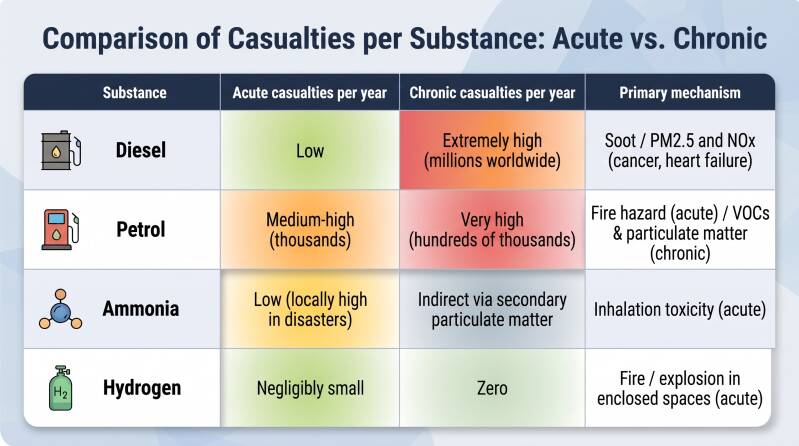
Which fuel causes the greatest loss of human life globally? The answer is often counterintuitive.
Global health data shows that diesel and gasoline claim millions of lives each year from chronic exposure to particulate matter (PM2.5), NOx, and carcinogenic soot, complemented by thousands of acute crash and explosion fatalities due to gasoline's low flash point (-40°C).
Compare that baseline to industrial ammonia (NH3):
• 0% carcinogenic particulate matter, zero black carbon, and zero carbon emissions.
• Extremely narrow flammability range (15–28%)—virtually unignitable compared to volatile gasoline.
• Over a century of mature, global industrial handling, pipeline transport, and storage safety standards.
Ammonia is a toxic industrial chemical, not a fuel for private consumer vehicles. But for heavy baseload industry, marine shipping, and modular off-grid infrastructure:
1. It liquifies under mild conditions (-33°C or ~8 bar).
2. It operates in closed-loop, direct-conversion architectures (like HPDD) that eliminate public transport liabilities and convert reactants on-site.
3. It completely removes the chronic respiratory burden that fossil combustion imposes on surrounding communities.
When evaluated on net human health impact and industrial containment, ammonia is the superior pathway for heavy industry decarbonization.
#AmmoniaEnergy #Decarbonization #HeavyIndustry #ProcessSafety #CleanTech #HydroPuls #Hydrogen