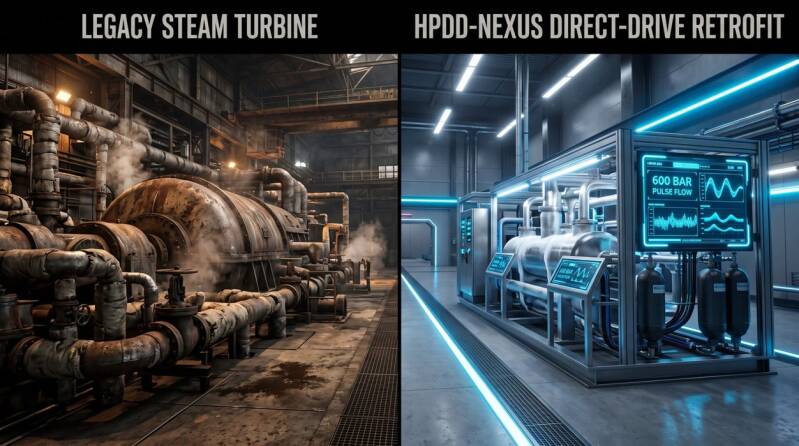
The steam turbine has anchored heavy industry and baseload power for over a century. Yet in a modern energy landscape defined by extreme ramping demands, volatile part-load requirements, and severe grid congestion, legacy monolithic turbines are hitting their physical limits.
When a multi-megawatt steam turbine experiences a trip or is forced to ramp down, the results are immediate: massive efficiency degradation, severe thermal stress, and capital-intensive downtime.
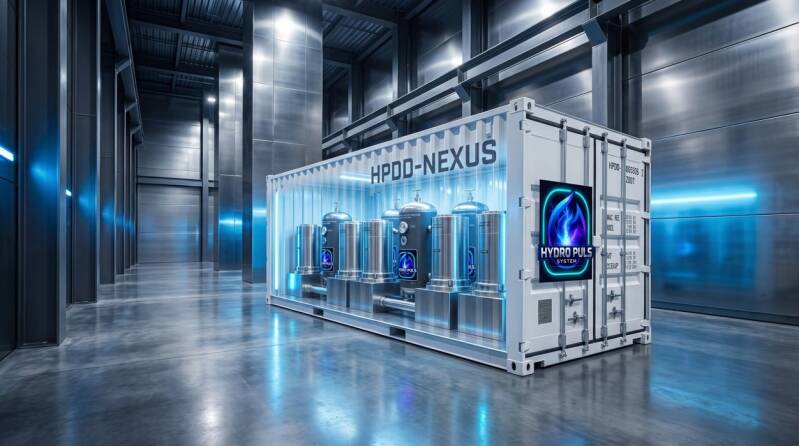
Introducing the HPDD Nexus: a crankshaft-free, modular linear fluidic matrix engineered as a thermodynamic paradigm shift for steam power conversion.
How the HPDD Nexus rewrites the mechanics of steam:
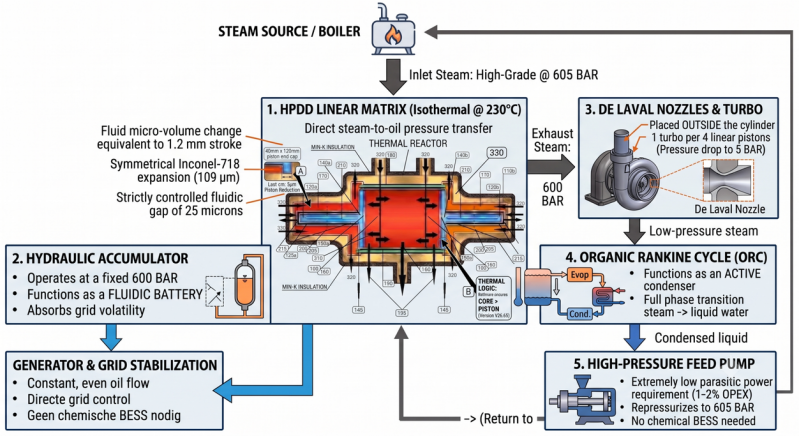
• Extreme Pressure Management (605 bar): High-grade steam at 605 bar no longer impacts fragile, high-speed rotating turbine blades. Instead, an opposed-piston core (2 pairs of pistons in absolute opposition) absorbs the kinetic work through an exact 1.2 mm micro-stroke.
• Isothermal Symmetry at 230°C: Advanced Inconel-718 metallurgical synchronization ensures that both the cylinder boring and linear piston expand by an identical 109 µm at our 230°C operational baseline, keeping the critical 25-micron fluidic gap perfectly stable.
• The Hydraulic Accumulator as a Fluidic Battery: Rather than driving a generator through a rigid mechanical shaft, expansion energy is converted directly into linear hydraulic pressure at 600 bar. A dedicated accumulator buffers every micro-fluctuation, dispatching a perfectly regulated fluid flow to downstream generation.
• Thermal Cascade with Active Condensation (ORC): Expanding through convergent-divergent DeLaval nozzles, the steam exits at ~5 bar directly into an Organic Rankine Cycle (ORC). The ORC acts as an active condenser—generating secondary electricity from phase-change enthalpy while enabling liquid feed pumps to repressurize the condensate back to 605 bar with minimal parasitic power.
What this delivers to industrial operators and utility planners:
1. 99.999% Modular Fault Tolerance: Individual module servicing or faults no longer trigger plant-wide thermal shocks or complete shutdowns.
2. Dynamic Peak-Shaving & Balancing: The Nexus array can be integrated in parallel with legacy baseload turbines (e.g., 100 MW), allowing the main turbine to sit at its peak efficiency point while the HPDD matrix absorbs wide operational swings (from 2 MW to 20 MW) with zero efficiency loss.
3. Modular Scaling Roadmap: Built for seamless industrial integration, backed by a clear roadmap targeting 200 Hz / 600 kW operational units.
One core architecture. Infinite industrial resilience.
#EnergyTransition #PowerGeneration #SteamTurbines #ProcessEngineering #Decarbonization #HydroPuls #ThermalEnergy #DeepTech #Infrastructure