

The Port Paradox: Why "Green" Ships Still Burn Heavy Fuel Oil in Harbor
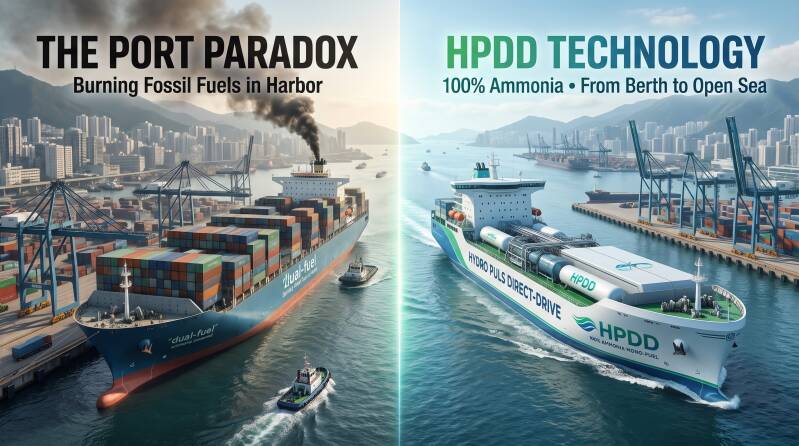
In the maritime industry, there is an open secret rarely mentioned in glossy marketing brochures: so-called "ammonia-powered" or dual-fuel vessels almost never operate on alternative fuels during port maneuvers or coastal approaches.
The moment a vessel enters restricted waterways or begins mooring operations, crews routinely revert to 100% marine gas oil (MGO) or heavy fuel oil (HFO).
Why does this happen?
Conventional two-stroke and four-stroke internal combustion engines are bound to fixed crankshaft geometry. At idle, micro-loads, and during the rapid load fluctuations required for maneuvering, the combustion kinetics of slow-burning fuels like ammonia become highly unstable. The risk of misfires, engine knock, and dangerous unburned ammonia slip is simply too high. The resulting paradox is stark: right at the port interface and near densely populated coastal centers—where local air quality matters most—these vessels emit standard fossil exhaust.
Breaking with the Crankshaft: Why HPDD Operates 100% on Ammonia, Always
Real maritime decarbonization cannot stop at the harbor entrance.
The Hydro Puls Direct-Drive (HPDD) platform eliminates these operational compromises entirely:
• Software-Defined Thermodynamics: Without the constraints of a mechanical crankshaft, the HPDD piston stroke profile adapts dynamically in real time. Linear compression within a +600 bar operational envelope establishes the precise thermodynamic conditions (pressure and temperature matrix) required to sustain complete, stable combustion of pure ammonia across all load profiles.
• True 100% Mono-Fuel from Berth to Open Sea: HPDD requires zero fossil pilot fuel—neither while cruising nor during high-transient port maneuvering. The powertrain operates continuously, reliably, and exclusively on 100% ammonia from cast-off to tie-up.
• Instant Hydrostatic Torque: By replacing heavy mechanical reduction gearboxes and rotating shaftlines with direct fluid power, the system delivers immediate hydrostatic response and precision low-speed control without toxic emissions.
Decarbonizing maritime transport does not mean retrofitting century-old engine blocks with fossil-dependent fallback modes. It requires re-architecting powertrain physics from first thermodynamic principles.
#Maritime #Shipping #PortOperations #CleanTech #Ammonia #Decarbonization #MarineEngineering #HydroPuls #ZeroEmissions #FluidPower