

The Maritime Ammonia Illusion: Why Marketing Calls It "Zero-Emission" While Engineering Calls It Dual-Fuel
Headlines across the shipping industry frequently celebrate the arrival of the world’s first "ammonia-powered" cargo vessels. For non-engineers, this creates the impression that modern maritime transport is already cruising cleanly on 100% pure green ammonia.
The thermodynamic reality in the engine room tells a fundamentally different story.
Because ammonia has an exceptionally high auto-ignition temperature (~650°C), a sluggish flame propagation speed, and a narrow flammability range, conventional internal combustion engines (whether two-stroke or four-stroke crankshaft engines) cannot reliably compress and ignite pure ammonia on their own.
To make them work, marine operators must rely on a continuous compromise:
1. The Pilot Fuel Reality (Dual-Fuel, Not Mono-Fuel)
Conventional systems require a dedicated pilot injection of high-carbon fossil fuel (MGO or diesel) to trigger combustion. Depending on engine load and operating conditions, this pilot fuel can account for 5% to over 15% of the total energy input. Calling these engines pure ammonia systems is great for PR, but technically incorrect: they remain dual-fuel setups anchored to fossil logistics.
2. Unburned Ammonia Slip & N2O Spikes
Because standard crankshaft kinematics impose fixed piston speed profiles, slow-burning ammonia often leaves the cylinder incomplete, creating toxic ammonia slip and severe nitrous oxide (N2O) spikes—a greenhouse gas nearly 300 times more potent than CO2. Suppressing these issues demands massive, multi-ton Selective Catalytic Reduction (SCR) skids and scrubbers that permanently penalize vessel deadweight and operating budgets.
3. The Crankshaft Penalty
Coupling these complex dual-fuel blocks to traditional rotating crankshafts, reduction gearboxes, and long propeller shafts introduces cumulative mechanical friction losses, keeping overall net powertrain efficiency capped at standard thermal limits.
Rethinking the Physics: Software-Defined Direct-Drive
True maritime decarbonization requires breaking away from the mechanical limitations of the crankshaft:
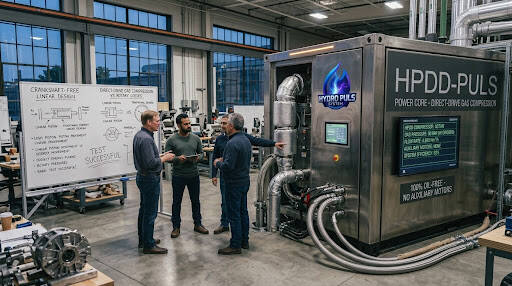
• Pure Mono-Fuel Combustion: The Hydro Puls Direct-Drive (HPDD) platform eliminates the fixed stroke geometry of traditional blocks. Software-defined linear compression at +600 bar creates the exact thermodynamic conditions (pressure and temperature matrix) required to react pure ammonia cleanly and completely, without requiring a fossil pilot fuel injection.
• Inherent Emission Suppression: Millisecond expansion cycles drop temperatures instantly at the end of the power stroke, freezing out thermal NOx formation at the source rather than dragging oversized catalytic trailers behind the exhaust.
• Direct Fluid Power: Eliminating intermediate rotating gears and shafts allows direct conversion into high-pressure hydrostatic power, achieving 62–63% net LHV efficiency.
Decarbonizing maritime transport is not about adding fossil pilot fuels and massive scrubbers to 100-year-old engine architectures. It is about fundamentally re-engineering combustion physics at the frontline.
#Maritime #Shipping #CleanTech #Ammonia #Decarbonization #MarineEngineering #HydroPuls #ZeroEmissions #AlternativeFuels