

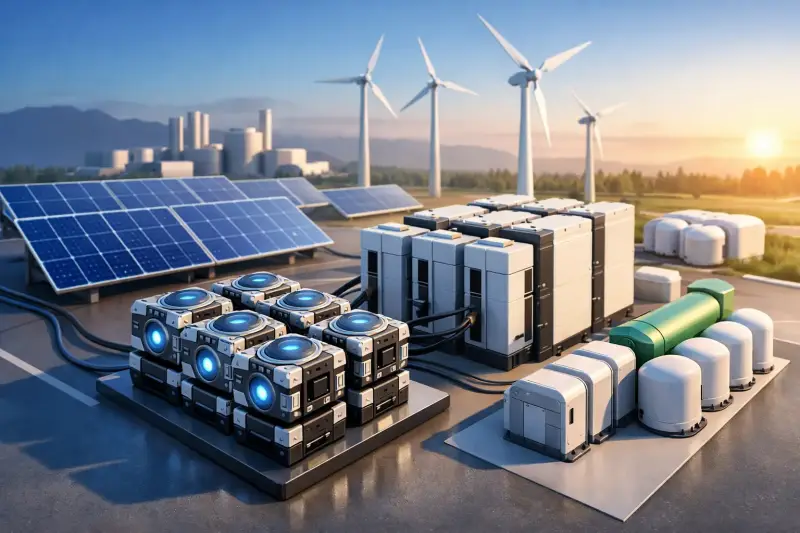
Define the Industrial Energy Boundary First
An off-grid system must cover more than average electricity demand. Map the entire site energy boundary: continuous electrical load, motor starts, peak process loads, heat demand, cooling duty, compressed air, pumping head, and any water or carbon-capture requirement. Then distinguish critical loads from loads that can be curtailed or sequenced.
This exercise often changes the generation architecture. A facility with large pumps, crushers, fans, refrigeration compressors, or desalination trains may need substantial shaft power and short-duration surge capacity, but not necessarily oversized electrical generation running inefficiently at partial load. A data center may value stable electrical quality, high-grade cooling, and water availability as much as gross megawatt output.
Load data should be collected at sufficiently fine intervals to expose transient behavior. Fifteen-minute utility data is useful for initial sizing, but second-by-second or minute-by-minute process data is needed to understand starts, ramps, and coincident peaks. Design to the true operating envelope, including maintenance states and black-start conditions, rather than to a single annual average.
How to Deploy Offgrid Power Without Oversizing It
The conventional answer is often to add generation capacity until every peak is covered directly by gensets. That approach can create high capital cost, low annual utilization, poor fuel economics, and excessive maintenance exposure. A better approach separates constant energy conversion from rapid load response.
The core generation unit should operate near its thermodynamic sweet spot whenever possible. Variable demand can then be managed through controls, demand sequencing, thermal storage, electrical storage where it is justified, and hydraulic energy storage for systems with major pumping or mechanical duties. This is particularly relevant where a process requires high instantaneous torque or fluctuating fluid power.
An isolated-combustion, hydraulic direct-drive architecture takes this separation seriously. Rather than forcing a conventional crankshaft-driven engine to follow every load swing, a system such as Hydro Puls Systems' HPDD is designed to maintain stable pulse-based energy conversion while hydraulic transfer manages the connection between the energy core and industrial work. The architectural objective is straightforward: reduce frictional and parasitic losses, avoid chronic partial-load operation, and couple power directly to pumps, generators, fans, or driveline equipment.
Oversizing is still necessary in some cases. A mine, defense installation, hospital-grade campus, or mission-critical data operation may require N+1 generation redundancy. The difference is that redundancy should be intentional and tied to a defined availability target, not used as a substitute for proper load analysis.
Select Fuel for the Transition, Not Just Day One
Fuel choice determines logistics, emissions performance, operating cost, permitting complexity, and future asset value. Natural gas or LNG may be available today, while hydrogen or ammonia may become commercially preferable as supply chains, carbon pricing, and regulation change. A system locked to one fuel pathway can become a stranded operational decision long before its mechanical life ends.
A deployable off-grid plant should therefore evaluate fuel flexibility at the design stage. This includes fuel storage, vaporization or conditioning, safety systems, combustion behavior, emissions treatment, and operator training. Hydrogen introduces low volumetric energy density and demanding storage requirements. Ammonia offers easier liquid storage and a potential zero-carbon energy carrier pathway, but requires careful materials selection, toxicity management, and combustion or cracking strategy.
The right choice depends on location and duty cycle. A coastal industrial site may favor delivered ammonia. A facility with pipeline access may begin on gas and maintain a conversion pathway. A renewable-rich project may combine local hydrogen production with dispatchable thermal generation. The engineering requirement is not ideological fuel selection. It is a credible transition plan supported by physical infrastructure.
Treat Heat, Cooling, and Water as Primary Outputs
Off-grid power becomes economically stronger when electricity is not the only product. Every industrial thermal system rejects energy. The question is whether that energy is wasted or directed into a process with measurable value.
Combined heat and power can supply hot water, steam, kiln preheat, drying, greenhouse heating, absorption cooling, or district-scale thermal loads. Where the process requires refrigeration, cooling water, or air conditioning, the ability to recover or generate a cold stream can reduce compressor duty and lower the electrical peak that drives system sizing.
Water is equally strategic for remote operations. Sites producing desalinated water, treating wastewater, operating greenhouses, or supporting industrial cooling should assess the water balance alongside the power balance. Combustion-derived water, atmospheric water extraction, reverse osmosis, and waste-heat integration may each play a role. The best design depends on local humidity, feedwater quality, thermal grade, and the cost of transporting water to the site.
This multi-output approach changes project economics. A power plant that also displaces boiler fuel, refrigeration electricity, trucked water, and diesel-driven pumping is not competing with the grid tariff alone. It is replacing multiple energy and utility costs across the operation.
Engineer the Microgrid Around Stability and Recovery
An autonomous plant needs a control philosophy before equipment is ordered. Define the grid-forming source, frequency and voltage regulation method, spinning reserve, load-shedding sequence, synchronization requirements, and black-start procedure. If renewable assets are included, specify how their intermittency is absorbed without destabilizing process loads.
Battery energy storage can be valuable for millisecond response, power quality, short-duration peaks, and renewable smoothing. It is not automatically the lowest-cost answer for multi-hour or multi-day resilience. Thermal storage, fuel inventory, hydraulic accumulators, controllable process loads, and modular dispatchable generation can reduce the battery capacity required.
Protection coordination matters as much off-grid as it does on a utility network. Fault levels may be lower and more variable than on a grid-connected system, especially where inverter-based resources dominate. Relay settings, arc-flash studies, grounding, selective coordination, and islanding logic must be engineered as a complete electrical system. A microgrid that produces energy but cannot clear faults selectively is not resilient.
Design for Serviceability, Not Just Commissioning
Remote power assets are judged over years of operation, not during the commissioning ceremony. Specify modular equipment that can be transported to the site, isolated for maintenance, and replaced without taking down the full plant. Standardize pumps, valves, sensors, controls hardware, and wear components where possible.
Remote monitoring should track fuel quality, vibration, hydraulic pressure, combustion conditions, electrical harmonics, thermal performance, and component health. Predictive maintenance is most valuable when it is tied to actionable spares planning and operating decisions. Knowing that a pump is degrading has little value if the replacement cannot reach a remote site for six weeks.
Operators also need a practical degradation plan. What happens when one module is down? Which loads remain energized? Can production continue at reduced throughput? Can waste heat still support a critical thermal process? These questions should be tested in factory acceptance procedures and site commissioning scenarios.
Build the Business Case on Avoided Costs
The financial model for off-grid power should include more than fuel consumption and generator CAPEX. Quantify avoided grid-extension cost, lost-production risk, demand charges, boiler fuel, cooling electricity, water transport, curtailment exposure, and carbon compliance. Include the value of phased deployment when the site is expanding and utility infrastructure cannot keep pace.
For investors and utilities, modularity reduces timing risk. Capacity can be added in blocks as process demand grows, rather than committing all capital before revenue-producing loads exist. For industrial operators, direct coupling of thermal, hydraulic, and electrical outputs can reduce operating cost by eliminating unnecessary energy conversions.
The most credible projects use conservative fuel assumptions, explicit maintenance allowances, and clear availability definitions. They also compare alternatives fairly: grid extension, diesel, gas reciprocating engines, turbines, renewables with storage, and integrated CHP or direct-drive systems. Off-grid power is not a single technology decision. It is an infrastructure decision with process consequences.
A well-deployed autonomous energy system gives an industrial site something more valuable than independence: control over its production envelope. Start with the process physics, preserve fuel optionality, and design every recovered joule to do useful work.