

"Why hydraulic pressure? Isn't hydraulics inherently an energy loss?"
This is one of the most common questions we encounter when discussing high-pressure architectures with industrial process engineers and plant managers. From the standpoint of conventional plant design, it is a completely valid reflex.
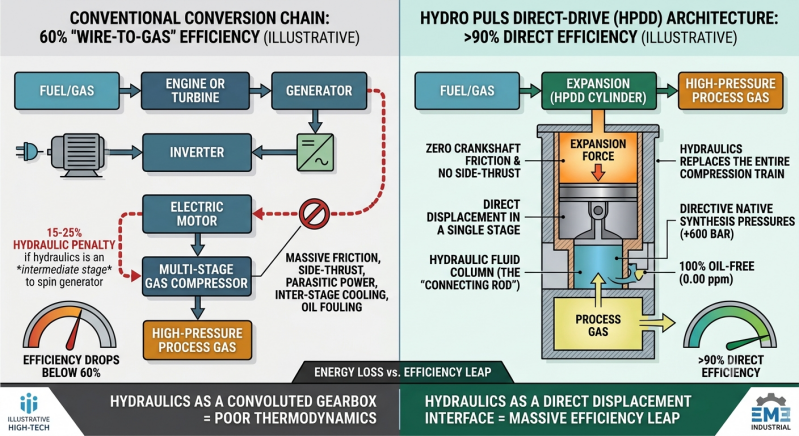
In a standard facility, the energy conversion path usually looks like this: Fuel/Gas ➔ Engine or Turbine ➔ Generator ➔ Inverter ➔ Electric Motor ➔ Multi-Stage Gas Compressor ➔ High-Pressure Process Gas.
If you insert a hydraulic stage into that specific chain, using an engine to drive a discrete hydraulic pump, which then drives a shaft to spin a generator, you inevitably introduce a 15% to 25% penalty in fluid friction, throttling, and heat loss. That is undeniably poor thermodynamics.
The misconception lies in the reference frame.
In the Hydro Puls Direct-Drive (HPDD) architecture, hydraulics is not an intermediate transmission step for electricity generation. It is the direct replacement of the entire mechanical compression train:
Zero Crankshaft Friction & No Side-Thrust: Instead of converting expanding forces into rotary motion via a crankshaft, which generates massive piston-skirt friction and mechanical side-thrust, expansion acts directly upon a linear fluid column. The hydraulic column IS the connecting rod.
Eliminating Parasitic Multi-Stage Compressors: Pressurizing syngas, nitrogen, or hydrogen to reaction levels (150 to +600 bar) via conventional rotating compressors consumes enormous electrical power and requires constant inter-stage cooling. The true "wire-to-gas" efficiency of those rotating trains often drops below 60%.
Direct Displacement in a Single Stage: HPDD delivers process fluids and gases directly at native synthesis pressures (+600 bar). It bypasses the entire round-trip chain of generators, inverters, drive motors, and multi-stage mechanical compressors.
100% Oil-Free (0.00 ppm): Legacy gas compressors rely on continuous lubrication, presenting a constant risk of fouling and poisoning downstream catalysts. HPDD provides native, contaminant-free pressure.
Hydraulics represents an efficiency loss when used as a convoluted gearbox to spin a generator.
When direct hydraulic displacement acts as a frictionless, infinitely rigid interface that eliminates the most failure-prone, Capex-intensive, and power-hungry compressor on the plant? It is not an energy loss, it is the single largest efficiency leap on the balance of plant.
#ProcessEngineering #HPDD #HydroPulsDirectDrive #Thermodynamics #GasCompression #EnergyEfficiency #Industry #Hydrogen #Ammonia #CleanTech