

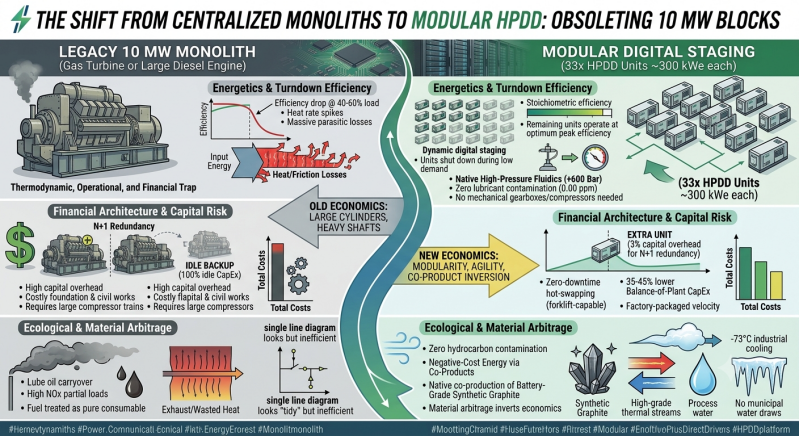
10 MW Monolith vs. 33 Modular HPDD Units: Why the Centralized Block is Obsolete
When engineering a 10 MW continuous industrial load—whether for high-density data centers, microgrids, or chemical synthesis loops—legacy thinking defaults to procuring a single 10 MW heavy-fuel turbine or multi-cylinder medium-speed reciprocating diesel engine.
While a single monolithic block looks tidy on a single line diagram, it is a thermodynamic, operational, and financial trap. Deploying 33 modular Hydro Puls Direct-Drive (HPDD) units (~300 kWe each) outperforms a 10 MW monolithic turbine or diesel block across every physical and economic metric.
1. Energetics & Turndown Efficiency
* The Monolith Trap: A 10 MW gas turbine suffers an efficiency cliff when throttled down to 40–60% load during off-peak demand or intermittent renewable swings. Parasitic losses remain massive, and heat rate spikes.
* Modular Digital Staging (HPDD): 33 decentralized modules can be staged dynamically. If demand drops to 6 MW, 13 units shut down completely while the remaining 20 operate precisely at their optimum stoichiometric peak efficiency.
* Native High-Pressure Fluidics (+600 Bar): While a turbine produces purely rotational mechanical shaft work that requires parasitic electric motors, gearboxes, and multi-stage compressors to achieve pressure, HPDD delivers direct-displacement hydraulic kinetics up to +600 bar natively with zero lubricant contamination (0.00 ppm).
2. Financial Architecture & Capital Risk
* N+1 Redundancy Costs: With a single 10 MW engine, achieving real industrial uptime requires buying a second identical 10 MW machine as an idle, multi-million-dollar backup (100% idle CapEx).
* N+1 on HPDD: Redundancy requires adding just one extra 300 kWe unit (a 3% capital overhead vs. 100%).
* Zero-Downtime Hot-Swapping: A turbine overhaul halts site operations or mandates massive grid imports. An HPDD module can be isolated, serviced, or swapped out on a forklift without interrupting the remaining 32 running cores.
* Balance-of-Plant (BoP) CapEx: Eliminating multi-stage gas compressor trains, external dynamic seals, and bulky foundation anchor civil works cuts balance-of-plant spend by 35–45%.
3. Ecological & Material Arbitrage
* Emission Profiles & Lube Poisoning: Large diesels inevitably suffer from blow-by, lube oil carryover, and high NOx during partial loads. HPDD’s positive-displacement pulse architecture ensures zero hydrocarbon contamination (0.00 ppm), safeguarding catalysts and eliminating hazardous oil waste streams.
* Negative-Cost Energy via Co-Products: A monolithic diesel or turbine treats fuel purely as a consumable cost sink, venting exhaust. The HPDD platform couples high-pressure dissociation with the native co-production of battery-grade synthetic graphite. The material arbitrage inverts project economics entirely, turning fuel consumption into a high-value material refinery.
* Decoupled Thermal & Water Balancing: A standard 10 MW generator rejects low-grade exhaust heat that frequently goes wasted without extensive bottoming cycles. Modular HPDD deployment produces controllable high-grade thermal streams alongside deep industrial cooling (-73°C) and pure process water, eliminating municipal water draws.
Industrial scale is no longer about building bigger cylinders or spinning heavier rotor shafts. It is about modular, factory-packaged velocity, digital turndown agility, and inverting OpEx through structural co-product economics.
#ModularPower #HPDD #HydroPulsDirectDrive #Decarbonization #EnergyTransition #PowerGeneration #Microgrids #IndustrialEngineering #SyntheticGraphite