

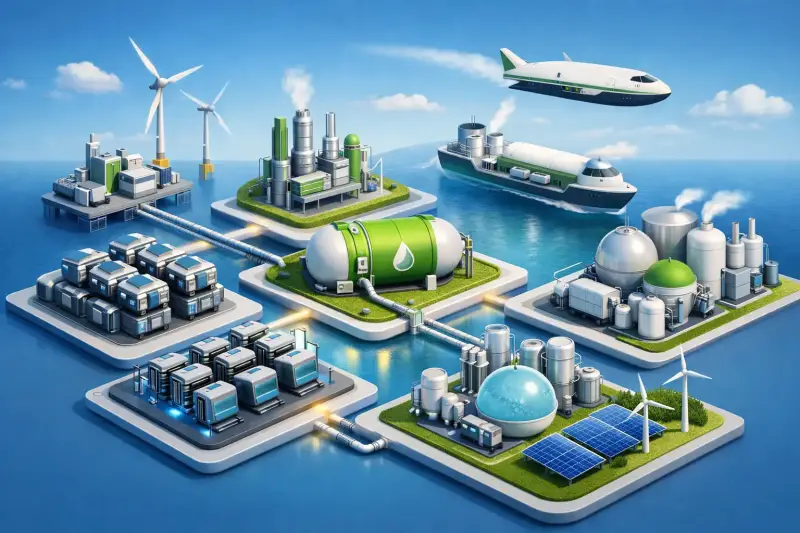
Ammonia is moving from a future-fuel concept to a serious industrial design variable. The question is no longer whether ammonia can store and transport carbon-free energy at scale. The question is which of the top ammonia ready energy platforms can convert that molecule into dependable power, heat, motion, cooling, and water without creating a new layer of operational risk.
For industrial buyers, an ammonia-ready platform is not simply an engine fitted with a different fuel skid. It is an integrated energy architecture built around fuel conditioning, controlled conversion, emissions treatment, thermal recovery, storage safety, and load response. The right choice depends on whether the facility needs electricity, high-grade heat, shaft power, process steam replacement, backup capacity, or several outputs at once.
What Makes an Energy Platform Truly Ammonia-Ready?
A credible ammonia platform must deal with the fuel's physical and chemical realities. Ammonia is easier to liquefy and ship than hydrogen, but it has lower flame speed, more difficult ignition behavior, toxicity considerations, and a significant nitrogen oxide challenge when combusted. These properties affect the entire plant, from vaporization and cracking to combustion control, material selection, ventilation, monitoring, and exhaust cleanup.
The strongest platforms are designed for a staged fuel transition. They can begin with conventional fuels or hydrogen blends where project economics require it, then move toward higher ammonia utilization as fuel supply, regulations, and operating experience mature. That pathway reduces stranded-asset risk, particularly for ports, industrial campuses, remote power systems, and developers planning assets with 20-year operating lives.
Technical evaluators should measure each option against five practical criteria:
- Conversion efficiency at the actual operating profile, not only at nameplate load
- Ability to deliver useful heat, cooling, hydraulic work, or shaft power alongside electricity
- Nitrogen oxide control and treatment requirements
- Fuel-system complexity, including cracking, purification, storage, and safety systems
- Modular deployment, maintenance strategy, and tolerance for changing load demand
7 Top Ammonia-Ready Energy Platforms
These platforms are not interchangeable. Each represents a different answer to the same industrial problem: how to turn ammonia into valuable energy while controlling capital cost, emissions, and operational complexity.
1. Ammonia-Ready Reciprocating CHP Systems
Reciprocating combined heat and power systems are a familiar starting point for distributed industrial energy. Their appeal is straightforward: they are modular, can be deployed in multiple smaller units, and can provide electricity plus recoverable heat for greenhouses, food processing, district energy, and manufacturing.
For ammonia operation, however, the engine requires more than fuel-system modifications. Combustion stability, pilot-fuel requirements, ignition strategy, lubricant compatibility, and NOx control determine whether the unit is practical. In many deployments, cracked ammonia or ammonia-hydrogen blends offer a more manageable transition than direct high-ammonia combustion.
This platform works best where maintenance teams already understand engine-based CHP and where heat demand is reasonably consistent. Its limitation is partial-load efficiency. An engine that cycles or operates far below its optimal point can erase much of the fuel-cost advantage.
2. Ammonia-Fired Gas Turbine Systems
Gas turbines offer high power density and remain relevant for large power blocks, pipeline compression, and marine applications. They can also integrate with heat recovery equipment for process heat or steam production. For facilities requiring multi-megawatt output in a compact footprint, turbine architecture remains an important ammonia pathway.
The engineering challenge is flame management. Ammonia's low reactivity can require hydrogen enrichment, preheating, advanced combustor geometry, or cracking. High combustion temperatures can also intensify NOx formation, making selective catalytic reduction and carefully controlled combustion essential parts of the platform rather than optional add-ons.
A turbine-based solution is strongest when high-temperature exhaust has direct value. Cement, refining, chemical processing, and large CHP sites may justify the added balance-of-plant complexity. It is less compelling where electricity is the only required output and site loads fluctuate sharply.
3. Solid Oxide Fuel Cell Power Plants
Solid oxide fuel cells are one of the most efficient electrochemical routes for converting ammonia-derived fuel into electricity. At operating temperature, the system can internally reform or process ammonia into hydrogen-rich fuel, avoiding some of the losses associated with external cracking. Their high-quality waste heat can also support CHP configurations.
The trade-off is operating discipline. These systems operate at elevated temperatures, have specific startup and thermal-cycling requirements, and rely on materials and controls that must be engineered for long service life. Fuel purity and stack degradation are major commercial considerations.
For data centers, premium power users, and industrial facilities with stable baseload demand, solid oxide systems can be highly attractive. They are particularly valuable where local emissions, acoustic limits, and power quality matter as much as fuel efficiency.
4. Ammonia Cracker Plus Hydrogen Fuel Cell Systems
This architecture separates the problem into two controllable processes: crack ammonia into hydrogen and nitrogen, then convert the hydrogen in a fuel cell. It can provide very low local carbon emissions and avoids direct ammonia combustion in the primary power unit.
The advantage is conversion control. The disadvantage is that every added subsystem carries a cost, thermal loss, footprint requirement, and maintenance obligation. The cracker must deliver hydrogen at the purity required by the selected fuel cell, and the plant must manage residual ammonia to protect downstream components.
This is a strong option for applications where near-zero local pollutant emissions are non-negotiable, such as enclosed ports, urban infrastructure, sensitive industrial sites, and certain defense installations. It is generally harder to justify where low-cost bulk power is the only objective.
5. Cracked-Ammonia Hydrogen Engine or Turbine Plants
Where operators want familiar rotating equipment while reducing the difficulty of direct ammonia combustion, external cracking can supply hydrogen-rich fuel to an engine or turbine. This route can simplify ignition and improve combustion behavior while retaining a known power-generation architecture.
Its business case rests on heat integration. Ammonia cracking consumes energy, so the best projects use recovered exhaust or process heat to support the cracking reaction. A poorly integrated cracker can turn a potentially efficient system into an expensive fuel-conditioning train.
For industrial facilities with abundant waste heat, this is often a pragmatic bridge platform. It supports hydrogen-ready equipment procurement now while preserving access to ammonia as the transported and stored energy carrier.
6. Dual-Fuel Marine and Heavy-Transport Propulsion Systems
Shipping and heavy transport face a different duty cycle from stationary power plants. The platform must handle rapid transients, long voyages, storage constraints, redundancy requirements, and strict crew-safety procedures. Dual-fuel ammonia systems are therefore likely to remain relevant during the transition, using a pilot fuel or hydrogen fraction to stabilize combustion.
The strategic value is substantial. Ammonia can be stored as a liquid under moderate pressure or refrigeration, offering logistics advantages over compressed hydrogen for vessels and high-energy-duty transport. But propulsion buyers must evaluate the full safety case, including double-wall piping, ventilation, leak detection, containment, emergency shutdown, and crew training.
The winning marine platform will not be defined solely by fuel consumption. It will be defined by uptime, maintainability, bunkering compatibility, emissions compliance, and the ability to operate safely across global routes.
7. Direct-Drive Isolated Combustion and Hydraulic Energy Cores
A different class of platform removes the conventional crankshaft as the central energy-conversion constraint. Direct-drive isolated combustion systems use controlled pressure pulses and hydraulic transfer to separate combustion from the variable electrical or mechanical load. That separation allows the combustion process to remain closer to its thermodynamic sweet spot while hydraulic power is directed to generators, pumps, fans, compressors, or driveline equipment.
For ammonia, this architecture is strategically relevant because stable combustion conditions matter. Rather than forcing a thermal machine to chase every load fluctuation, the platform can buffer and route energy through hydraulic architecture. A system such as Hydro Puls Systems' HPDD is positioned as an Autonomous Energy Heart for this purpose, combining isolated combustion with direct industrial work and multi-output energy recovery.
This approach is especially compelling where the plant needs more than electricity: desalination, direct air capture, industrial pumping, greenhouse heating, cooling infrastructure, cement production, and off-grid systems. The central diligence question is integration maturity. Buyers should require validated duty-cycle data, emissions performance, hydraulic-component life, control logic, and site-specific heat balances.
Choosing the Right Platform for the Asset, Not the Fuel
Ammonia does not create value simply because it is carbon-free at the point of use. Value appears when the energy platform converts it efficiently and when every useful output is captured. A data center may prioritize firm electricity, cooling, and water. A cement facility may prioritize high-capacity mechanical power and heat integration. A vessel may prioritize fuel volume, redundancy, and bunkering resilience. A greenhouse may value steady CHP and carbon-managed thermal output.
The most bankable projects will begin with a full energy-flow model: fuel input, electrical demand, thermal demand, cooling requirement, water balance, emissions treatment, storage logistics, and expected operating profile. That model should identify the value of constant-operation equipment versus load-following equipment before a technology is selected.
The useful next step is not to ask which platform is universally best. Ask which architecture keeps fuel conversion stable, captures the most valuable outputs, and gives the asset a credible path from today's fuel economics to an ammonia-powered operating future.