

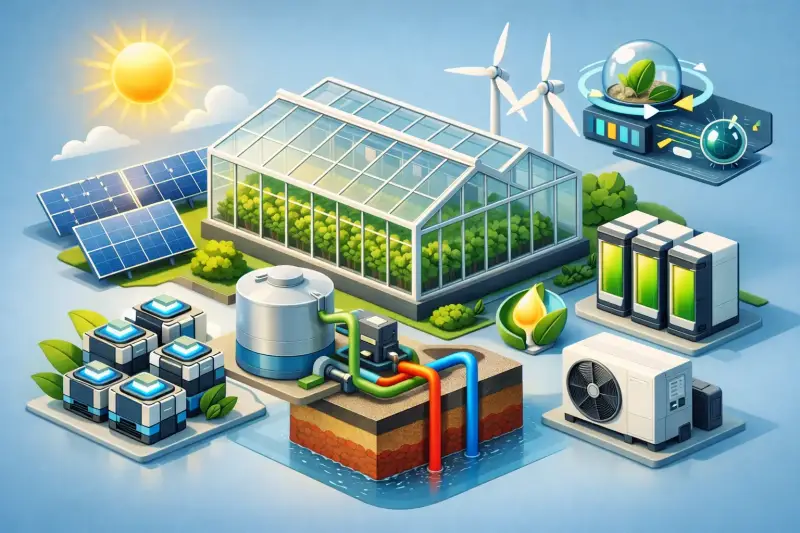
A greenhouse that misses its night temperature band by even a few degrees is not having a minor efficiency problem. It is running a crop risk, a revenue risk, and often a grid risk at the same time. That is why the top greenhouse energy strategies are not about chasing a single lower utility bill. They are about engineering a controllable thermal and electrical system that protects yield, extends seasonal resilience, and lowers cost per kilogram produced.
Why top greenhouse energy strategies start with load shape
Most greenhouse operators already know their energy bill is driven by heating demand. What is less often modeled with enough discipline is the mismatch between when heat is needed, when electricity is expensive, and when supplemental CO2 has agronomic value. That mismatch is where mediocre systems lose margin.
A greenhouse is not a generic commercial building. It is a tightly coupled biological process with sharp morning ramp loads, weather-driven thermal swings, humidity constraints, and, in many cases, artificial lighting that changes the electrical profile by the hour. Any serious strategy starts by plotting the full site load shape - thermal, electric, and carbon dioxide demand together.
This changes the investment logic. A boiler that looks acceptable on simple thermal efficiency may be weak when electricity prices spike. A grid-only strategy may look clean on paper but become fragile during winter volatility or curtailment events. Likewise, oversized CHP can waste value if the thermal sink is poorly matched. The engineering question is not which asset is cheapest in isolation. It is which architecture holds the greenhouse in its operating sweet spot under real load variation.
Combined heat and power remains central - if it is sized correctly
For commercial greenhouses, CHP still sits near the center of the most credible energy architectures because it monetizes a fact others ignore: greenhouses can use heat, power, and often CO2 at the same site. That is a rare thermodynamic advantage.
But CHP is not automatically efficient at the project level. It depends on run hours, heat recovery quality, dispatch strategy, and the ability to keep the prime mover operating close to its high-efficiency zone. Conventional engine-based CHP often suffers when load swings force inefficient cycling or partial-load operation. That is where many greenhouse projects underperform their models.
The better approach is to design around stable prime-mover operation, thermal buffering, and direct integration with the greenhouse heat network. If the system can decouple generation from moment-to-moment load volatility, recover heat across useful temperature bands, and maintain high annual utilization, CHP shifts from backup logic to core infrastructure logic.
For technically advanced projects, this is also where next-generation architectures deserve attention. Hydro Puls Systems has argued for a different path: an autonomous energy core that maintains engineered operating stability while coupling efficiently to industrial loads. For greenhouse operators, that matters because the value of CHP is not just nameplate efficiency. It is controllable output quality across changing horticultural conditions.
Thermal storage is not optional in serious greenhouse design
A surprising number of energy projects still treat storage as an add-on rather than a control asset. In greenhouses, that is a mistake. Hot water storage smooths the gap between heat generation and crop-driven demand, reduces short cycling, and lets operators buy or generate electricity on a more favorable schedule.
The simplest gain is operational. Instead of forcing the generation asset to follow every demand fluctuation, storage absorbs excess thermal output and releases it during rapid demand ramps. That improves equipment life and usually lifts real-world efficiency.
The larger gain is economic. Storage creates dispatch flexibility. If a CHP unit, boiler, heat pump, or hybrid plant can charge thermal storage when fuel economics are favorable, the greenhouse becomes less exposed to peak periods and less dependent on instantaneous generation. In high-volatility markets, that flexibility can be worth more than a nominal efficiency upgrade.
Sizing is where discipline matters. Too little storage and the system still hunts. Too much and capital is trapped in underused volume. The right design starts with hourly thermal profiles, lighting schedules, weather bins, and crop strategy rather than a generic tank rule of thumb.
Electrification works best as a hybrid, not a slogan
Heat pumps are now part of many greenhouse conversations, and for good reason. They can deliver high useful efficiency, especially where low-temperature heat sources are available and power pricing is favorable. But greenhouse heating is rarely a one-technology problem.
In colder climates or high-load operations, pure electrification can create severe peak demand exposure. It can also struggle when supply temperatures rise, defrost penalties appear, or grid carbon intensity changes by season. That does not disqualify heat pumps. It means they should be engineered into a hybrid system.
A strong hybrid design might use heat pumps for baseload thermal demand, CHP for coincident power and heat, thermal storage for smoothing, and auxiliary combustion for extreme peaks. This architecture usually outperforms a single-technology design because each asset is used where it is strongest. Heat pumps handle steady efficient recovery. CHP handles multi-output value. Peak units protect resilience without carrying the whole annual load.
For investors and operators, the practical lesson is straightforward. Electrification is most bankable when it reduces system cost and risk together. If it simply shifts fuel dependency into expensive winter electricity, it is not decarbonization leadership. It is procurement exposure.
CO2 utilization should be treated as an energy strategy
In greenhouse economics, CO2 is not a side topic. It is part of the energy architecture because on-site generation can create both thermal value and carbon enrichment value. That is a major advantage over conventional buildings or industrial sheds.
When combustion-based systems are specified, the quality, cleanliness, and controllability of CO2 delivery matter. Growers are not buying exhaust. They are buying plant response within strict contaminant limits and timing windows that align with photosynthesis, venting strategy, and lighting conditions.
This is where simplistic comparisons between grid electricity and on-site generation often break down. Imported electricity may look attractive on one metric, but if it forces separate CO2 procurement, backup thermal systems, and less resilient operations, the whole-site economics shift. A full model should assign value to on-site CO2 where agronomically relevant and technically recoverable.
Not every site should prioritize this equally. In some geographies, CO2 supply is already secure. In others, it is volatile and expensive. The answer depends on crop type, climate, venting losses, and regulatory framework. But ignoring CO2 in energy planning is a category error for serious greenhouse infrastructure.
Envelope and climate control still produce the fastest returns
Big generation assets get the attention, but many greenhouses still leave value on the table through weak control logic and avoidable thermal losses. Screen systems, tighter zoning, improved pipe distribution, condensate heat recovery, and smarter humidity control can reduce the size and cost of everything upstream.
This is especially true where operators have expanded facilities in stages. Legacy houses often end up with mismatched control loops, uneven emitter performance, and thermal distribution that reflects construction history rather than current crop economics. Before adding capacity, it often makes sense to test whether the load can be reduced or shifted.
Advanced control matters here. A greenhouse should not be managed as a simple thermostat problem. Temperature, humidity, radiation, CO2 dosing, and energy asset dispatch must work as one coordinated system. Better prediction and control can cut fuel use without compromising growth conditions, but only if the control philosophy respects biology as much as mechanical efficiency.
Fuel flexibility is now a strategic asset
A greenhouse energy plant built today will face fuel transition pressure during its lifetime. Natural gas may remain central in many markets, but electricity pricing, carbon policy, hydrogen availability, renewable gas supply, and resilience requirements are all moving targets.
That is why fuel-agnostic or fuel-flexible design deserves a place among the top greenhouse energy strategies. An asset that performs efficiently across conventional fuels today while preserving a pathway toward hydrogen, ammonia-derived systems, or cleaner hybrid operation tomorrow has a different risk profile than a stranded single-fuel machine.
This does not mean every greenhouse should bet on immediate hydrogen adoption. Most should not. It means owners should value architectures that can adapt without full plant replacement. In capital-intensive horticulture, future optionality has measurable financial value.
The best greenhouse strategy is architectural, not tactical
Many underperforming projects have one thing in common: they were assembled as a collection of devices rather than engineered as an energy architecture. A heat pump was added because electrification was fashionable. A boiler was retained because it was familiar. A CHP unit was sized from annual averages. Storage was trimmed to save capital. Controls were expected to fix the mismatch later.
That approach usually produces avoidable friction, lower utilization, and disappointing returns. The better path is to start from first principles. Define the greenhouse as a multi-output system with thermal demand, electric demand, CO2 value, weather volatility, crop sensitivity, and resilience requirements. Then select assets that maintain high efficiency under those real conditions, not just under brochure conditions.
For greenhouse operators and investors, the opportunity is larger than utility savings. The right energy architecture improves crop stability, extends operating certainty, and turns energy from a recurring vulnerability into a managed production advantage. In a sector where margins are shaped by both biology and thermodynamics, that is where the next serious gains will come from.