

Water purification (ZLD)
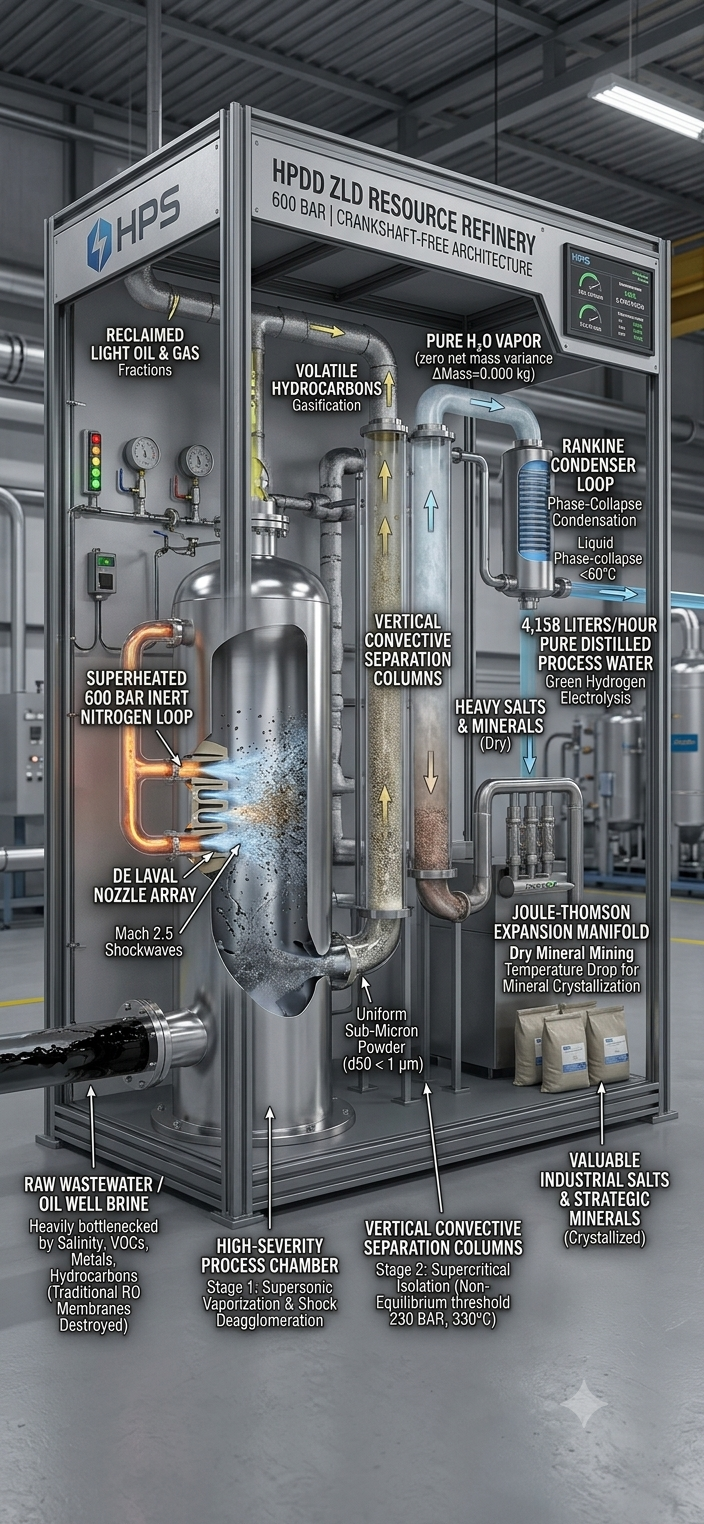
HPDD Zero Liquid Discharge (ZLD): The Revolution in Industrial and Petrochemical Water Treatment
Traditional methods for treating heavily contaminated industrial wastewater and "produced water" from oil wells are hitting a massive wall. High salinity, volatile organic compounds (VOCs), heavy metals, and emulsified hydrocarbons clog and destroy traditional membranes (such as reverse osmosis) often within hours. This leads to skyrocketing operational costs (OPEX), frequent downtime, and a massive, toxic stream of liquid sludge.
With the Hydro Puls Direct-Drive (HPDD) platform, we eliminate these liabilities entirely. We replace fragile mechanical filtration with a software-defined, molecular separation core. No membranes, no chemical additives, and zero liquid waste: pure process intensification that transforms toxic wastewater into high-value raw materials.
How It Works: The 3-Step HPDD Process
Our crankshaft-free HPDD technology does not treat complex wastewater as a mechanical filtration problem, but as a highly predictable, closed-loop thermodynamic cycle. This process unfolds in three seamless, perfectly synchronized phases:
1. Supersonic Evaporation & Acoustic Shockwaves (Physical Phase)
The contaminated wastewater or oil-field brine is injected directly into our high-pressure treatment chamber. Here, it meets a superheated, oxygen-free nitrogen stream under a brute force of $600\text{ bar}$, accelerated through custom-designed ceramic de Laval nozzles to well over Mach 2.5.
The resulting acoustic decompression shockwaves cause the liquid matrix to literally "flash-explode" in milliseconds. This process instantly tears heavy metals, complex salts, and hydrocarbons away from their liquid bonds, pulverizing them into a perfectly homogeneous, dry sub-micron powder, completely bypassing the need for mechanical filters or blades.
2. Supercritical Isolation & Hydrocarbon Stripping (Chemical Phase)
This ultra-fine powder stream ascends into our vertical separation columns, which operate under the strict laws of Supercritical Vapor-Liquid Equilibrium (VLE) at 230bar and 330C. At this specific threshold, the traditional boundaries between liquid and gas vanish.
Volatile hydrocarbons and light oil fractions cleanly gasify and separate based on their distinct densities. Simultaneously, the pure water vapor moves into the isolation zone with an absolute zero net mass variance (Delta\Mass = 0,000kg). What remains is a dry, valuable mineral powder and absolutely zero toxic liquid sludge.
3. Phase-Collapse & Mineral Salt Mining (Thermodynamic Phase)
The isolated water vapor enters our active Rankine condenser, where a sudden temperature drop to below 60C triggers an immediate liquid phase-collapse. This causes the internal system back-pressure to drop to near-vacuum levels, reducing the auxiliary pump load to an absolute minimum of just 1% to 2%.
This phase delivers a continuous yield of over 4,158 liters of ultra-pure, scale-free distilled process water per hour (per 10-MW block) the ideal, high-purity feedstock for green hydrogen electrolysis. Concurrently, the heavy fractions pass through a Joule-Thomson expansion manifold to cool, forcing commercially valuable industrial salts and crystallized minerals to precipitate sequentially in their purest, dry forms.
Transforming Environmental Liabilities into High-Value Revenue
With the HPDD Zero Liquid Discharge platform, we are completely rewriting the economic rules for heavy industry and the oil and gas sector:
- Eliminate Membrane Liabilities: No expensive membranes, filters, or mechanical parts that clog, require chemical cleaning, or demand frequent, costly replacement.
- 100% Valuable Resource Reclamation: We do not "treat" your toxic wastewater at a financial loss. Instead, we extract valuable, saleable industrial salts, high-purity minerals, and captured hydrocarbons right on-site.
- Ultra-Pure Process Water: The generated distilled water is of such high purity that it can be directly reused as high-grade process water or fed straight into green hydrogen electrolyzers.
- Zero Injection Wells or Sludge Ponds: Petrochemical operators can completely eliminate the massive liabilities, logistical costs, and environmental risks associated with deep-well waste injection and toxic tailings.
The HPDD transforms your largest ecological risk into a highly automated, software-defined, asset-backed commodity refinery.
