

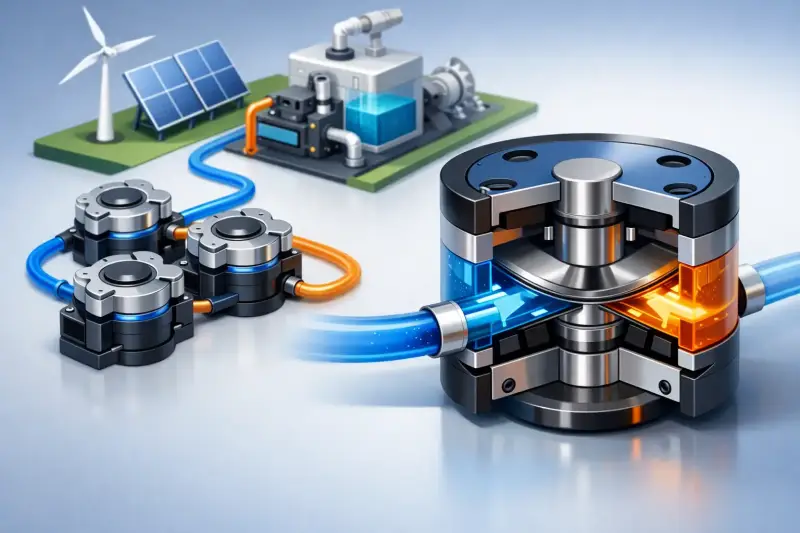
A conventional engine loses efficiency in places most operators have learned to accept - crankshafts, gear trains, load swings, transient combustion behavior, and the mechanical penalties of converting thermal energy into rotating motion before doing useful work. That is exactly why the question of how hydraulic energy transfer improves efficiency matters. It is not a minor optimization. It is an architectural shift in how energy is converted, controlled, and delivered to real industrial loads.
For technical buyers, the key point is simple: hydraulic transfer changes the path energy takes through a machine. When that path is shorter, more controllable, and less dependent on rotating mechanical assemblies, parasitic losses fall. When the prime mover can operate near a fixed optimal condition while the load varies independently, system efficiency rises again. Those two effects alone make hydraulic architectures fundamentally different from conventional crank-driven systems.
Why conventional mechanical transfer leaves efficiency on the table
In a standard reciprocating engine, combustion pressure acts on a piston, which drives a connecting rod, which turns a crankshaft, which then feeds a transmission, generator, pump, propulsor, or other downstream machine. Each stage adds friction, inertia, vibration, alignment constraints, and off-design behavior.
That arrangement was historically practical, but it is not thermodynamically elegant. The crank mechanism imposes a geometric compromise on piston motion. Torque delivery becomes cyclic. Rotational speed becomes tightly coupled to the operating window of the machine. Once the external load changes, the combustion process, speed, and mechanical stress field all tend to change with it.
The result is familiar to anyone running heavy-duty assets: lower part-load efficiency, higher wear, larger thermal swings, and more energy spent managing the machine rather than serving the load.
How hydraulic energy transfer improves efficiency at the architecture level
When engineers ask how hydraulic energy transfer improves efficiency, the first answer is that it replaces indirect mechanical compromise with direct pressure-based energy movement.
Hydraulic systems transfer power through pressurized fluid rather than through a long chain of rotating components. That matters because pressure is a highly effective carrier of force. Instead of forcing thermal energy through crank geometry and rotational conversion before it becomes useful work, a hydraulic architecture can capture force at the piston and transfer it directly to where work is required.
In practical terms, this creates several efficiency advantages. Friction losses can drop because there are fewer heavily loaded sliding and rotating interfaces. Energy delivery becomes more controllable because pressure and flow can be modulated independently of combustion timing. The prime mover no longer has to chase every transient in the load profile. It can remain near a designed sweet spot while the hydraulic circuit manages output variation.
That decoupling is one of the most important gains in advanced energy systems. Constant operation is almost always easier to optimize than variable operation. Combustion is cleaner and more stable. Thermal conditions are easier to hold. Mechanical stress is lower. Control logic becomes more precise.
Reduced friction and lower parasitic losses
Friction is not a footnote in industrial power conversion. It is a primary efficiency destroyer. Bearings, crank journals, valve trains, gear meshes, transmissions, and auxiliary drive systems all consume energy continuously.
Hydraulic energy transfer can cut those losses by simplifying the mechanical chain. If force is captured and moved hydraulically, there is less need for multiple rotational conversion steps and less dependence on large inertia-carrying components. The machine spends more of its input energy producing pressure and flow that can be used directly.
This does not mean hydraulic systems are lossless. Fluid shear, leakage, throttling, and pump inefficiencies still exist. The engineering question is not whether losses disappear, but whether the total loss stack is lower than in a conventional architecture. In many advanced designs, especially where direct coupling to pumps, linear actuators, or hydraulic motors is possible, the answer is yes.
The efficiency gain becomes even more meaningful in applications with variable duty cycles. Mechanical drivetrains often suffer when forced to operate away from a narrow design point. Hydraulic systems can absorb those variations with less penalty if the pressure circuit, accumulators, and control strategy are engineered correctly.
Stable operating conditions change the thermodynamics
A major reason how hydraulic energy transfer improves efficiency keeps coming up in next-generation power discussions is that it allows the energy core to operate under more stable conditions.
Conventional engines tied directly to load demand constantly speed up, slow down, and experience changing cylinder conditions. That instability affects combustion quality, heat rejection, emissions behavior, lubrication, and component life. Even small deviations from ideal conditions can compound into significant fuel penalties over thousands of operating hours.
A hydraulic intermediary breaks that direct coupling. Energy can be generated in pulses or cycles optimized for the prime mover, then buffered and dispatched according to load demand. This means combustion pressure, timing, and thermal behavior can be engineered around efficiency rather than around driveline convenience.
For combined heat and power, off-grid generation, marine propulsion, greenhouse energy systems, and industrial process applications, that is a serious advantage. It allows one platform to produce mechanical work, electricity, and useful heat from a more stable operating regime. Stability is not just good for reliability. It is good for efficiency because the machine spends less time in compromised operating states.
Better matching between source and load
Most industrial energy losses come from mismatch. The source wants to run one way. The load wants to behave another way.
A generator prefers stable input. A pumping system may see large demand swings. A propulsion system faces rapidly changing torque requirements. A CHP installation may need to prioritize heat recovery at one moment and electrical output at another. Conventional architectures force awkward compromises because the machine and the load are mechanically married.
Hydraulic transfer introduces a controllable interface. Pressure, flow, and storage can be tuned to the demand side without constantly destabilizing the energy conversion side. That improves overall plant efficiency because fewer corrective actions are needed across the system.
This is also where hydraulic architectures become commercially interesting for investors and operators. Better matching means better fuel economy, lower wear, smaller peak design penalties, and potentially lower balance-of-plant complexity. In many cases, it also means more useful output from the same input fuel.
Where the biggest gains usually appear
The strongest efficiency case for hydraulic transfer is rarely in a simple, steady, single-purpose machine. It is strongest in systems where load variability, multipurpose output, or direct force application dominates performance.
Heavy transport and shipping benefit because propulsion demand is dynamic, and mechanical drivetrains impose real penalties under fluctuating conditions. Industrial pumping and compression benefit because hydraulic power can be closely aligned with the actual work process. CHP and distributed energy platforms benefit because thermal and mechanical outputs can be coordinated more intelligently. Remote and off-grid assets benefit because stable operation improves fuel use and system resilience at the same time.
This is one reason companies such as Hydro Puls Systems frame hydraulic architecture not as a component choice, but as a new class of energy platform. Once hydraulic transfer is treated as the core of the machine rather than an accessory subsystem, new integration strategies become possible.
Trade-offs engineers should evaluate honestly
Hydraulic energy transfer is not automatically superior in every case. The quality of the hydraulic circuit matters. Poorly designed systems can lose efficiency through pressure drops, fluid heating, leakage, poor sealing, and control instability.
Fluid cleanliness and thermal management also matter. High-performance hydraulic systems require disciplined materials selection, sealing strategy, and maintenance standards. In some very small or low-duty applications, the added complexity of a hydraulic circuit may not justify the gain.
There is also an application question. If the end use is already perfectly served by direct electric drive or by a very stable mechanical system operating near its design point, the margin for hydraulic improvement may be narrower. The biggest gains tend to appear where conventional systems are constantly forced into off-design behavior.
That is the right way to assess the technology. Not as a universal replacement, but as a superior architecture where force transfer, variable load handling, and thermodynamic stability define the economics.
The strategic efficiency case
The deeper value in how hydraulic energy transfer improves efficiency is not just a few points of machine performance. It is the ability to redesign the entire energy pathway around first principles.
If pressure-based transfer reduces friction, decouples generation from demand, stabilizes combustion, and allows direct coupling to useful work, then efficiency stops being a local component metric. It becomes a system characteristic. That changes the business case for modular power, fuel-flexible generation, hydrogen-ready platforms, industrial heat utilization, and high-duty propulsion.
For decision-makers evaluating future energy infrastructure, this matters because the next decade will reward architectures that do more than survive fuel transition. They need to convert more of every unit of input into bankable output while holding reliability, controllability, and integration value.
The most efficient machine is not always the one with the most familiar layout. Often, it is the one that removes the most unnecessary motion between energy creation and useful work.