

Industry Update: Why the Multi-Billion Dollar Battery Storage (BESS) Market is Based on a Fundamental Design Flaw
The energy sector is currently locked in a massive race to deploy multi-megawatt Battery Energy Storage Systems (BESS). The irony? This gold rush is purely treating a symptom, not the cause. Because legacy power plants are rigid and inflexible, massive battery banks are required to store excess power and bridge grid shortages. This band-aid demands staggering capital expenditure (CAPEX), suffers from rapid cell degradation, and drains enormous amounts of electricity just to run the heavy HVAC cooling systems required to prevent thermal runaway.
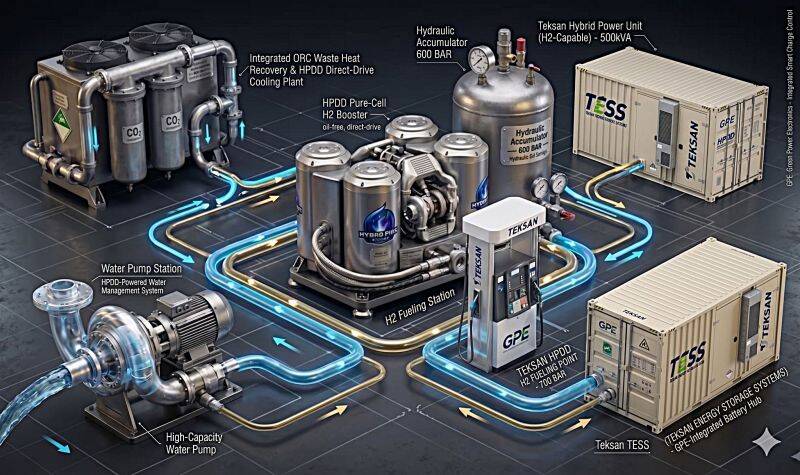
The Hydro Puls Direct-Drive (HPDD) platform proves that this dynamic is entirely obsolete. By introducing a highly flexible, software-defined modular swarm architecture, we tackle grid volatility directly at the source—making traditional battery parks completely unnecessary.
How does an HPDD installation eliminate the need for a BESS?
- Dynamic Source Load-Matching: Instead of one massive, unyielding power plant that must dump excess energy at negative prices, the HPDD operates as a synchronized container swarm. If downstream demand drops, individual containerized units seamlessly drop offline. If demand spikes, our built-in 600-bar hydraulic accumulators instantly bring them back online with zero friction.
- The Power of Hydraulics: Much like an industrial excavator, the engine's combustion core runs continuously at a fixed, ultra-efficient thermodynamic sweet spot. The hydraulic circuit handles 100% of the volatile, millisecond-by-millisecond grid modulation, absorbing the shocks that would typically destabilize a power plant.
- From Power Drain to Circular Dividends: While a conventional BESS consumes massive amounts of parasite electricity just to cool itself, the HPDD v26 flips the equation. Utilizing extreme expansion physics via integrated De Laval exergy loops, it co-generates industrial sub-zero cooling () and thousands of liters of pure freshwater per hour—all at a parasitic load of exact 0.0 kW.
The Economic Death Blow to Battery Arbitrage Battery developers survive on energy arbitrage—buying cheap during oversupply and selling high during shortages. However, when power providers retrofit existing facilities with an HPDD modular schil (shell), the power generation itself modulates instantly. Oversupply and shortages vanish, flattening the market's price volatility. Without these artificial price swings, the return on investment (ROI) for chemical batteries completely evaporates.
Existing power plants do not need to be decommissioned. By simply adding an active swarm of HPDD containers to the facility grounds, operators can lock their main plant into a highly stable, efficient baseline while the containers effortlessly modulate the rest.
This infrastructure shift is legally fortified by 42 filed patents and our PCT application currently in the international phase across 150 countries. The future of infrastructure does not need battery patches; it needs a flexible source.
#EnergyTransition #PowerGeneration #GridFlexibility #HPDD #HydroPuls #ZeroEmission #GreenAmmonia #Sustainability #BESS #Infrastructure