

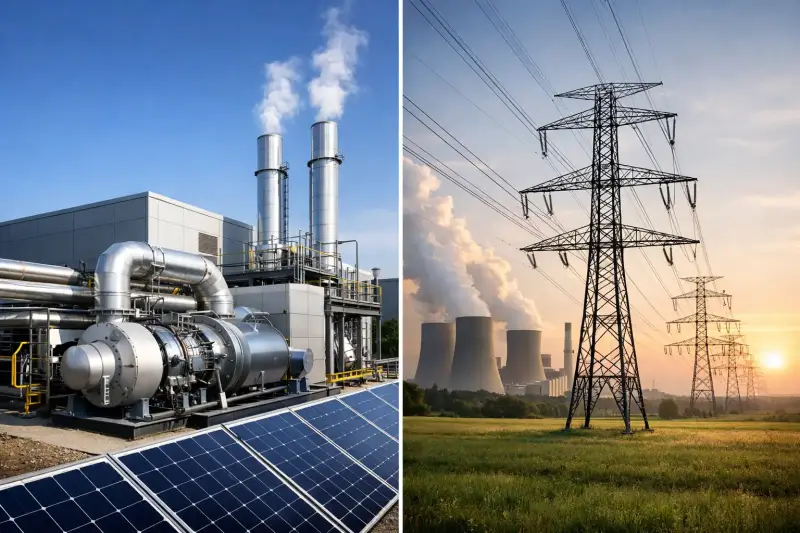
When a facility buys every kilowatt-hour from the grid while dumping usable heat into the atmosphere, it is paying twice for the same energy mistake. That is the real frame for onsite chp vs grid electricity - not just utility price versus equipment cost, but whether the site captures the thermodynamic value already embedded in fuel.
For industrial operators, greenhouse developers, data infrastructure planners, and energy investors, this comparison is rarely binary. It is architectural. Grid electricity is a delivered commodity shaped by market pricing, transmission losses, congestion, and generation mix. Onsite combined heat and power, by contrast, is a local energy conversion strategy that can turn one fuel input into multiple useful outputs at the point of demand. The result can be lower operating cost, higher resilience, and materially better primary energy utilization, but only when the site load profile is right and the system design is technically disciplined.
Onsite CHP vs grid electricity starts with first principles
Grid electricity looks simple because the complexity sits somewhere else. Power is generated remotely, stepped up, transmitted, distributed, and billed as a clean final product at the meter. From the customer side, it feels efficient because the machine room is invisible.
But from a system perspective, grid power often carries hidden losses before it reaches the facility. Central generation efficiency may be moderate to high depending on the asset class, yet transmission and distribution losses, reserve requirements, and the mismatch between centralized generation and local thermal demand all matter. If a site then uses separate boilers for heat, the total fuel burned across the wider system can be substantial.
Onsite CHP changes that equation by colocating generation with demand and recovering thermal energy that would otherwise be rejected. In a well-matched application, total system efficiency can move far above standalone power generation because electricity and heat are produced from the same fuel input. That is the core economic and engineering advantage.
The question is not whether CHP is theoretically more efficient. It usually is when thermal loads are continuous and recoverable heat is genuinely useful. The real question is whether the facility can convert that efficiency advantage into cash flow, uptime, and strategic flexibility.
Where grid electricity still wins
There are cases where grid power is the correct answer, even for energy-intensive assets. A facility with low or intermittent heat demand may struggle to justify CHP because the value engine is incomplete. If recovered heat cannot be used for process heating, hot water, absorption cooling, drying, greenhouse climate control, or another productive sink, much of the CHP advantage disappears.
Grid electricity also wins on simplicity. There is no on-site generation asset to permit, fuel, maintain, dispatch, or integrate with existing thermal systems. For smaller loads, or for sites in regions with low electricity tariffs and high reliability, the grid can remain the lower-friction option.
Decarbonization policy can also tilt the balance. If a site has access to low-carbon grid electricity and limited clean fuel options for thermal generation, electrification may outperform fossil-based CHP on emissions. That said, this depends heavily on the local grid mix, marginal generation source, and whether the site still needs high-temperature heat that electric systems cannot deliver economically.
Where onsite CHP changes the economics
The strongest CHP cases share one characteristic: steady coincidence between electric load and thermal demand. Industrial plants, district energy nodes, food processing sites, hospitals, greenhouses, desalination systems, and some data centers with adjacent heat use are classic examples.
In these settings, onsite generation is not simply replacing purchased electricity. It is reducing power purchases while displacing separate thermal production. That dual displacement is what reshapes the business case.
A conventional comparison based only on power price misses the point. If grid electricity costs $0.10 per kWh but the facility also spends heavily on steam, hot water, or process heat, then the proper comparison must include avoided boiler fuel, avoided transmission losses, capacity value, resilience value, and potentially avoided downtime costs. For many operators, downtime is more expensive than energy. That is why the resilience dimension matters as much as the efficiency number.
CHP can also reduce exposure to tariff volatility. A site with controllable on-site generation is less vulnerable to peak pricing, demand charges, and curtailment events. In unstable grids or remote industrial developments, this becomes strategic infrastructure rather than an equipment purchase.
The emissions picture is more nuanced than it looks
One of the most misleading versions of the onsite chp vs grid electricity debate is the idea that one option is always cleaner. The truth is conditional.
If onsite CHP uses a carbon-intensive fuel and the local grid is increasingly powered by low-carbon generation, the emissions advantage may narrow or reverse on a pure electricity basis. But that still does not settle the analysis. CHP should be compared against the combined emissions of grid electricity plus separate heat production, not against grid power alone.
That distinction matters. A high-efficiency CHP system can lower total site emissions if it displaces both purchased electricity and boiler fuel, especially where the marginal grid is still fossil-heavy. The equation improves further when the platform is fuel-flexible or designed for a transition path toward hydrogen, ammonia-derived fuel streams, renewable gases, or integrated carbon capture.
This is where architecture matters more than labels. A system built around stable combustion conditions, low parasitic losses, and multi-fuel adaptability is better positioned for the decarbonization curve than a fixed single-purpose asset. For industrial buyers making 15- to 25-year capital decisions, that future readiness is not optional.
Reliability, redundancy, and the real value of control
Grid electricity is often treated as the default reliable option until a plant trip, weather event, transmission fault, or frequency disturbance proves otherwise. Centralized grids are powerful, but they are not immune to systemic risk.
Onsite CHP gives operators something the grid cannot sell directly: control over their own energy core. That control can be designed in different ways. Some sites use CHP for baseload and the grid for backup. Others retain grid interconnection but reduce dependence dramatically. Critical infrastructure may build layered redundancy with CHP, storage, thermal buffering, and islanding capability.
This is where standard engine-based CHP has historically run into mechanical and operational constraints. Variable loading, maintenance intervals, combustion instability, and parasitic losses can erode theoretical gains. More advanced architectures aim to decouple prime mover operation from end-use load variation so that the energy conversion system can run in its optimal band while electric, hydraulic, and thermal outputs are managed intelligently downstream.
For OEMs and engineering teams, that is a major design shift. It moves the conversation from buying a generator set to designing an autonomous energy platform.
CAPEX is visible, but OPEX decides the winner
Most failed energy investment decisions begin with an incomplete spreadsheet. Grid electricity looks favorable when the analysis focuses on immediate capital avoidance. Onsite CHP looks favorable when the analysis assumes ideal utilization. Neither is enough.
The right model has to include capacity factor, spark spread or fuel-price differential, thermal utilization rate, maintenance profile, interconnection cost, emissions compliance, and the cost of lost production during outages. For industrial operators, waste heat value should be modeled against actual process demand by hour and season, not annual averages.
A poorly matched CHP asset can become an expensive generator with stranded heat. A well-matched CHP asset can outperform grid supply economics for years and create a platform for microgrid operation, thermal integration, and future fuel conversion.
Investors should also look at modularity. Large monolithic systems can deliver scale, but modular energy blocks often reduce deployment risk, improve redundancy, and align capacity additions with demand growth. That matters in greenfield projects, remote developments, and sectors facing uncertain expansion timelines.
The better question is not which is cheaper
The most useful way to think about onsite CHP vs grid electricity is not asking which source has the lowest nominal energy price today. The better question is which architecture creates the most usable energy, the most controllable uptime, and the lowest long-term exposure to fuel, grid, and regulatory volatility.
For some sites, the answer will still be the grid, especially where heat demand is weak and power is clean, cheap, and stable. For others, onsite CHP will be the rational choice because it converts fuel locally, harvests heat productively, and gives the operator control over a mission-critical asset.
For next-generation platforms, the opportunity is larger than conventional CHP. Companies such as Hydro Puls Systems are pushing toward energy architectures that operate in a tighter thermodynamic sweet spot, reduce frictional losses, and support fuel transition without forcing industrial operators to rebuild their entire energy strategy twice.
That is where this market is going. Not toward a simple grid-versus-generator argument, but toward engineered energy ecosystems where power, heat, motion, storage, and fuel flexibility are designed as one system from the start.
The facilities that will outperform over the next decade are the ones that stop buying energy as a commodity and start designing it as an advantage.