

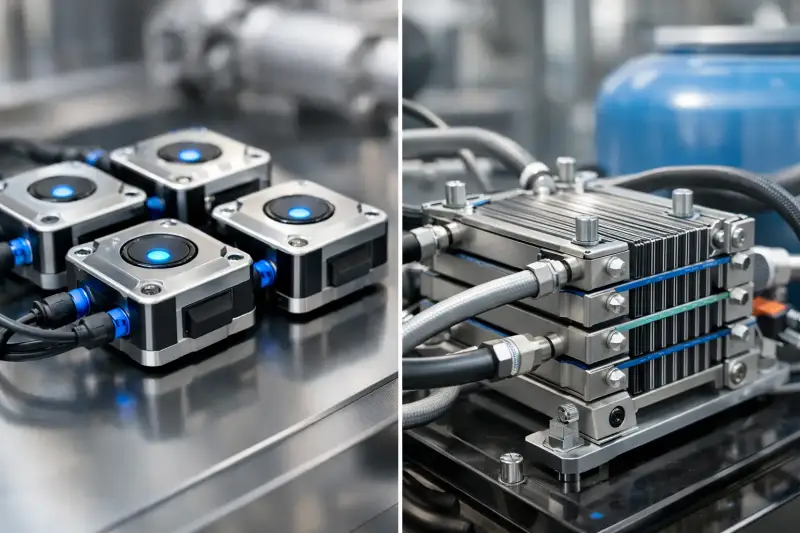
A hydrogen project gets real the moment the conversation moves from molecule supply to conversion architecture.
Choosing between hydrogen combustion platforms and fuel cells is a capital allocation question, not a science fair debate. For industrial operators, utilities, and infrastructure investors, the decisive issue is not which pathway sounds cleaner on a slide. It is which architecture converts hydrogen into dependable power, heat, and motion under real duty cycles, maintenance constraints, and financing pressures.
Efficiency Is Not One Number
Fuel cells can achieve strong electrical efficiency at the stack level under controlled conditions. They are ideal when prioritizing quiet operation, low local emissions, and clean electrical generation for tightly managed environments with predictable loads.
However, system-level performance depends on stack degradation, thermal management, hydrogen purity, and parasitic loads. Nameplate efficiency is rarely the whole story in the field.
Hydrogen combustion platforms take a different route. While they may post lower pure electrical efficiency if measured narrowly at a single operating point, industrial buyers optimize for total useful energy output, uptime, and resilience across a demanding operating profile.
In CHP, process heat, district energy, and steam support, a combustion platform captures high-grade heat directly. Once thermal recovery is valued properly, total system efficiency becomes highly competitive.
Ruggedness and Infrastructure Flexibility
Combustion platforms win decisively when applications demand ruggedness, fuel flexibility, or easier integration into established industrial maintenance ecosystems:
-
Direct-Drive Efficiency: Every conversion step introduces losses. If a site needs pumping, compression, or motion, direct coupling to hydraulic or mechanical work outperforms electricity-first designs followed by reconversion.
-
Fuel Transition Bridge: Many industrial customers cannot switch to pure hydrogen in one step. Combustion systems handle phased adoption, dual-fuel capability, and ammonia readiness without stranding core assets.
-
Infrastructure Tolerance: Fuel cells require tight purity control. Combustion systems offer far more tolerance under uncertain fuel supply conditions, crucial for remote sites, mining, or marine vessels.
The Bottom Line
For investors, this is ultimately a bankability discussion. Modern combustion design can reduce substantially through lean-burn strategies and precise control, neutralizing the legacy emissions argument.
The goal isn't to declare a universal winner. If the project prioritizes pure power and controlled cycles, fuel cells excel. If it requires CHP, thermal recovery, direct mechanical work, and rugged serviceability, combustion holds the stronger business case.
Hydro Puls Systems is pushing this exact frontier—treating hydrogen-capable combustion not as a retrofit compromise, but as a new energy conversion architecture built around isolated combustion, stable operating zones, and direct industrial work output. The winners will be chosen by thermodynamics, uptime, and capital discipline.
#HPDD #HydroPuls #HydrogenEnergy #CleanTech #IndustrialEngineering #EnergyArchitecture #Decarbonization #PowerGeneration #ProcessHeat