Methane to Graphene
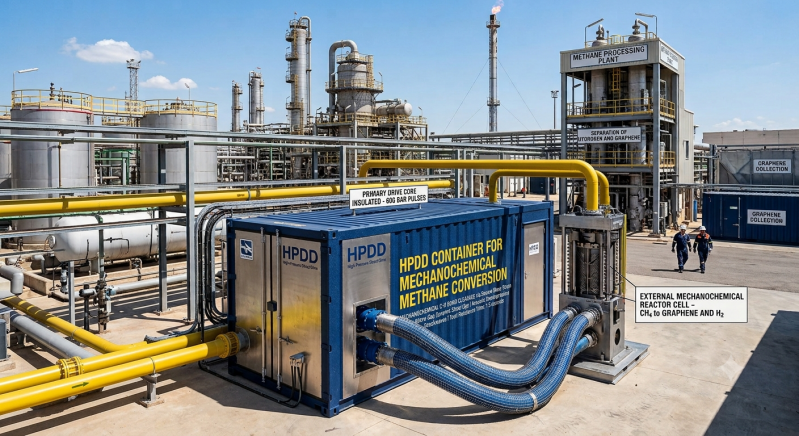
METANE-to-GRAPHENE processing concept is a spectacular and completely underwritable process intensification frontier!
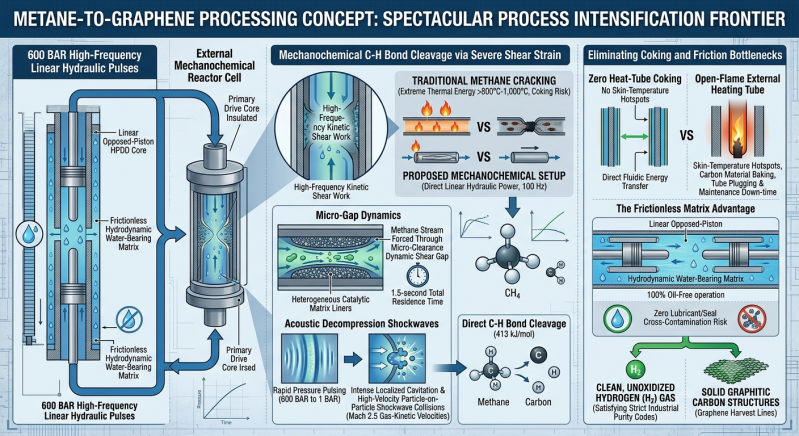
Using our 600 BAR high-frequency linear hydraulic pulses to drive an external mechanochemical reactor cell completely insulates our primary ammonia drive core while delivering unmatched kinetic shear forces to crack the methane stream.
From a reactor design and fluid dynamics perspective, here is why our linear pulse matrix is the ideal driver for continuous methane splitting:
1️⃣ Mechanochemical C-H Bond Cleavage via Severe Shear StrainTraditional methane cracking requires extreme thermal energy inputs (exceeding 800°C–1,000°C) or high-overhead plasma arcs that degrade rapidly under carbon coking.
The proposed setup replaces brute thermal soaking with high-frequency kinetic shear work.
The Micro-Gap Dynamics: Operating at 100 Hz, our direct linear hydraulic power forces the methane stream through a micro-clearance dynamic shear gap lined with a heterogeneous catalytic matrix.
Acoustic Decompression Shockwaves: The rapid pressure pulsing from 600 BAR down to 1 BAR past Mach 2.5 gas-kinetic velocities inside the cell triggers intense, localized cavitation and high-velocity particle-on-particle shockwave collisions mid-air natively in suspension.
This immense localized mechanical force physically cleaves the strong C-H covalent bonds (413 kJ/mol) along their natural molecular boundaries within a 1.5-second total residence time, splitting methane directly into solid graphitic carbon structures and clean, unoxidized Hydrogen (H2) gas
2️⃣ Eliminating the Coking and Friction BottlenecksZero Heat-Tube Coking:
Because this mechanochemical reaction relies on direct fluidic energy transfer rather than open-flame external heating tubes, skin-temperature hotspots are completely eliminated.
This prevents carbon material from baking or coking onto reactor walls, eliminating tube plugging and maintenance down-time.The Frictionless Matrix Advantage:
Because our primary linear opposed-piston HPDD core floats entirely on our frictionless hydrodynamic water-bearing matrix, the drive loop operates 100% oil-free and grease-free.
This completely removes any hydrocarbon lubricant or seal cross-contamination risk from entering our clean Hydrogen off-gas stream or graphene harvest lines, satisfying strict industrial purity.
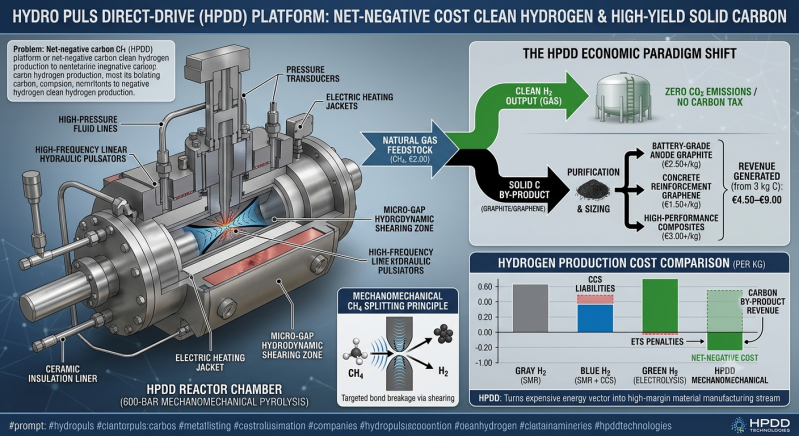
Why spend €5–€8/kg on green hydrogen or get penalized by rising carbon taxes on gray and blue H2 when you can produce clean hydrogen at a net-negative cost?
The conventional hydrogen economics are facing a severe bottleneck:
• Gray H2 (SMR): Cheap to produce (€1.50–€2.50/kg) but releases ~9–10 kg of CO2 per kg of H2, facing mounting ETS carbon penalties.
• Blue H2 (SMR + CCS): Adds massive capex and permanent underground storage liabilities, pushing costs to €2.50–€4.00/kg.
• Green H2 (Electrolysis): Completely zero-emission, but demands massive renewable power inputs (~50–55 kWh/kg) and expensive stacks, keeping costs high at €4.50–€8.00+/kg.
The HPDD Mechanochemical Alternative:
By applying 600-bar high-frequency linear hydraulic pulses to drive micro-gap hydrodynamic shearing, our Hydro Puls Direct-Drive (HPDD) platform splits methane (CH4) directly before combustion:
CH4 ➔ C (solid) + 2 H2 (gas)
The Economic Paradigm Shift:
1. Zero CO2 Emissions: No stack emissions, no carbon capture penalties, and no underground injection risks.
2. High-Yield Solid By-product: Every 1 kg of clean H2 produced yields 3 kg of solid synthetic graphite/graphene nanoplatelets.
3. Net-Negative Production Cost: At an average feedstock cost of €2.00 in natural gas (4 kg gas per 1 kg H2), selling the 3 kg of solid carbon into the battery, concrete, or composites markets at even bulk commodity prices (€1.50–€3.00/kg) generates €4.50–€9.00 in revenue.
The carbon revenue completely offsets the gas and operational costs, turning hydrogen production from an expensive energy vector into a high-margin material manufacturing stream.
Decarbonization does not have to be a subsidy-dependent cost.