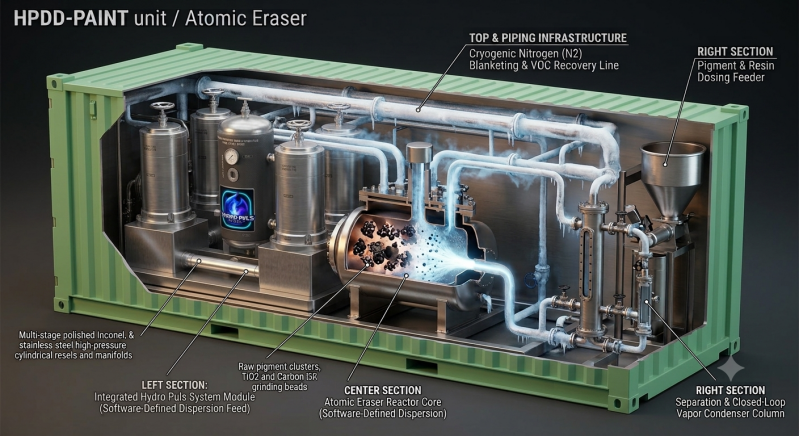
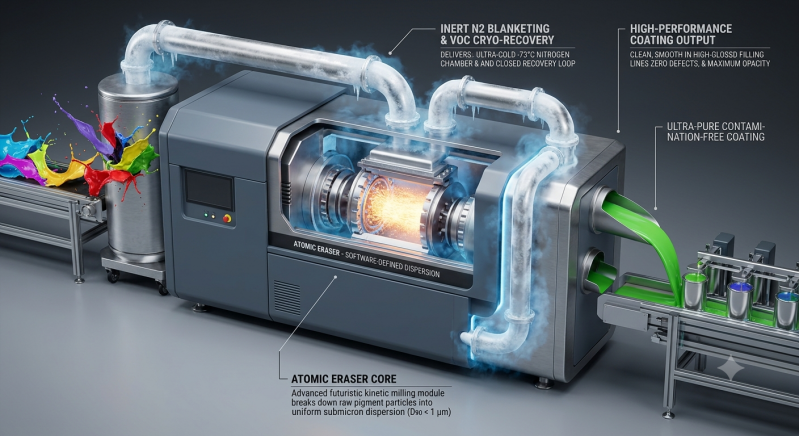
HPDD-PAINT unit
Beyond Bead Mills: Software-Defined Precision for the Coatings Industry 🎨⚙️❄️
Revolutionizing Paint & Coating Manufacturing: From Mechanical Grinding to Software-Defined Precision
Pigment dispersion and de-agglomeration of hard-to-process solids, such as titanium dioxide (TiO_2), carbon black, and transparent iron oxides, represent the most resource-intensive bottlenecks in modern paint and coating plants. Conventional technologies rely heavily on mechanical bead mills and high-speed dissolvers. These legacy systems suffer from high energy consumption, continuous ceramic/zirconium bead wear, excessive shear-induced friction heat, and significant solvent vaporization losses during open handling.
The HPDD Multi-Vector Platform, driven by the Atomic Eraser kinetic core, eliminates mechanical grinding bottlenecks by replacing rotating shafts and physical grinding media with high-frequency, non-contact pulse dynamics. The platform integrates direct submicron milling with closed-loop cryogenic nitrogen management in a single automated process skid.
Key Technological Pillars
1. Software-Defined Submicron Milling & De-Agglomeration
- Dynamic PSD Control (D_90 < 1mu): Kinetic pressure pulses break pigment agglomerates cleanly down to primary submicron crystal structures. By generating narrow particle size distributions on demand, manufacturers achieve maximum opacity, gloss, and color strength while reducing raw pigment usage by up to 15–20%.
- Zero Bead Wear & Pure Formulations: Traditional media mills contaminate high-grade coatings through the continuous degradation of zirconium oxide or glass beads. The Atomic Eraser operates entirely media-free, delivering ultra-pure electronic, automotive, and optical-grade coatings.
- Instant Digital Recipe Changes: Transitioning between formulations, such as shifting from high-gloss automotive finishes to matte industrial primers—requires zero mechanical retooling. Operators adjust target flow, frequency, and pressure curves directly through the software interface, reducing changeover downtime and solvent wash cycles to minutes.
2. Multi-Vector Cold Nitrogen (N_2) Integration
- Inert Blanketing & Anti-Skinning: The intrinsic expansion cycle generates continuous inert nitrogen gas, creating a protective blanket across process tanks, piping manifolds, and bottling heads. This completely prevents oxidation and surface skinning in air-sensitive alkyd resins and UV-curable prepolymers.
- ATEX Explosion Neutralization & Closed-Loop VOC Recovery: Delivering continuous N_2 eliminates ignition risk in solvent-borne lines handling volatile hydrocarbons (xylene, toluene, acetates). The cryogenic temperature of the process gas stream forces volatile organic compounds (VOCs) to condense in-situ for recovery and recycling rather than venting or flaring.
- In-Situ Thermal Management: High-viscosity dispersing generates destructive shear heat that can trigger premature polymer cross-linking or gelation. The direct integration of deep cryogenic cooling neutralizes friction heat at the exact moment of shear, maintaining ideal reaction temperatures across continuous 24/7 runs.
Operational & Economic Impact
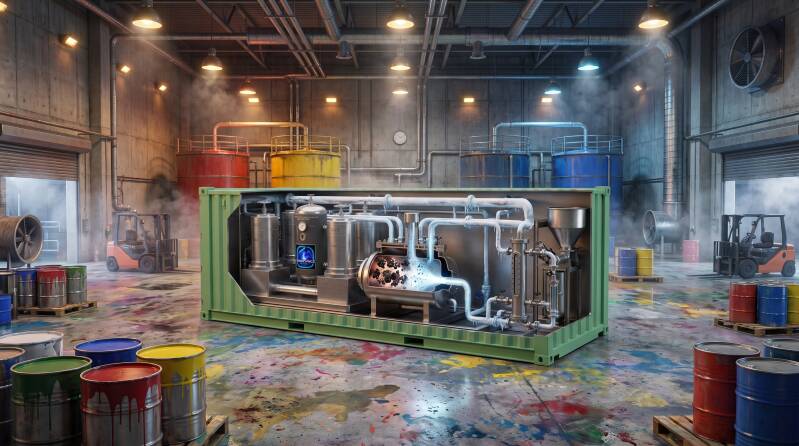
- Footprint Consolidation: Replaces multi-stage pre-mixers, horizontal bead mills, external chillers, and dedicated nitrogen generators with a single containerized or skid-mounted system.
- Lower Operating Costs: Eliminates consumable grinding media, lowers direct electrical consumption, and drastically cuts volatile solvent replacement costs.
- Superior Batch Consistency: Eliminates mechanical wear variables, ensuring that every production run strictly matches master quality curves.
Transition your coating production from mechanical grinding to software-defined, closed-loop precision.
Contact our engineering team at Hydro Puls Systems to evaluate your custom integration.