Ammonia for FREE

Rethinking Ammonia: From Emission Liability to Net-Negative Commodity

Ammonia underpins global food security and stands as the prime zero-carbon fuel candidate for deep-sea shipping. Yet conventional synthesis remains an acute climate liability, responsible for roughly 1.8% of global greenhouse gas emissions.
The fundamental issue is not the catalytic Haber-Bosch synthesis loop, it is the upstream generation and compression of hydrogen.
Legacy Steam Methane Reforming (SMR) operates at 1,000°C, releasing 1.8 to 2.0 tons of direct CO_2 for every ton of ammonia synthesized. Meanwhile, green hydrogen via water electrolysis faces prohibitive CapEx barriers, heavy electrical grid constraints, and massive multi-stage compression penalties.
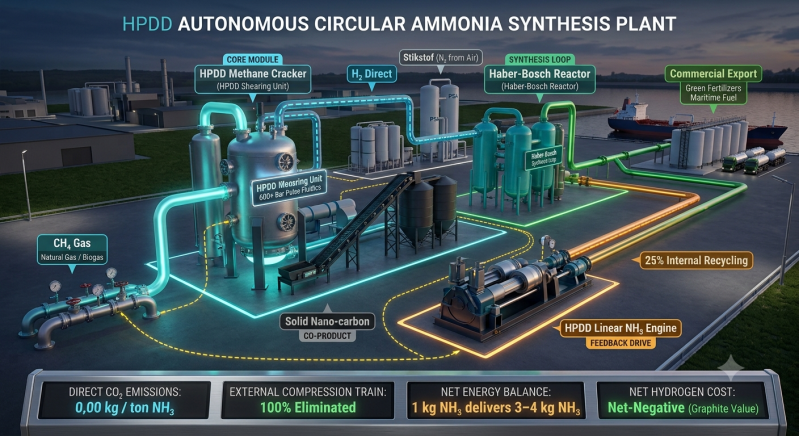
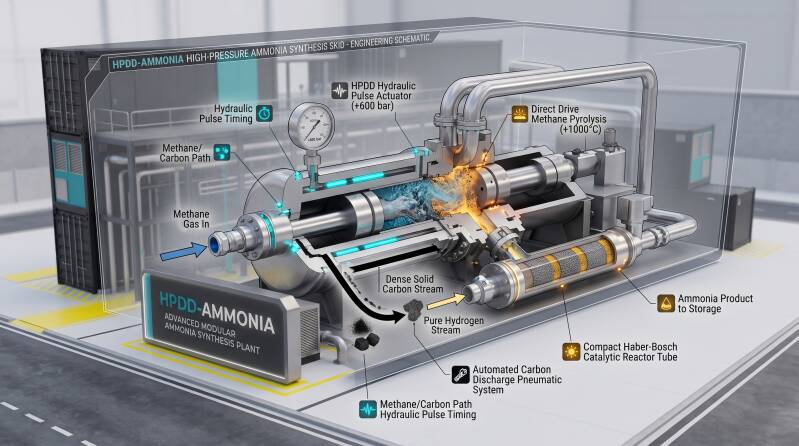
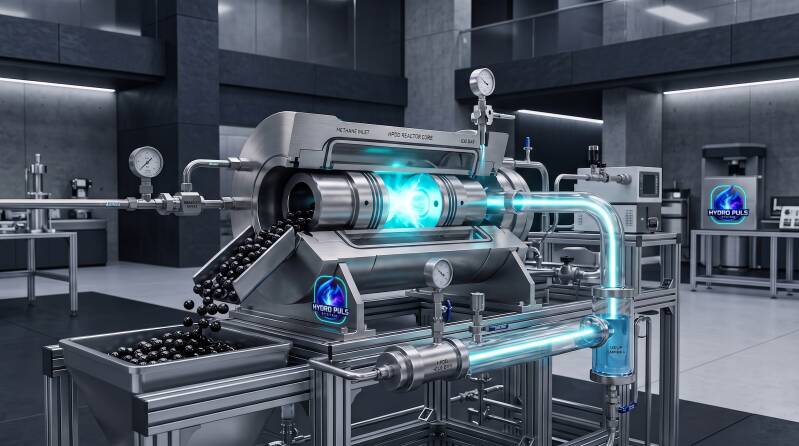
The Hydro Puls Direct-Drive (HPDD) architecture bypasses both pathways. By replacing thermal burner arrays with crankless, opposed-piston fluid dynamics at +600 bar, HPDD integrates methane pyrolysis, high-pressure syngas conditioning, and synthesis delivery into a modular, self-sustaining ISO skid.
Core Engineering Advantages
1. High-Value Turquoise Feedstock at Net-Negative Cost
Operating at pressures up to +600 bar, HPDD activates methane dissociation via rapid adiabatic pulse-compression and extreme localized shear zones without air or open combustion. Every ton of synthesized NH_3 generates roughly 0.53 tons of battery-grade solid carbon (carbon black, synthetic graphite, and nano-platelets). Monetizing this pristine solid carbon flips the hydrogen feedstock cost negative, fundamentally altering project levelized economics.
2. Direct Pressure Coupling (Zero Parasitic Compressor Trains)
Standard Haber-Bosch loops run between 150 and 250 bar, typically requiring multi-megawatt reciprocating or centrifugal compressor trains that consume substantial balance-of-plant energy. Because HPDD operates natively as a positive-displacement fluidic driver at +600 bar, syngas is pressurized directly during generation. This eliminates external multi-stage compressor skids, dynamic shaft seal degradation, and associated electrical parasitic loads.
3. Hermetic, 100% Oil-Free Gas Streams
Conventional reciprocating compressors rely on lubricant-wetted packings that release trace aerosol mists into the process stream, rapidly poisoning sensitive ruthenium and iron catalysts. The HPDD architecture isolates actuation circuits behind an unpressurized siloxane fluid barrier. The gas pathway remains fully hermetic and oil-free, extending catalyst bed lifespans and eliminating frequent re-bedding downtime.
4. Autonomous Multi-Utility Skid Architecture
By routing a fraction of the synthesized product stream into an integrated HPDD direct-expansion power core, the system autonomously covers its own mechanical actuation, cooling loops, and air-separation power loads. The installation operates independently of heavy electrical grid interconnections, transforming stranded or distributed natural gas sources directly into high-purity, transportable clean ammonia at the wellhead.
| Metric | Legacy SMR (Grey) | Water Electrolysis (Green) | HPDD Direct-Drive (Turquoise) |
|---|---|---|---|
| Direct CO₂ Footprint | 1.8 – 2.0 t CO₂ / t NH₃ | 0.0 t CO₂ / t NH₃ | 0.0 t CO₂ (Solid C byproduct) |
| Valuable Byproduct | None (Waste CO₂) | Oxygen (O₂) | ≈ 0.53 t Battery-Grade Carbon |
| Syngas Compression BoP | Multi-stage electric compressors | Multi-stage high-pressure compressors | Integrated Direct-Drive Fluidic Pulse |
| Catalyst Contamination Risk | Trace lube-oil carryover | Low | Zero (Hermetic siloxane barrier) |
| Grid Power Dependency | Low (Self-fueled thermal) | Extreme (9–10 MWh / t NH₃) | Autonomous (Self-powered skid) |
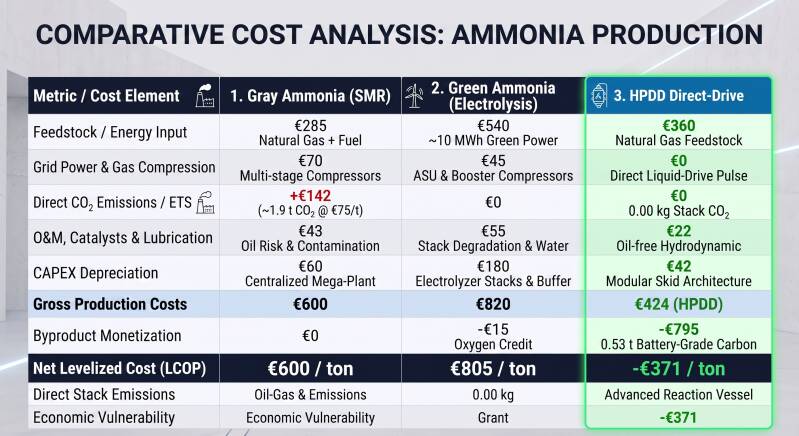
The Modular Path to Industrial Scaling
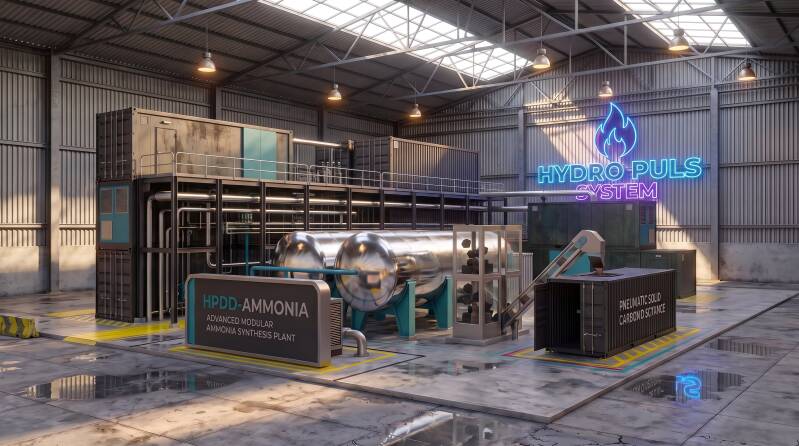
Rather than waiting on utility-scale renewable grid overhauls or costly pipeline infrastructure, HPDD enables chemical producers, port terminals, and agricultural co-ops to deploy localized, containerized synthesis capacity right where fuel or fertilizer is consumed.
Turn carbon liabilities into high-performance materials while producing zero-emission ammonia at a structurally negative production cost.