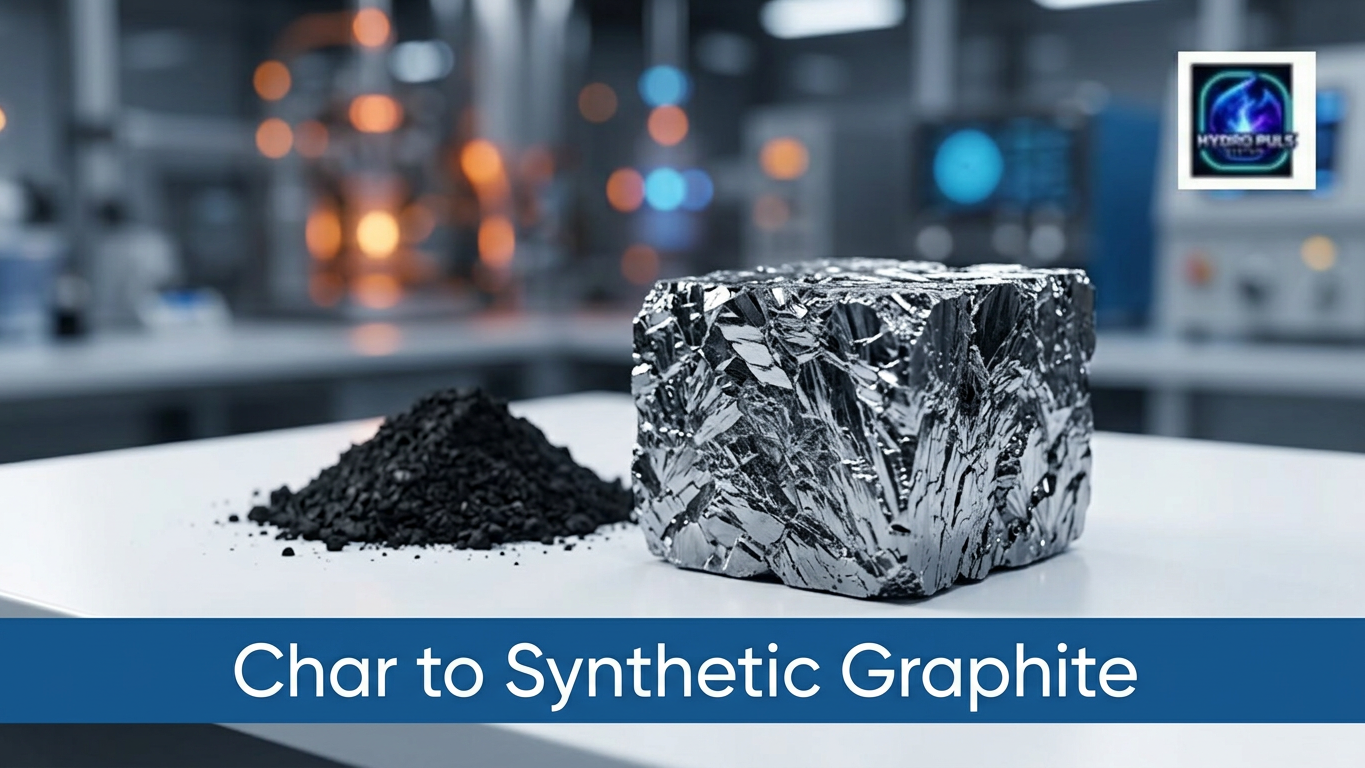
Pyrolisis to char to Graphite
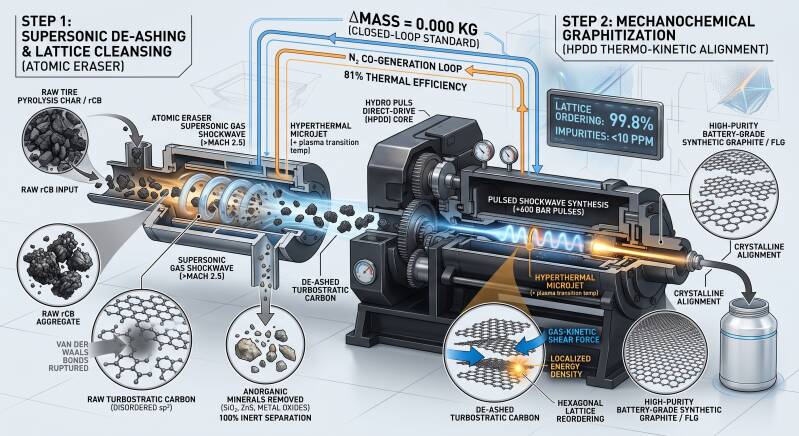
From Pyrolysis Char to Synthetic Graphite: How the Atomic Eraser & HPDD Bypass Traditional Acheson Furnaces ⚙️⚡️
Global demand for battery-grade synthetic graphite is skyrocketing, yet conventional graphitization remains an energy-intensive bottleneck, requiring static Acheson furnaces running at 2500°C to 3000°C for weeks.
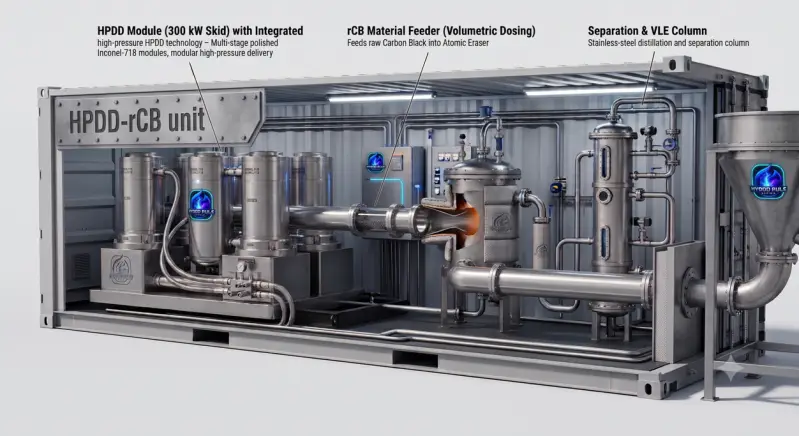
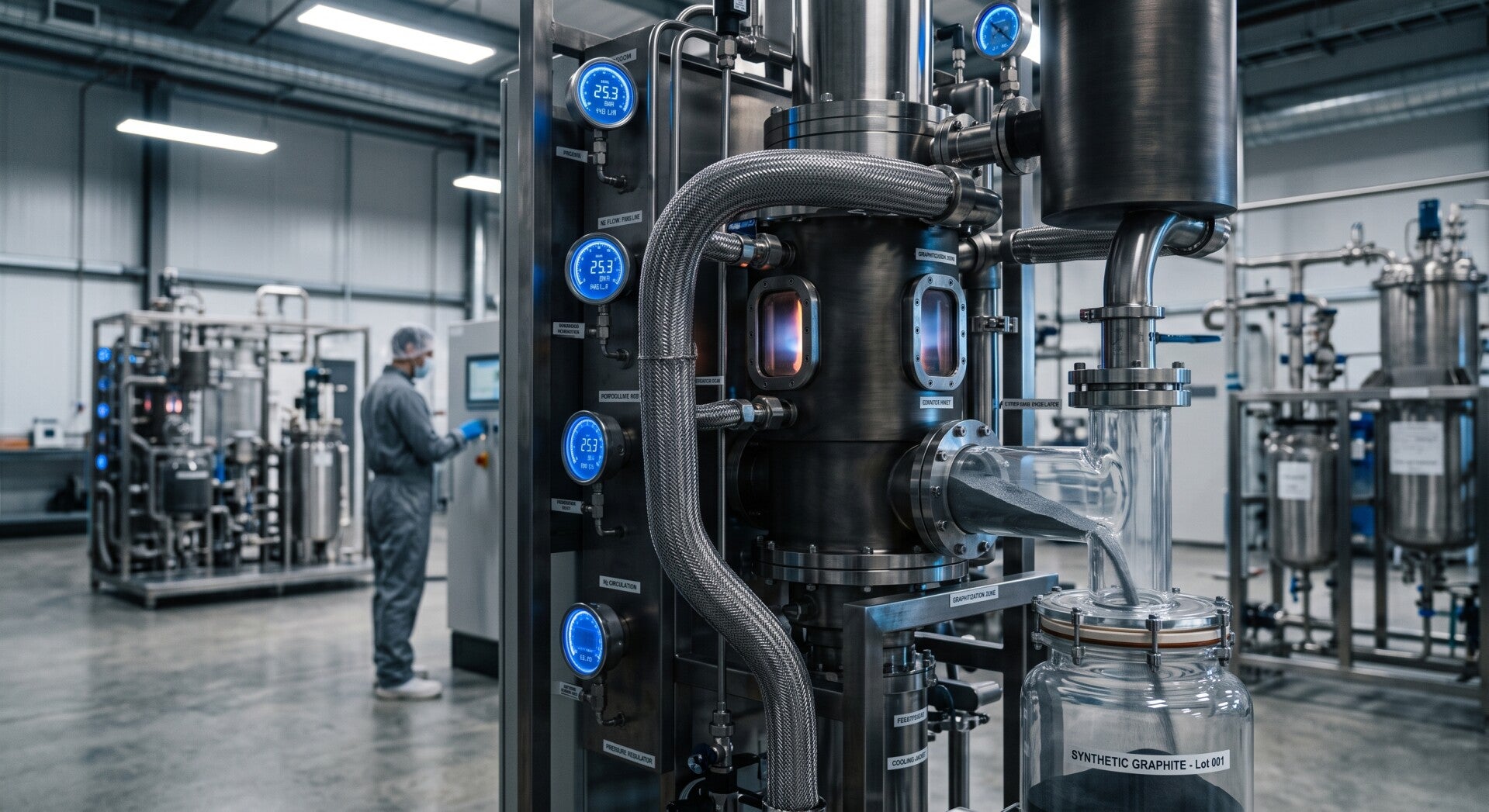
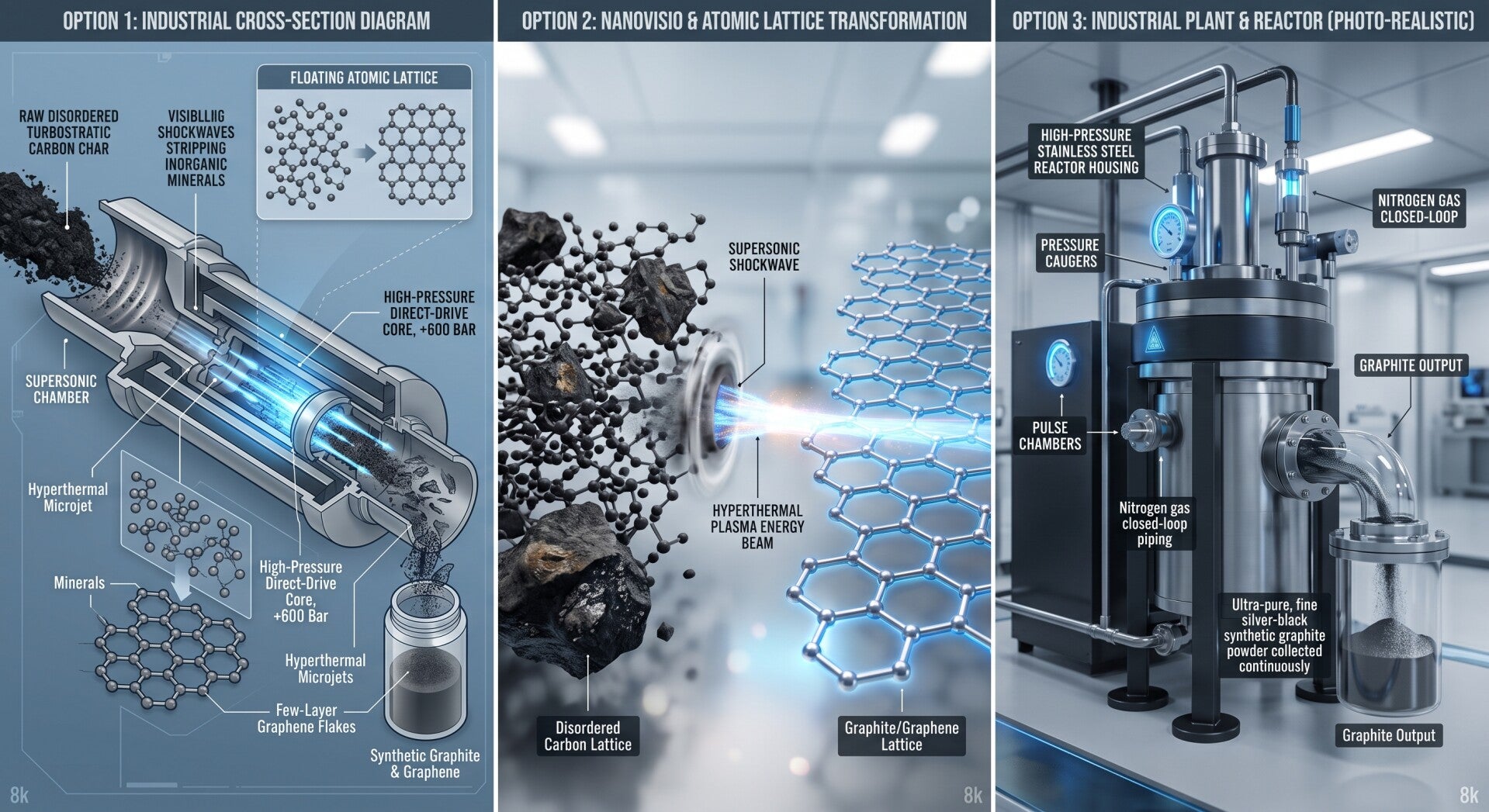
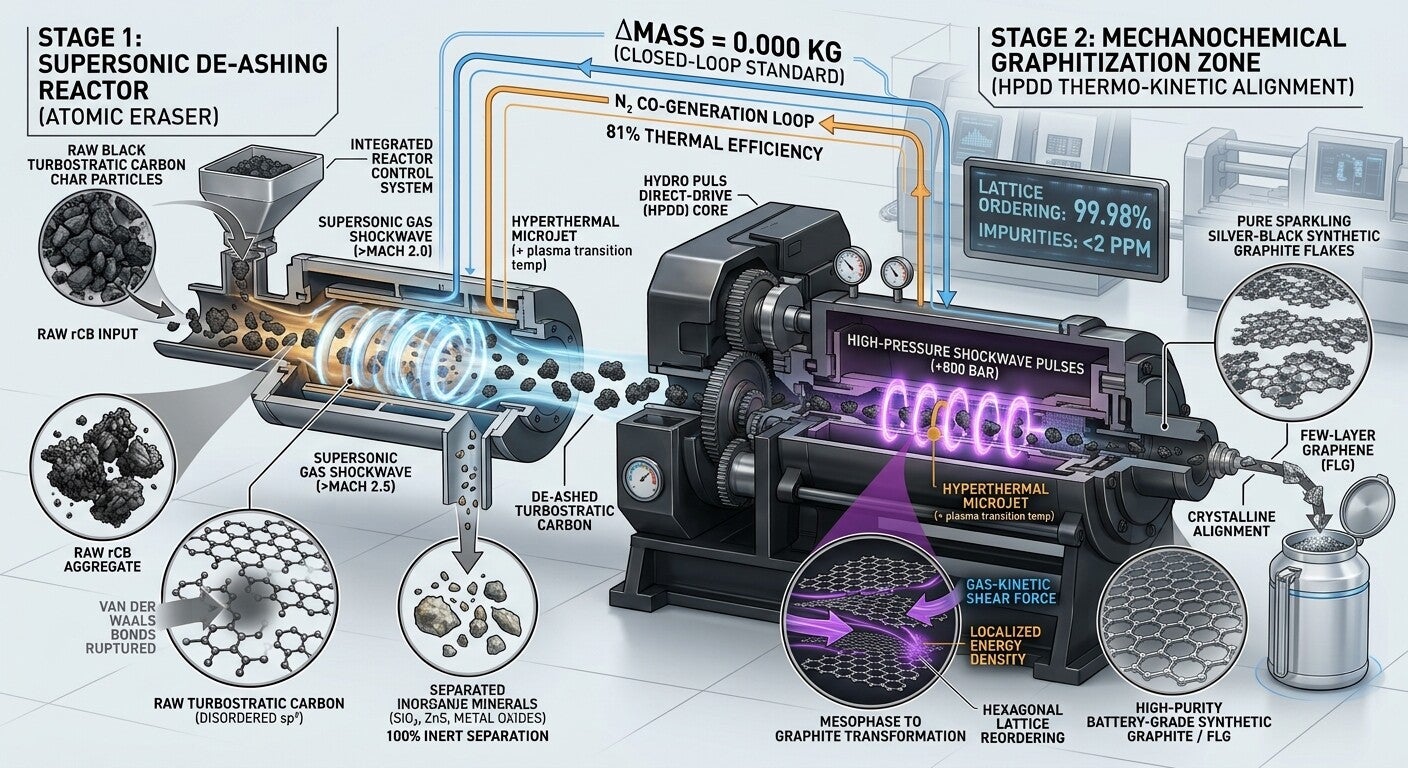
By coupling the Atomic Eraser with the Hydro Puls Direct-Drive (HPDD) thermodynamic core, we achieve direct physical de-ashing and mechanochemical lattice graphitization in a continuous, two-step closed loop.
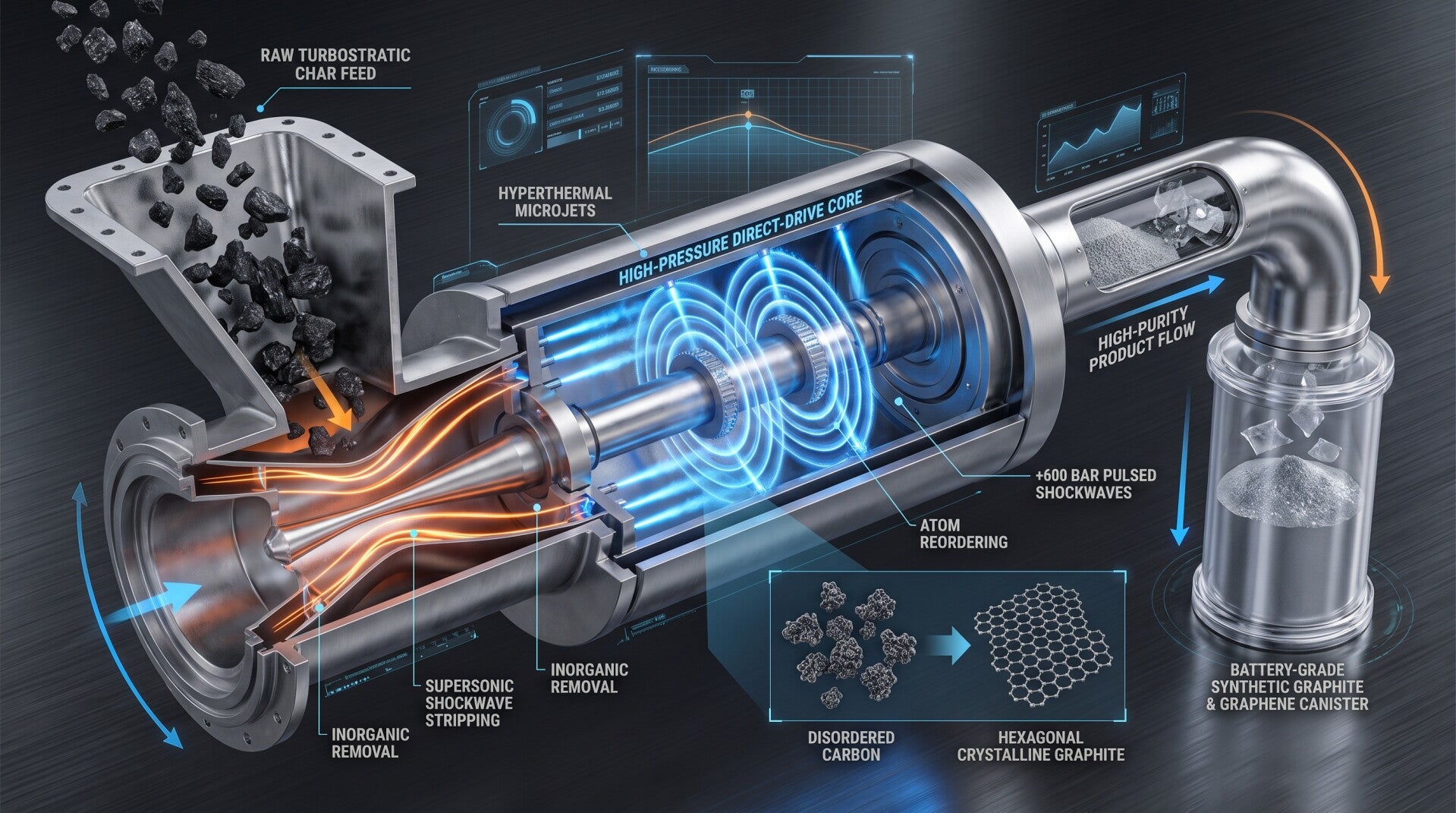
Step 1: Supersonic De-Ashing & Lattice Cleansing (Atomic Eraser)
• Kinetic Shock (>Mach 2.5): Supersonic gas shockwaves rupture the Van der Waals bonds holding raw recovered Carbon Black (rCB) and pyrolysis char aggregates together.
• Inert Mineral Stripping: Anorganic mineral inclusions (SiO2, ZnS, and metal oxides) are mechanically detached and separated under an absolute DeltaMass = 0 standard, eliminating chemical acid leaching and milling-media contamination.
Step 2: Mechanochemical Graphitization (HPDD Thermo-Kinetic Alignment)
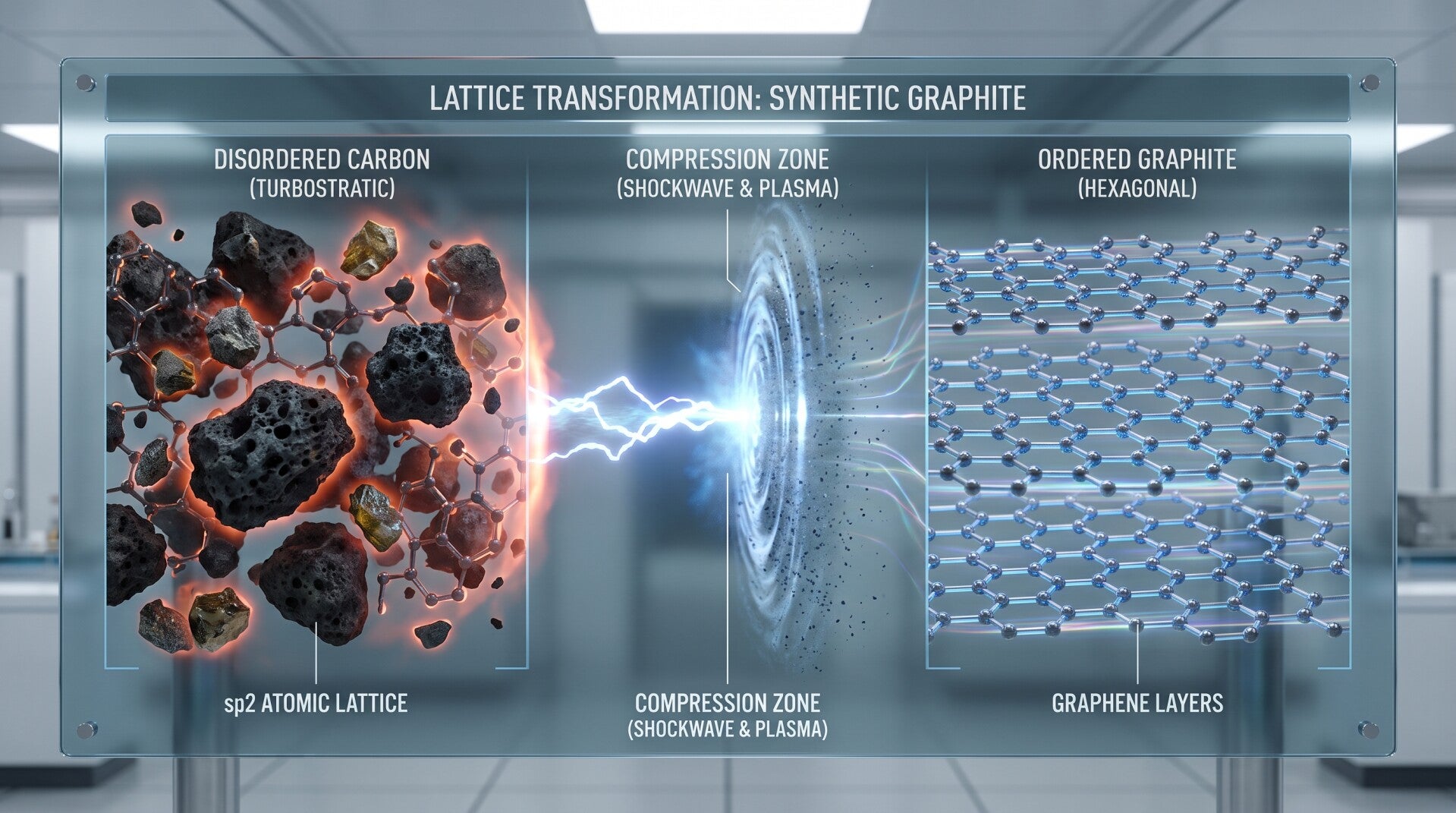
• Pulsed Shockwave Synthesis: Instead of relying solely on prolonged thermal soaking, the HPDD core subjects the cleaned, turbostratic (sp2) carbon layers to extreme pressure pulses (+600 bar) and hyperthermal microjets.
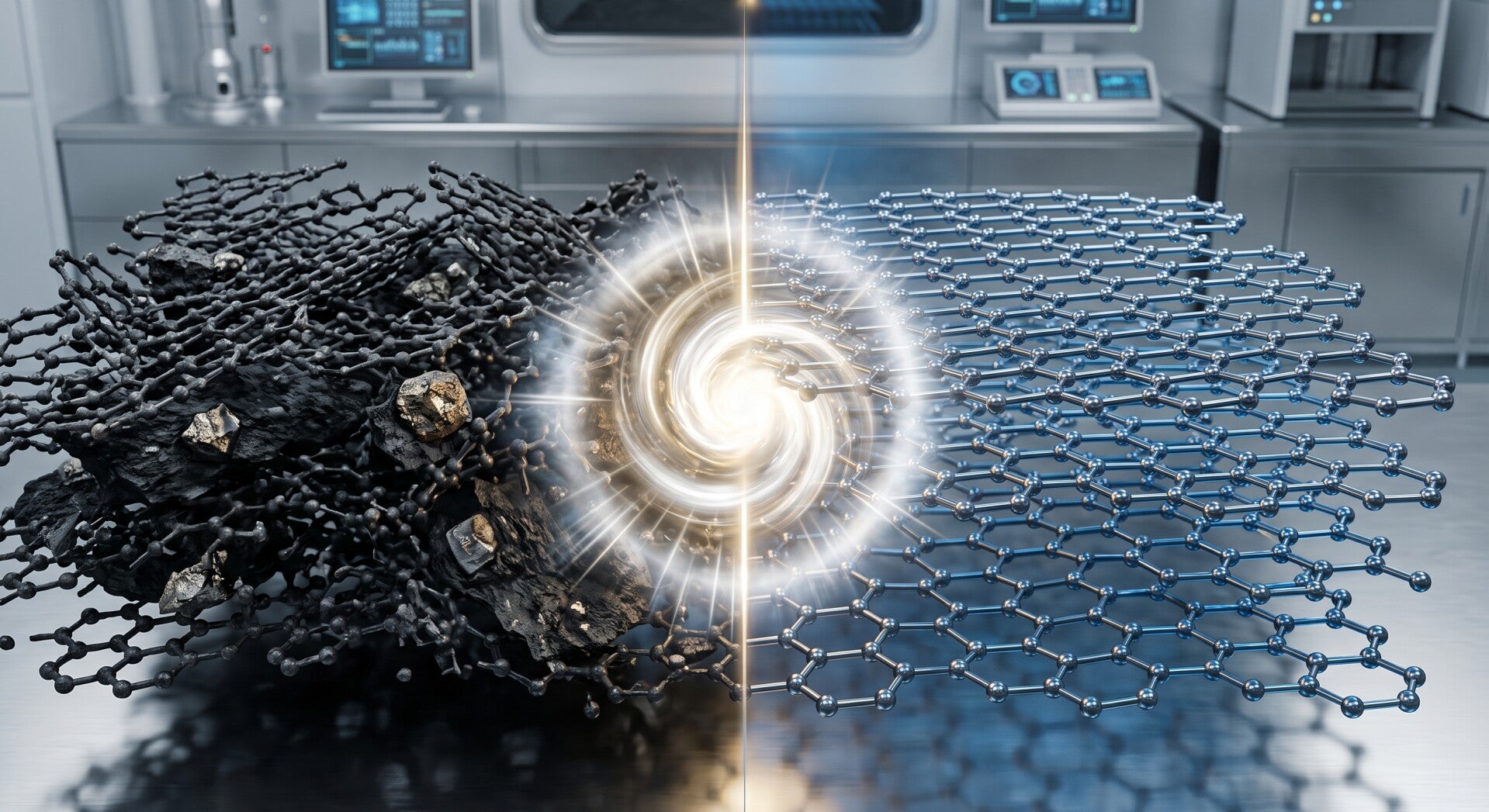
• Lattice Reordering: The combination of intense gas-kinetic shear and localized energy density forces disordered carbon sheets into a parallel, hexagonal crystalline matrix in microseconds.
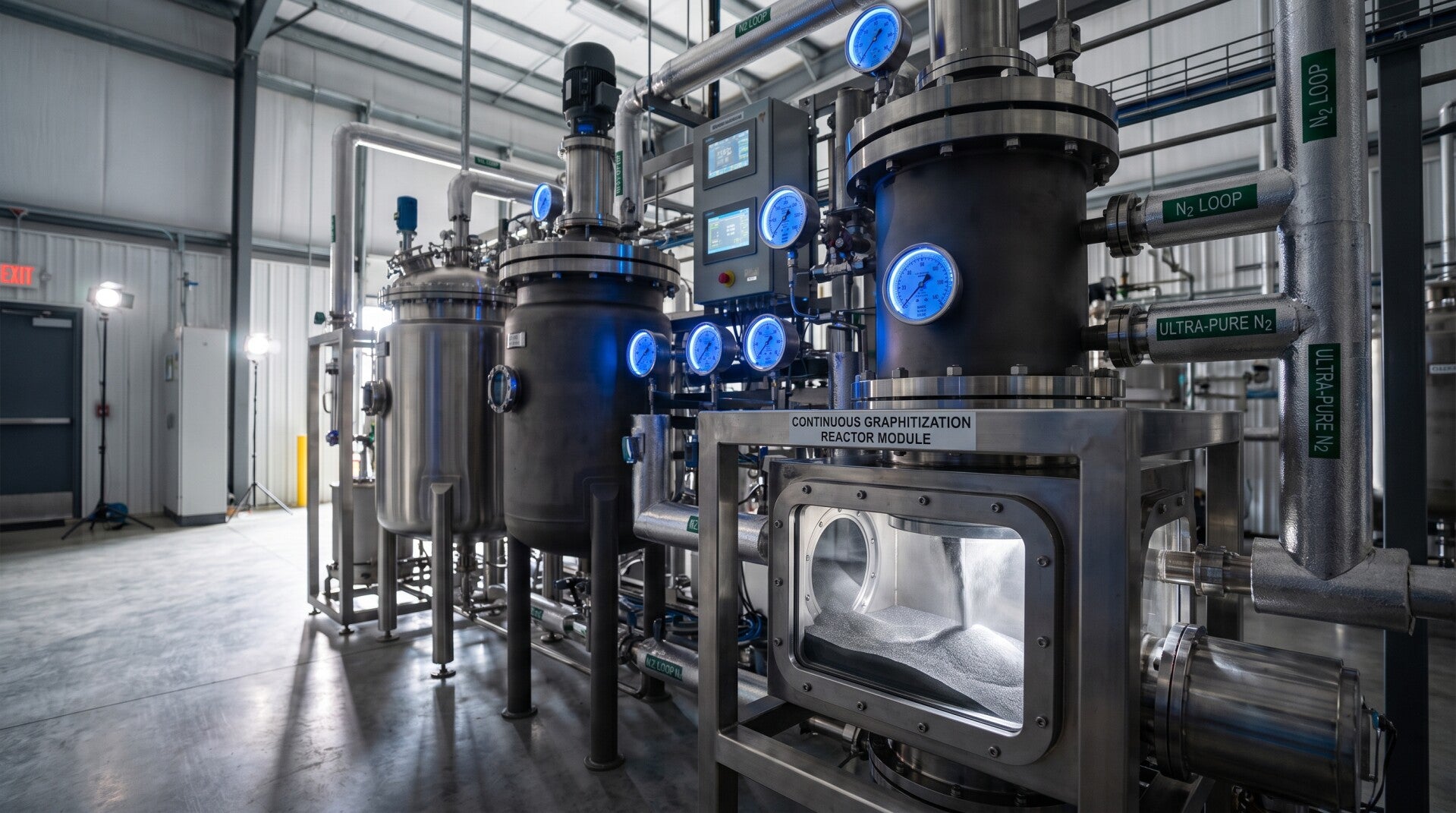
• Inert Process Backbone: Powered by the continuous co-generated nitrogen stream (N2) from the HPDD core, the process operates in a completely oxygen-depleted environment to prevent oxidation.
The Industrial Shift:
Instead of weeks of static heating, extreme thermodynamics transforms low-value tire pyrolysis char directly into high-purity, battery-grade synthetic graphite and few-layer carbon structures.
Zero chemical acids. Zero mechanical wear. Pure gas-kinetic physics.
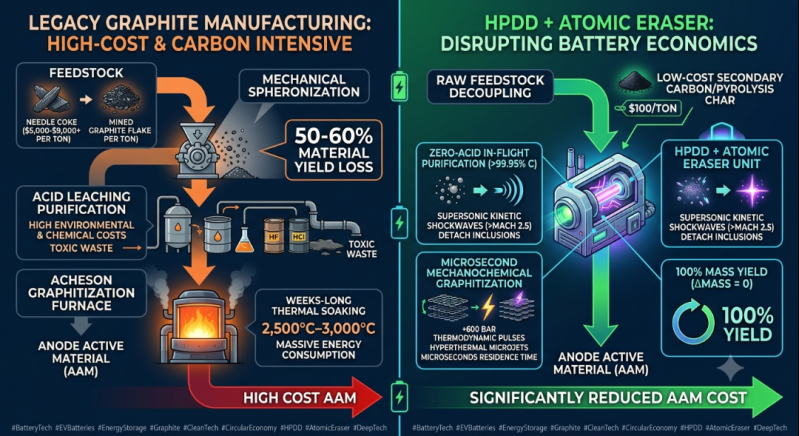
How HPDD & The Atomic Eraser Disrupt Battery Cell Manufacturing Economics 🔋⚡️
Graphite is by far the largest raw material component in an EV battery by weight (~50–70 kg per vehicle). Yet, battery-grade synthetic graphite has remained one of the most carbon-intensive and expensive bottlenecks in the battery supply chain, trading at $5,000 to $9,000+ per metric ton.
The cost isn't driven by the carbon itself, it is driven by archaic manufacturing physics:
1. Weeks-long thermal soaking at 2,500°C–3,000°C in Acheson graphitization furnaces.
2. 50–60% material yield loss during mechanical spheronization of natural graphite flakes.
3. Severe environmental and chemical costs associated with acid leaching (HF/HCl) to reach the required >99.95% purity.
The HPDD + Atomic Eraser train bypasses these constraints, reshaping the battery cost equation:
• Raw Feedstock Decoupling (Tire Char to Anode Precursors):
Instead of relying on premium needle coke or mined natural flake graphite, the unit takes low-cost secondary carbon/pyrolysis char ($100/ton) and transforms it directly into high-value turbostratic carbon and synthetic nano-graphite.
• Zero-Acid In-Flight Purification (>99.95% C):
Supersonic kinetic shockwaves (>Mach 2.5) detach mineral inclusions (SiO2, ZnS, iron oxides) mechanically in flight. Cell manufacturers obtain ultra-pure, sub-micron precursor feeds without toxic chemical leaching, water treatment burdens, or milling-media contamination.
• Microsecond Mechanochemical Graphitization:
By applying +600 bar thermodynamic pulses paired with hyperthermal microjets under an inert co-generated N2 atmosphere, the HPDD core reorders the sp2 carbon sheets in microseconds. This eliminates the massive energy footprint and weeks of furnace residence time typical of legacy graphitization.
• 100% Mass Yield (ΔMass = 0):
Unlike conventional mechanical shaping where over half the feedstock is ground into useless dust, the hermetically closed loop retains 100% of the active carbon mass.
The Manufacturing Impact:
By crushing precursor processing costs, slashing graphitization energy demands by orders of magnitude, and eliminating chemical purification lines, the HPDD-Atomic Eraser platform creates a viable pathway to substantially compress anode active material (AAM) costs, unlocking cheaper, localized, and truly circular battery cell production.
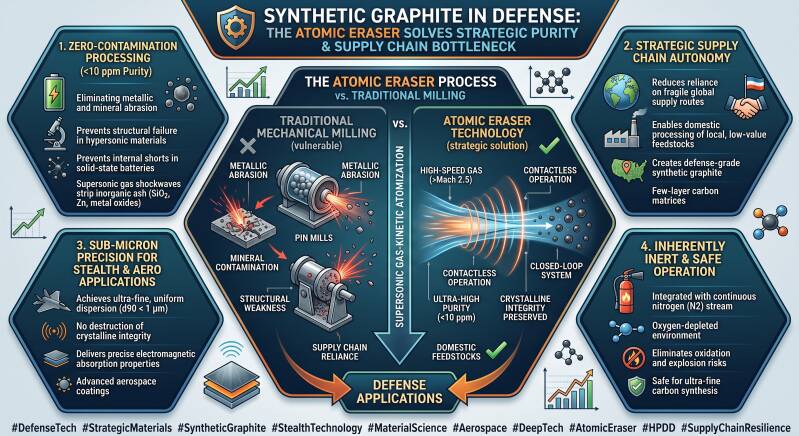
Synthetic Graphite in Defense: How the Atomic Eraser Solves the Strategic Purity & Supply Chain Bottleneck 🛡️⚙️
High-purity synthetic graphite is classified as a critical strategic defense material, essential for missile nozzle throats (+2,500°C resistance), radar-absorbent stealth coatings (RAM), and resilient energy storage for defense-grade solid-state batteries (ASSB).
Yet the defense sector faces two major vulnerabilities: concentrated foreign supply chains and product contamination caused by traditional mechanical milling.
The Atomic Eraser technology directly addresses these operational hurdles:
1. Zero-Contamination Processing (<10 ppm Purity)
Traditional ball and pin mills introduce metallic and mineral abrasions that cause structural failure in hypersonic materials and internal shorts in defense batteries. The Atomic Eraser operates 100% contactless via supersonic gas shockwaves (>Mach 2.5), stripping inorganic ash (SiO2, Zn, metal oxides) under an absolute DeltaMass = 0 closed-loop standard.
2. Strategic Supply Chain Autonomy
Instead of relying on fragile global supply routes, the Atomic Eraser enables domestic processing by directly upgrading local, low-value secondary carbon feedstocks into defense-grade synthetic graphite and few-layer carbon matrices.
3. Sub-Micron Precision for Stealth & Aero Applications
Supersonic kinetic shear achieves ultra-fine, uniform dispersion (d90 < 1 µm) without destroying crystalline integrity—delivering the precise electromagnetic absorption properties required for advanced aerospace coatings.
4. Inherently Inert & Safe Operation
Integrated directly with the continuous nitrogen (N2) stream from the HPDD core, the entire process runs in an oxygen-depleted environment, eliminating oxidation and explosion risks during ultra-fine carbon synthesis.
Decentralized, contactless, and chemically pure: gas-kinetic engineering for next-generation defense materials.
#DefenseTech #StrategicMaterials #SyntheticGraphite #StealthTechnology #MaterialScience #Aerospace #DeepTech #AtomicEraser #HPDD #SupplyChainResilience