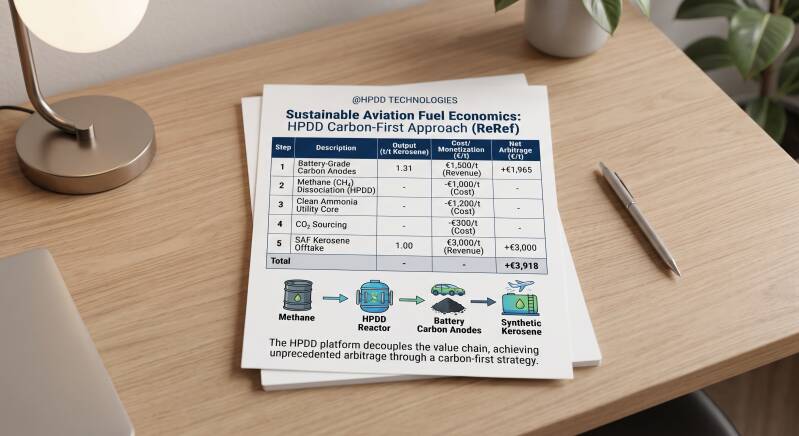
HPDD-SAF

Sustainable Aviation Fuel (SAF) Production via Hydro Puls Direct-Drive (HPDD)

1. Technical Architecture & Process Intensification

Conventional high-pressure triplex or diaphragm pumps introduce significant maintenance liabilities: mechanical crankshaft side-thrust causes uneven liner wear, dynamic wet-seals degrade rapidly under continuous shear, and lubricant migration risks deactivating expensive downstream catalyst beds.
The HPDD core is engineered around a non-crankshaft, direct linear drive platform optimized for process intensification:

  • Dual Opposed-Piston Balance (4-Piston Dynamic Balancing):
    The power head is built with two opposing pairs (4 pistons total). Working in direct opposition along a shared centerline, dynamic acceleration forces cancel out entirely. This eliminates radial side-loads on cylinder walls, radically attenuates mechanical vibration sent into plant pipe-racks, and provides smooth fluid-column pressurization far superior to angular crank drives.
  • Isothermal Micro-Gap Precision at 230°C:
    SAF hydrotreating and hydrocracking routinely settle at process boundaries around 230°C. Conventional pumping mechanisms suffer clearance drift from mismatched thermal expansion coefficients, causing either fluid slip or catastrophic piston binding. Both the cylinder bore and the pistons in the HPDD core are manufactured from high-grade Inconel. At the 230°C design standard, both components expand identically by 109 µm, maintaining an uncompromised 25 µm micro-gap. This continuous tolerance delivers high volumetric efficiency without dynamic contact friction or mechanical ring wear.
  • Unpressurized Siloxane Fluid Barrier:
    Cross-contamination between the hydraulic drive circuit and the biogenic feed/hydrogen stream is fully prevented using an inert siloxane barrier fluid. The siloxane buffer operates in an unpressurized state, eliminating hydraulic over-pressure on static and labyrinth seals. No hydrocarbon lubricating greases or engine oils enter the reaction path.
  • Kinetic Hydrogen Micro-Dispersal:
    Rather than relying on massive, high-pressure hydrogen recycle gas loops and static mixers, HPDD utilizes high-frequency hydraulic shock pulses to induce extreme fluid-shear across the 25 µm clearance. Hydrogen gas is cleaved into micron and sub-micron bubbles directly inside the biogenic oil or intermediate wax stream. This dramatic expansion in interfacial surface area accelerates reaction kinetics inside hydrotreater and hydro-isomerization reactors, eliminating diffusion limitations at lower overall excess hydrogen ratios.
  • Future Platform Growth (High-Frequency Direct Drive):
    The direct linear architecture scales beyond conventional mechanical stroke limits. The platform roadmap integrates continuous operations up to 100 Hz / 300 kW, allowing plants to adjust throughput velocity dynamically without changing skid geometry.

2. Technical Benchmark: HPDD vs. Legacy High-Pressure Pumping
TECHNICAL BENCHMARK: HPDD VS. CONVENTIONAL PUMPING Parameter API 674 Crank Pumps Multi-Stage Centrifugal HPDD Direct-Drive Skid Peak Fluid Pressure 150–300 bar (multi-stage) 100–200 bar (visc. drop) +600 bar direct single-stage pulse Operating Temp. Degrades >120°C (oil-cooled) Heavy external seal coolers 230°C continuous design standard Clearance Retention Dynamic ring/packing wear Recirculation slip at low flow 109 µm Inconel balance (5 µm gap) Dynamic Balancing Dampers & concrete pads High-speed gyroscopic loads Self-canceling (2 opposed pairs) Fluid Purity Lube oil / packing migration Barrier fluid leakage risk 100% oil-free (unpressurized siloxane) H₂ Dispersal Dynamic Macro-bubble slugging Requires static spargers Acoustic micro-bubble shearing Maintenance Interval 1,500 – 3,000 hrs (packing) 4,000 – 6,000 hrs (impellers) >8,000 hrs continuous base-load

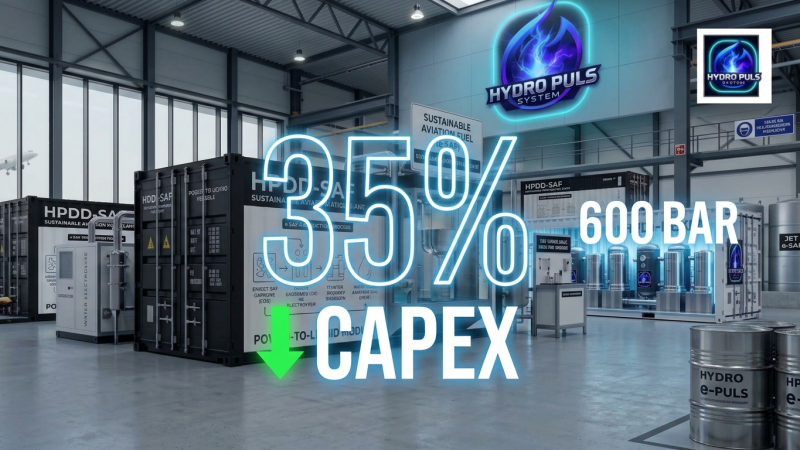
3. Financial Architecture & Unit Economics

In current SAF production, Capex is heavily inflated by the balance-of-plant (BOP) required for multi-stage gas compression, multi-story hydrogen recycle loops, and high-frequency turnaround schedules for pump packings.
FINANCIAL BREAKDOWN: SAF SYNTHESIS & PROCESS INTENSIFICATION Economic Parameter Traditional SAF Synthesis HPDD Direct-Drive Module High-Pressure BOP Capex Multi-stage compressor trains & recycle loops -25% to -35% reduction via single-stage pulse Catalyst Replacement Cost Frequent poisoning via coking & oil traces Zero lube contamination + uniform micro-mixing Parasitic Power Demand 10–18% gearbox & driveline friction losses >92% mechanical transfer efficiency Total Opex Impact / Ton SAF High maintenance baseline Substantial net savings per metric ton produced

4. Certification & Regulatory Roadmap

For any alternative aviation fuel to enter airport hydrants, it must achieve drop-in qualification under global aviation specifications. Integrating HPDD into the processing loop requires adherence to strict quality protocols:

AVIATION COMPLIANCE & CERTIFICATION ROADMAP Standard / Gateway Core Compliance Target HPDD Integration Enabler ASTM D7566 (Annexes) Distillation curve, freeze pt (<-40°C), flash High-conversion hydrocracking selectivity ASTM D4054 (Tiers 1–4) Trace contaminant limits (<0.1 ppm organics) 100% oil-free / unpressurized siloxane barrier ASTM D1655 Final blending with conventional Jet A-1 Drop-in verification for commercial distribution ISCC PLUS / RSB Life-cycle greenhouse gas abatement Drastic parasitic electrical power reduction
  • ASTM D7566 Compliance: SAF produced using the HPDD reactor front-end must meet the exact parameters of its corresponding Annex within ASTM D7566 (e.g., Annex A2 for HEFA, Annex A5 for Alcohol-to-Jet). The process yields paraffinic kerosene identical in distillation curve, freeze point (below -40°C/-47°C), and flash point to traditional standards.
  • Hydrocarbon Cleanness Verification (Zero Lubricant Trace): Critical to Tier 1 testing under ASTM D4054 is verifying that process intensifiers do not introduce unknown organic contaminants. The oil-free design ensures that total acid number (TAN), trace metals, and silicone/siloxane levels remain comfortably under analytical detection limits (<0.1 ppm).
  • Sustainability & Carbon Accounting (CORSIA / EU RED III): The process skid must be certified under recognized voluntary schemes (such as ISCC PLUS or RSB). The high thermodynamic efficiency and reduced electrical parasitic load of the direct-drive platform cut Scope 1 and Scope 2 processing emissions, improving the life-cycle analysis (LCA) score required for EU ReFuelEU Aviation mandates and US IRA 45Z clean fuel production credits.

5. Site Integration & Modular Footprint

Traditional hydroprocessing units are capital-intensive, multi-story field erections that cannot be integrated into constrained industrial footprints. HPDD shifts SAF production into containerized, skid-mounted refinery infrastructure.

 
  • Footprint Optimization: A complete 1 MW to 10 MW equivalent HPDD hydroprocessing skid fits within standard ISO container envelopes (20-foot or 40-foot skids). The lack of dynamic mechanical vibration eliminates the need for deep civil concrete pilings; the unit sits on standard reinforced industrial slabs.
  • Plug-and-Play Feed Headers: The unit features direct connections for biogenic oils (used cooking oil, tallow, pyrolysis oils) and hydrogen headers, interfacing with existing refinery utility lines via standard high-pressure flanges.
  • Distributed Regional Deployment: Instead of transporting raw, low-density biogenic feedstocks thousands of kilometers to centralized mega-refineries, modular HPDD skids can be sited directly at decentralized agricultural processing facilities, rendering plants, or regional biodiesel hubs.
  • Dynamic Production Scalability: The direct-drive system can ramp its throughput up and down instantaneously via programmable stroke adjustments, responding directly to available green hydrogen or fluctuating off-grid renewable power inputs without stalling or risking pressure collapse in the catalytic zone.
MODULAR NEXUS-SAF SKID FOOTPRINT (20-FT ISO CONTAINER) Autonomous Process Intensification Architecture • Direct-Drive Linear Integration 6.06 m (20.0 ft) 2.44 m (8.0 ft) 1. Process Headers Biogenic Feed Header HEFA / PtL / AtJ feed lines H2 Injection Manifold Direct supply port (+600 bar) Siloxane Reservoir 0-bar barrier fluid buffer 2. HPDD 600-Bar Power Core Inconel Core 230°C / 5 µm Micro-Gap 2 Pairs (4 Pistons) Dynamically Balanced 3. BOP & Controls Edge Guard PLC <5ms deterministic control Thermal Management Closed-loop 230°C stabilizer Power Distribution Direct drive driver module DIMENSIONS & ENVELOPE • Footprint: Standard 20-ft ISO Skid • Length × Width: 6,058 mm × 2,438 mm • Height: 2,591 mm (Standard Cube) CIVIL & SITE REQUIREMENTS • Foundation: Standard industrial slab (flat) • Anti-vibration: Zero pilings (4-piston balance) • Net Skid Weight: ~11,500 kg fully dressed UTILITY CONNECTIONS • Process Interface: Flanged high-P headers • Thermal Loop: Integrated internal glycol/oil • Electrical: Direct 400V/480V 3-phase grid hookup

Breaking the Cost Barrier of e-SAF

Breaking the Cost Barrier of e-SAF: How HPDD Architecture Revolutionizes Synthetic Fuel Production

By prioritizing process simplification and ultra-high-pressure direct synthesis, Hydro Puls Direct-Drive (HPDD) technology offers a disruptive path to making Sustainable Aviation Fuel (SAF) economically viable while enhancing its environmental benefits.

The aviation industry faces an existential challenge: achieving net-zero emissions by 2050. While battery electric and hydrogen propulsion hold promise for short-haul flights, sustainable aviation fuel (SAF), and specifically synthetic kerosine (e-SAF), is the only viable solution for long-haul aviation, which accounts for the vast majority of the sector's emissions.

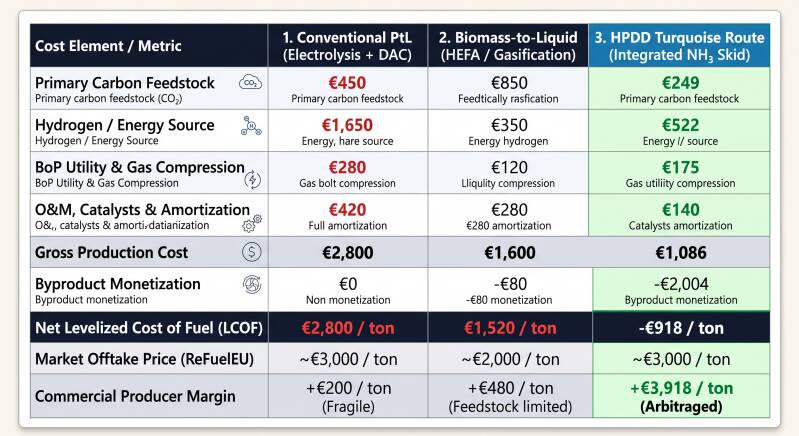
However, the widespread adoption of e-SAF, produced from green hydrogen and captured CO2 via the Power-to-Liquid (PtL) pathway, is currently bottlenecked by exceptionally high production costs. Traditional PtL processes are complex, energy-intensive, and capital-heavy.

Enter Hydro Puls Direct-Drive (HPDD) architecture. This innovative process design directly targets the core cost drivers of e-SAF production, promising a drastic reduction in Levelized Cost of Fuel (LCOF) by reimagining the compression and synthesis steps.

The Problem with Conventional Compression

The standard PtL process involves producing synthesis gas (syngas, a mix of H2 and CO) and then converting it into hydrocarbons via Fischer-Tropsch (FT) synthesis. This FT synthesis typically requires pressures between 20 and 40 bar.

To achieve these pressures, conventional plants rely on massive, meertraps gasturbocompressors. These machines are problematic for several reasons:

  • High Capital Expenditure (CAPEX): Large-scale compressors are incredibly expensive to purchase and install.

  • Significant Energy Consumption: Compressing gases is highly inefficient, consuming a large portion of the plant's total energy input.

  • Operating Complexity and Maintenance: Reciprocating or centrifugal compressors have many moving parts, making them prone to wear, requiring frequent maintenance, and reducing overall plant availability.

HPDD: Eliminating the Compressor via Direct Synthesis

The defining innovation of the HPDD architecture is its radical approach to compression: it eliminates the need for meertraps gasturbocompressors entirely.

Instead of compressing the syngas before synthesis, HPDD leverages an integrated process where the synthesis reactions are initiated at extraordinarily high pressures, often exceeding 600 bar. At these conditions, the reactants and intermediate products exist as superkritische vloeistoffen.

How HPDD works without a traditional compressor:

  1. Hydrolus Hydrogen Production: Green hydrogen is produced via electrolysis (e.g., PEM or AEM) already at an elevated pressure (e.g., 30-50 bar).

  2. High pressure CO2 Intro: Captured CO2 is also compressed, often utilizing liquid CO2 pumping, which is significantly more efficient than gas compression.

  3. Hydro Puls Direct-Drive Reactor: This is the heart of the system. The pressurized H2 and CO2 (or directly syngas) are fed into a specialized reactor. The "Hydro Puls" effect is a proprietary dynamic flow and reaction management system that drives the reactants into the ultra-high-pressure regime (+600 bar).

  4. Direct Synthesis: In this superkritische vloeistof phase, the conversion of syngas to hydrocarbons occurs rapidly and with high selectivity. The extreme pressure drives the reaction equilibrium forward, often eliminating the need for internal recycling loops common in low-pressure FT processes.

By eliminating the massive compressor trains, HPDD instantly slashes plant CAPEX and dramatically reduces parasitic energy losses, leading to a substantial improvement in overall process efficiency (Well-to-Wake energy efficiency).


Isobare Water recovery: Maximizing Thermal and Process Efficiency

The Fischer-Tropsch reaction produces a significant amount of water as a byproduct:

CO + 2H_2 \ (-CH_2-) + H_2O

In conventional low-pressure systems, managing this water requires depressurizing the product stream, condensing the water, separating it, and then often re-compressing the tail gas. Each pressure change incurs energy losses.

HPDD turns this challenge into an opportunity through isobare water recovery (isobaric water recovery). Because the synthesis occurs at such high pressures (+600 bar), the HPDD system can separate the water byproduct from the hydrocarbon products while maintaining the superkritische conditions.

Advantages of Isobare Waterterugwinning:

  • Energy Conservation: By avoiding the cycle of depressurization and re-pressurization, the system conserves the substantial energy invested in bringing the reactants to pressure.

  • Thermal Integration: The separation can be performed at high temperatures. The latent heat of vaporization from the produced water can be recovered and used to preheat incoming feedstreams or generate steam for other parts of the PtL process (like carbon capture).

  • Reactor Optimization: Continuously removing water pushes the FT equilibrium further towards hydrocarbon production, improving single-pass conversion rates.

Delivering High-Quality Synthetic Paraffinic Kerosine (SPK)

The ultimate goal is producing fuel that is not only sustainable but also high-performing. The HPDD process is inherently biased towards producing high-purity zuivere, aromaatvrije paraffinische kerosine (SPK).

The extreme pressure conditions in the HPDD reactor favour the formation of linear, saturated hydrocarbons (paraffins) with very few side reactions. This selectivity results in a fuel that is exceptionally clean.

The Impact on Contrails.

The environmental benefits of e-SAF produced via HPDD extend beyond carbon reduction. This is where the aromatic-free nature of the SPK becomes crucial.

While CO2 emissions get the most attention, non-CO2 effects, specifically contrails, are estimated to account for a significant portion (perhaps more than half) of aviation's total climate impact.

The link between aromatics and contrails:

  1. Aromatics in fuel: Traditional fossil kerosine contains significant levels of aromatics (up to 25%).

  2. Soot: During combustion, aromatics are the primary precursors to the formation of non-volatile particulate matter (nvPM), commonly known as soot.

  3. Contrail core: Soot particles act as condensation nuclei in the cold, humid upper atmosphere. Water vapor condenses and freezes around these particles, forming contrails.

  4. Persistent Contrails: Under certain atmospheric conditions, these contrails persist and spread, forming ice-crystal clouds (contrail-cirrus) that trap outgoing longwave radiation, exerting a significant warming effect.

Because HPDD-produced e-SAF (SPK) is aromaatvrij, its combustion produces drastically fewer soot particles. Studies have shown that using pure SPK can reduce initial ice crystal numbers in contrails by 50-70% or more. This significantly reduces the optical depth of the contrails and the formation of persistent contrail-cirrus clouds, offering a potent leverage point for immediate climate mitigation.

The Commercial Case for HPDD e-SAF

The integration of these features, compressor elimination, high-efficiency superkritische synthesis, isobare waterterugwinning, and the production of a high-purity, low-contrail fuel, creates a compelling commercial case for HPDD technology:

  • Lower CAPEX: Drastic reduction in initial capital investment due to the elimination of expensive compression hardware.

  • Reduced OPEX: Lower energy consumption leads to significantly reduced operational costs.

  • Faster Project Development: Modular, compressor-less designs simplify engineering and speed up deployment.

  • Premium Product: The resulting aromatic-free SPK is a premium fuel that can be blended with conventional jet fuel at higher ratios (eventually up to 100%) and offers measurable, monetizable non-CO2 climate benefits.

Conclusion

The transition to e-SAF is critical for aviation, but the current economic models are challenging. The Hydro Puls Direct-Drive (HPDD) architecture offers a paradigm shift. By moving away from energy-intensive, asset-heavy gas compression and embracing direct synthesis at superkritische conditions, HPDD provides a technology pathway to drastically lower e-SAF production costs. Simultaneously, by producing aromatic-free SPK that minimizes contrail-vorming, it delivers a superior environmental solution, accelerating the journey toward a truly sustainable aviation sector.