

HPDD POSEIDON-S
This application is in collaboration with Engineer Olexandr Borodin
His knowledge and experience in these fields has led to this discovery and application.
HPDD POSEIDON-S
Next-Generation Supercritical CO2 (sCO2) Direct-Drive Power Conversion
The HPDD POSEIDON-S is the dedicated supercritical carbon dioxide (sCO2) power-conversion variant of the modular HPDD-NEXUS platform. Where conventional thermal power stations and naval propulsion systems rely on massive, high-inertia steam or gas turbines using Rankine or Brayton cycles, the POSEIDON-S converts supercritical CO2 directly into mechanical and hydraulic power. It achieves this through an oil-free, high-frequency linear direct-drive core.
By pairing the high density and heat-transport characteristics of sCO2 with direct linear fluid dynamics, the POSEIDON-S delivers exceptional power density. This makes it particularly effective for naval architecture, Small Modular Reactors (SMRs), and industrial waste heat recovery.
Working Principle and Thermodynamic Fundamentals
The thermodynamic benefit of supercritical CO2 comes from operating near its critical point of roughly 31 degrees Celsius and 74 bar. Under these conditions, the fluid density approaches that of a liquid, while its transport properties retain the diffusivity of a gas.
Because the fluid is dense, the mechanical energy required to compress and circulate the sCO2 drops by up to 65 to 70 percent compared to compressing gaseous helium or nitrogen in conventional Brayton cycles. This drastic reduction in parasitic compression work is the main driver behind the system's net electrical and mechanical conversion efficiencies, which reach between 45 and over 50 percent.
The mechanical core functions through three key design principles:
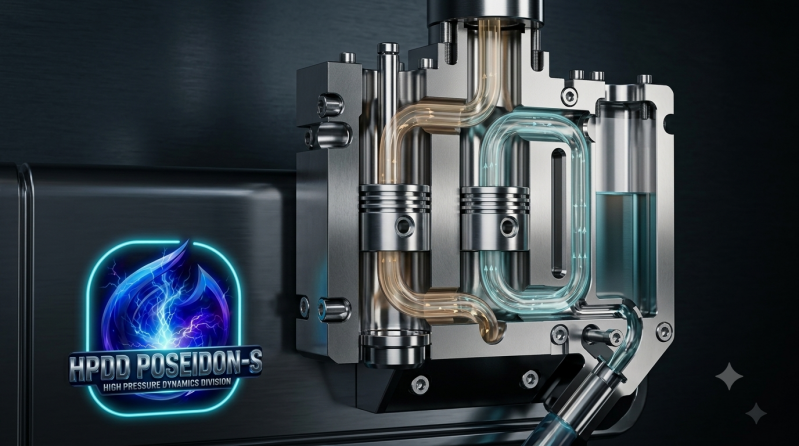
- Dual Opposed-Piston Dynamic Balance: The drive uses two opposed piston pairs (four pistons in total) moving along a shared linear axis. The expansion thrust of the hot supercritical fluid drives the Inconel pistons directly into fluid displacement. Because the opposing pistons move with equal mass and opposite acceleration, inertial forces cancel out entirely. This eliminates radial side-loads on cylinder walls, removes mechanical tilting moments, and prevents low-frequency vibrations from transmitting into the ship frame or skid structure.
- Isothermal Micro-Gap Seal Retention at High Temperature: Both the cylinder bore and the reciprocating pistons are manufactured from matched high-grade Inconel alloys. Under high thermal operating states up to 230 to 500 degrees Celsius, both components expand at the exact same rate. This thermal alignment keeps the critical 5-micron micro-gap constant across all operating loads, preventing gas blow-by without requiring piston rings or risking contact friction.
- Oil-Free Operation with an Unpressurized Siloxane Barrier: An inert, unpressurized siloxane buffer completely isolates the sCO2 process loop from the hydraulic drive circuit. No hydrocarbon lubrication ever enters the supercritical stream, which prevents chemical coking, fluid breakdown, and fouling on heat exchanger surfaces.
Key Engineering Advantages
- High Cycle Efficiency (45% to >50%): Combining minimal compression power with elevated heat absorption temperatures gives POSEIDON-S a net conversion efficiency that is 10 to 15 percentage points higher than standard medium-scale steam turbines.
- Substantial Footprint and Weight Reductions: Due to the dense working medium, component volumes, manifolds, and compact printed circuit heat exchangers are up to 80 percent smaller than equivalent steam equipment and condensers.
- Rapid Dynamic Response: Without the heavy rotational inertia of multi-ton turbine rotors, the linear direct-drive adjusts stroke length and pulse frequency in sub-5-millisecond control loops. This allows rapid load cycling without causing the thermal fatigue that damages spinning turbine blades.
- Acoustic Stealth and Low Vibration: Dynamic mass balancing eliminates low-frequency hull vibrations, providing a critical operational advantage for naval vessels where acoustic discretion is paramount.
Target Applications and Deployment
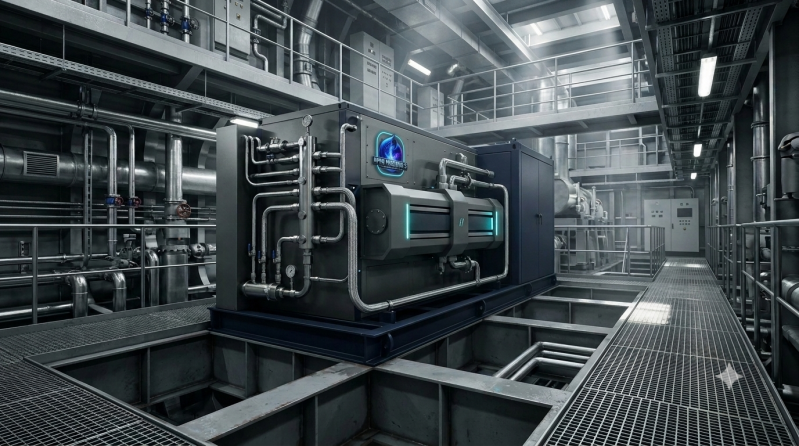
1. Naval Architecture and Commercial Maritime Propulsion In commercial shipping and naval vessels, machinery space directly reduces cargo payload, fuel bunker volume, or battery storage capacity:
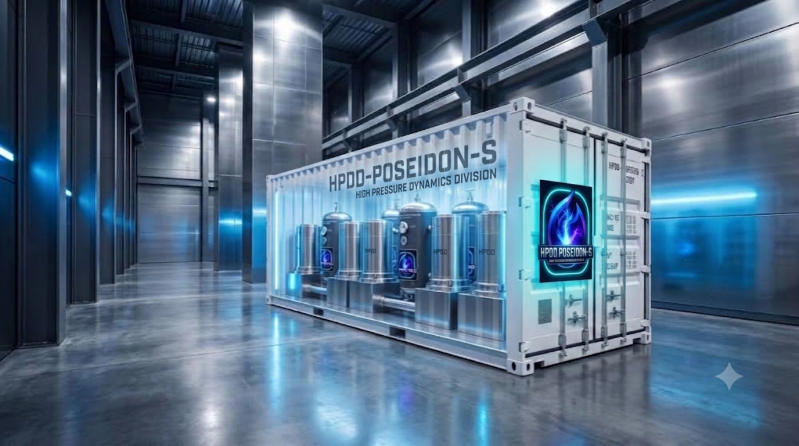
- Cargo Space Recovery: POSEIDON-S replaces bulky two-stroke marine engines or multi-deck steam turbines with a containerized skid that reduces engine room volume by up to 60 percent, freeing that space for revenue-generating cargo.
- Simplified Structural Integration: The absence of structural vibration eliminates the need for reinforced, deep-set engine bedplates, lowering overall hull construction costs and reducing vessel weight.
- Thermal Source Agnostic: The closed sCO2 loop interfaces with any primary heat source, including high-temperature solid oxide fuel cells (SOFC), clean hydrogen or ammonia combustion, or thermal storage systems.
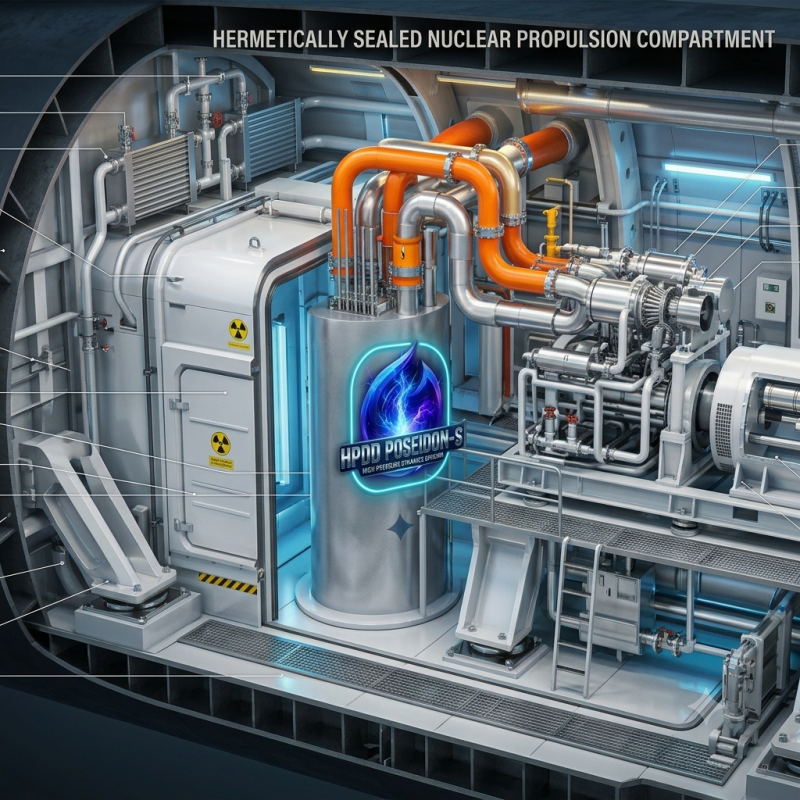
2. Integration with Small Modular Reactors (SMRs) Advanced fourth-generation SMRs (such as High-Temperature Gas-Cooled and Molten Salt designs) operate efficiently within a 300 to 550 degree Celsius window:
- Steam Elimination: The system removes water-steam circuits entirely, taking away steam-explosion hazards and water-induced stress corrosion around reactor cores.
- Direct Closed-Loop Conversion: The modular skid couples directly to SMR heat exchangers, matching reactor outputs from 10 to 100 megawatts electric in a compact, self-contained package.
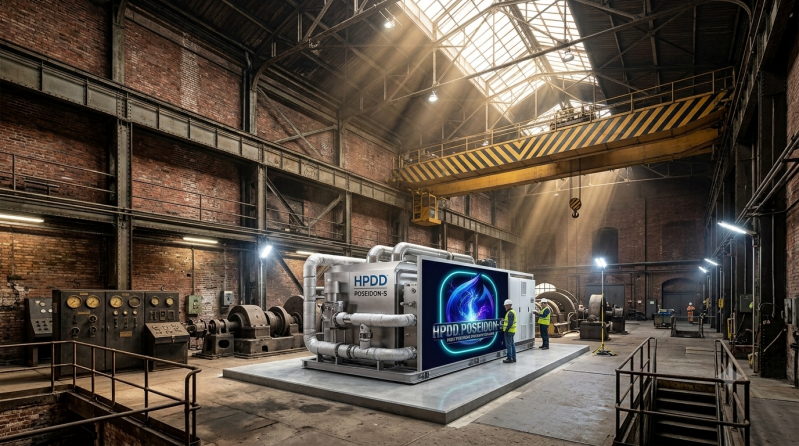
- 3. Industrial Waste Heat Recovery and Thermal Plants
- Connects directly to high-temperature exhaust streams from steel mills, cement kilns, and biomass installations.
- Makes decentralized power generation profitable at capacities where conventional steam turbines are too bulky and expensive to justify.
Financial Architecture and Economic Comparison
Compared to traditional steam and gas turbine systems, the POSEIDON-S provides clear economic improvements:
- Capital Expenditure (CAPEX): Overall system CAPEX is 25 to 40 percent lower thanks to modular skid manufacturing, compact heat exchangers, and the removal of massive concrete foundations.
- Operational Expenditure (OPEX): Maintenance costs drop significantly because the system eliminates high-speed rotational bearings, turbine blade erosion, and lubricant filtration loops.
- Maritime Value Creation: Reducing machinery space by up to 60 percent translates directly into higher container capacity (TEU) or expanded passenger accommodations.
- Fuel and Energy Savings: Net conversion efficiencies of 45 to over 50 percent cut fuel and thermal input requirements by a considerable margin compared to standard 30 to 38 percent steam baselines.
Technical Specifications Summary
- Working Medium: Supercritical Carbon Dioxide (sCO2)
- Continuous Pressure Rating: 150 to 600+ bar
- Operating Temperature Range: 200 to 500+ degrees Celsius
- Drive Geometry: 4-piston opposed direct-drive (2 balanced pairs in Inconel)
- Lubrication: 100% oil-free with an unpressurized siloxane barrier
- Clearance Tolerance: Synchronous thermal expansion maintaining a 5-micron dynamic micro-gap
- Control Architecture: Hard-deterministic edge PLC with sub-5ms cycle times
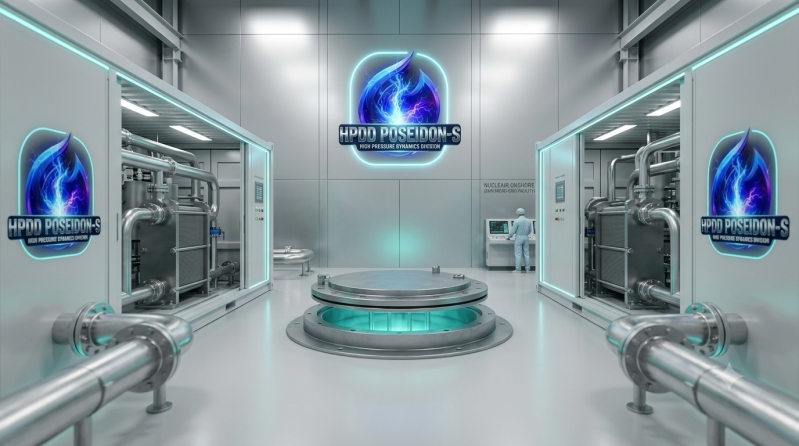
- Packaging: Modular 20-foot and 40-foot ISO containerized skids
Evaluate Your Facility for HPDD Integration Connect with our engineering team to map your plant's mass-energy balance and transition your infrastructure into the clean energy bonanza.