Industrial Salt Valorization: Transforming Landfill-Bound Mixed Salts into High-Grade SOP Fertilizer
This process was developed in collaboration with Chemical Engineer Srivathsan R.
Industrial processes frequently generate massive volumes of mixed, hazardous saline solid waste - predominantly co-mingled Sodium Chloride (NaCl) and Sodium Sulfate (Na2SO4). Due to low pure-commodity prices and high separation costs, hundreds of thousands of tons are discarded into landfills, creating persistent environmental liabilities and regulatory exposure.
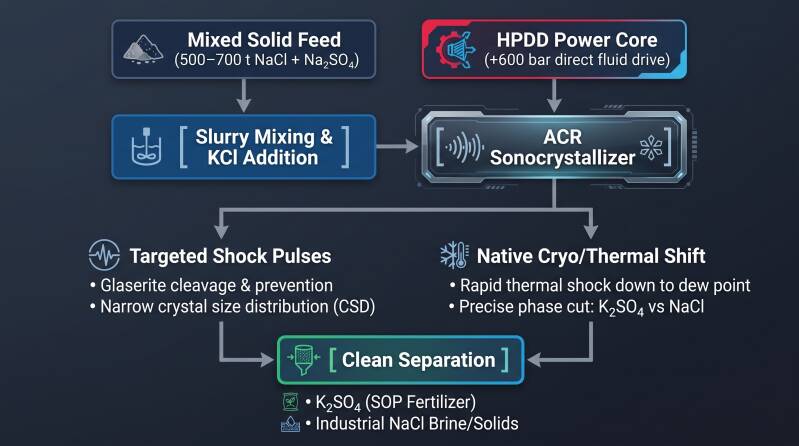
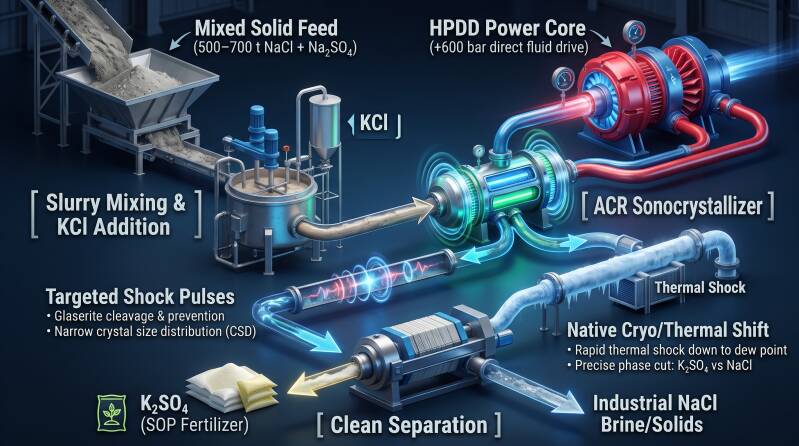
By pairing stoichiometric Potassium Chloride (KCl) addition with the Hydro Puls Direct-Drive (HPDD) and Acoustic Cavitation Reactor (ACR) platform, industrial sites can transform low-value mixed waste salts into two separated, high-demand commercial streams: premium Potassium Sulfate (K2SO4 / SOP) and refined industrial NaCl.
The Chemical Baseline: Quaternary Reciprocal Salt Separation
The conversion route relies on the quaternary reciprocal salt system:
2 KCl + Na2SO4 -> K2SO4 + 2 NaCl
Selective separation succeeds due to stark differences in temperature-dependent solubility:
- Potassium Sulfate (K2SO4): Demonstrates significantly lower solubility than NaCl, KCl, and Na2SO4 across standard processing temperatures, allowing it to precipitate first.
- Sodium Chloride (NaCl): Features an almost flat solubility gradient between 0°C and 100°C, remaining soluble while sulfate species crystallize.
- Commercial Upside: Substituting the energy-intensive, hydrochloric acid-producing Mannheim process with a direct aqueous conversion yields chloride-free SOP fertilizer - commanding a consistent price premium on global agricultural markets.
Why Conventional Crystallization Struggles
Standard chemical processing of reciprocal salt systems requires large capital expenditure and suffers from high continuous operating penalties:
- Double-Salt Entrapment (Glaserite Penalty): Conventional slow-rate crystallization frequently precipitates glaserite (Na2SO4 . 3K2SO4). This double salt traps potassium yield in an unsellable intermediate that requires complex secondary counter-current leaching trains.
- Massive Thermal Opex: Multi-effect evaporators and cooling crystallizers consume large volumes of external utility steam and grid power.
- Exchanger Scaling: Crystallizing sulfates form hard scales across heat exchanger surfaces, forcing regular plant shutdowns, descaling flushes, and thermal efficiency losses.
The HPDD-ACR Solution: Fluid-Kinetic Process Intensification
The HPDD platform integrates acoustic cavitation, high-frequency mechanochemical pulses, and native thermodynamic cycling to eliminate the bottlenecks of conventional crystallization:
1. Selective Sonocrystallization & Glaserite Suppression
The Acoustic Cavitation Reactor (ACR) generates targeted hydrodynamic shock pulses and localized micro-jets. These intense, transient shear zones alter nucleation kinetics, preventing the formation of glaserite double salts and directly driving pure, selective K2SO4 precipitation.
2. Controlled Crystal Morphology (CSD Optimization)
Cavitation micro-bubbles act as uniform, high-density nucleation sites throughout the bulk fluid. This controlled sonocrystallization yields a narrow Crystal Size Distribution (CSD) with well-defined crystal habits, drastically cutting downstream centrifuge residence times, eliminating filter clogging, and accelerating cake dewatering.
3. Integrated Thermal Cycling Without External Utilities
Crystallization requires steep temperature shifts to dissolve and separate salt cuts. The HPDD power core operates at an unmatched 62-63% net LHV efficiency, natively delivering:
- High-grade thermal enthalpy: Up to 230°C jacket boundaries for rapid, continuous salt dissolution.
- Cryogenic sink integration: Deep temperature differentials down to dew point for accelerated crystallization shocks.
- Direct hydraulic power: High-pressure fluid movement (+600 bar) without the parasitic draw of external compressors or grid.
Modular Resource Recovery
Rather than paying permanent gate fees to store hazardous mixed salts in insecure landfills, the HPDD-ACR architecture enables onsite, closed-loop valorization. By condensing multiple complex processing steps into a single, direct-drive system, industrial facilities turn an intractable waste burden into an autonomous, profitable chemical production