

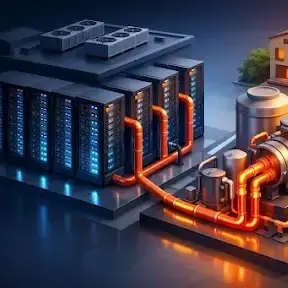
Can Data Centers Reuse Heat?
Build for It A data center can reject nearly as much thermal energy as it consumes in electrical power.
Treating this heat as waste made sense when power was cheap and cooling was isolated. In the era of high-density AI campuses, that model is failing under tight grid capacity and water constraints.
The opportunity is not simply attaching a heat exchanger to a data hall, it is converting rejected energy into an engineered, high-value thermal product. The Temperature Hurdle Not all recovered heat has the same value. Conventional air cooling yields low-grade heat that often requires expensive, electricity-hungry heat pumps for industrial reuse.
Liquid cooling (direct-to-chip, immersion) changes the physics: it captures heat closer to the source at higher, stable temperatures, cutting fan power and delivering a cleaner stream for district heating, greenhouse climate control, or industrial drying.
The real project is not recovery; it is predictable, year-round utilization. Cooling Remains Priority One A data center cannot compromise compute uptime for thermal sales.
Cooling is a resilience mission first: * Decoupled Loops: Critical server loops must be physically separated from external delivery circuits via plate heat exchangers to safeguard water quality, pressure, and serviceability. * Failsafe Rejection: The facility must retain full independent heat-rejection capacity (dry coolers, chillers) if external off-takers shut down.
The Multi-Output Energy Asset The future belongs to co-located systems designed around multiple synchronized outputs: baseload power, high- and low-grade heat, sub-zero cooling, and water management.
This is where legacy CHP systems fail, as their heat output fluctuates wildly with electrical demand. The Hydro Puls Direct
Drive (HPDD) architecture provides an Autonomous Energy Heart via isolated pulse mechanics and hydraulic transfer. For data centers, it consolidates generation into a unified conversion platform:
* Deep Cold: Native -73°C cold stream delivering 396 kW of high-density cooling.
* Water Independence: On-site production of 4,158 liters per hour of pure fresh water, solving cooling-tower consumption constraints.
* Usable Thermal & Power: Dispatchable electrical and hydraulic work integrated with controllable industrial heat.
An Architectural Pivot Heat reuse cannot be a cosmetic sustainability retrofit. When operators treat heat, water, and deep cold as engineered co-products from day one, data centers stop being grid liabilities.
They become dispatchable, multi-output nodes in the industrial energy ecosystem.
#DataCenter #AIInfrastructure #HeatReuse #HPDD #EnergyTransition #LiquidCooling #DistrictHeating #WaterResilience #HydroPuls