Why Nitrogen and Pure Water Are Entirely Free Byproducts with HPDD!
Looking at the mass balance makes the physical reality immediate: mass, like energy, cannot vanish.
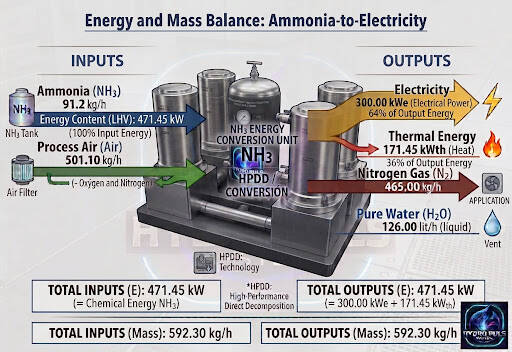
In our HPDD Ammonia-to-Electricity configuration, we feed 91.20 kg/h of ammonia (NH_3) and 501.10 kg/h of process air.
Together, they establish a total mass input of 592.30 kg/h.
The entire chemical energy content (471.45 kW LHV) is already converted 100% into dispatchable power: 300.00 kWe of electricity (64%) and 171.45 kWth of industrial heat (36%).
That means the core energy outputs already pay for the fuel and capital operation in full.
Consequently, the resulting physical streams become entirely free profit vectors:
* 465.00 kg/h Nitrogen Gas (N_2): Produced completely free of charge at 600 bar and 374°C as a byproduct of combustion.
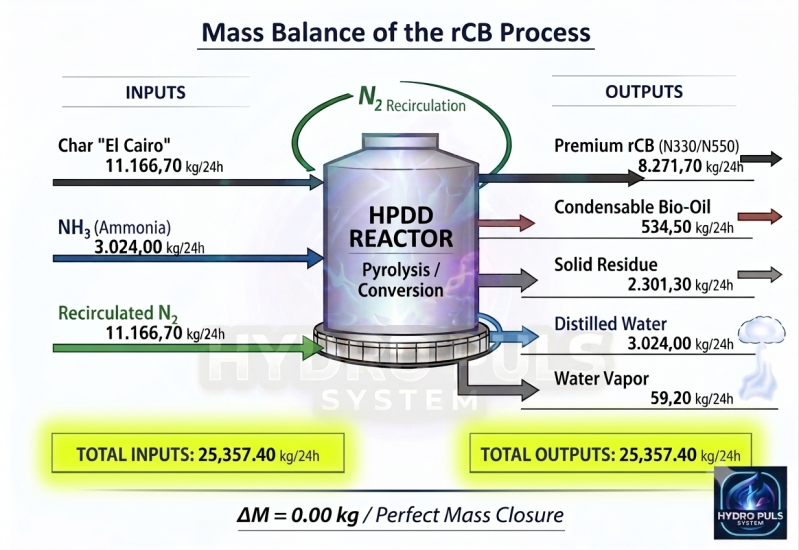
What a conventional engine vents uselessly into the atmosphere, we capture and dispatch as a high-value industrial asset. Delivered natively at extreme pressure and temperature, it eliminates external compression costs for blanketing, purging, or closed-loop recycling in synthesis and pyrolysis loops (such as the closed N_2 circuit in our rCB mass balance).
* 126.00 liters/h Pure Water (H_2O): Liquid distilled water formed by bonding the hydrogen from ammonia with atmospheric oxygen.
No municipal grid connection or reverse osmosis plant required; it condenses directly out of the process loop.
The Mass Balance:
465.00 kg/h (N_2) + 126.00 kg/h (H_2O equivalent) + trace vents = exactly 592.30 kg/h Total Output (Delta\M} = 0.00kg).
Evaluating power generation purely on electrical metrics misses half the economic opportunity.
With the Hydro Puls Direct-Drive architecture, electricity and heat cover the operating baseline, delivering hundreds of liters of pure water and high-energy 600-bar nitrogen to your plant at zero marginal cost.
#MassBalance #EnergyBalance #HPDD #Nitrogen #Ammonia #CircularEconomy #CHP #HydroPuls