

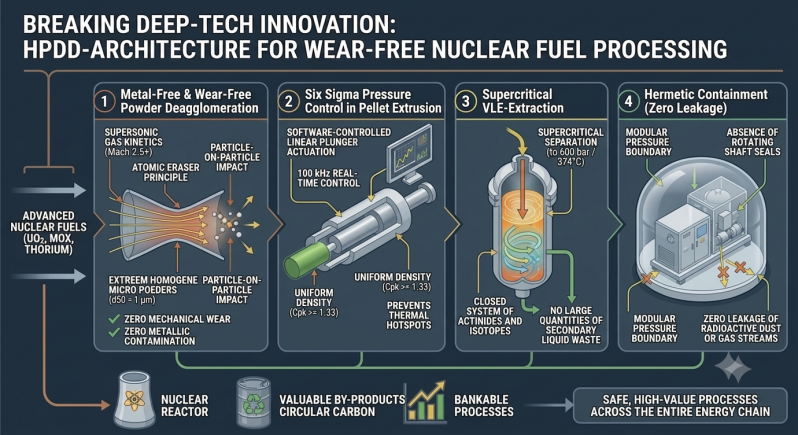
🔬 BREAKING DEEP-TECH INNOVATION: HPDD Architecture Paves the Way for Zero-Wear Nuclear Fuel Processing
The nuclear and advanced energy sectors face a critical challenge: increasing safety and efficiency in processing next-generation nuclear fuels (UO2 , MOX, Thorium) without the risks of mechanical contamination or containment leaks.
Our R&D analysis demonstrates that the Hydro Puls Direct-Drive (HPDD) gas-kinetic and hydraulic architecture provides a structural breakthrough across the nuclear fuel manufacturing and reprocessing chain.
⚙️ Key Applications in Nuclear Fuel Engineering:
⚛️ Contamination-Free Powder De-Agglomeration: Utilizing supersonic gas kinetics (Mach 2.5+ Atomic Eraser principles), uranium and thorium oxides are refined into highly homogeneous micro-powders (d 50 <1μm) via pure particle-on-particle impact. Eliminating mechanical ball mills ensures zero metallic contamination in the fuel matrix.
🎯 Six Sigma Precision in Pellet Compaction: Software-driven linear motion control (100 kHz real-time feedback) delivers ultra-precise pressure cycles for green pellet compaction. This guarantees uniform density distribution (C pk ≥1.33), preventing dangerous thermal hotspots during reactor operation.
🧪 Supercritical VLE Extraction (Up to 600 bar / 374 ∘ C): Enables closed-loop, supercritical fluid separation of actinides and isotopes, minimizing secondary liquid waste streams.
🛡️ Hermetic Containment (Zero-Leak Boundary): Without rotating crankshaft seals, the modular HPDD skid acts as a fully sealed high-pressure containment barrier, drastically lowering operational risk when handling radioactive gas or dust streams.
The global energy transition demands bankable, high-precision processing across the entire energy spectrum, from circular carbon assets to next-generation nuclear tech. 🚀
#HydroPuls #HPDD #NuclearEnergy #NuclearFuel #AdvancedNuclear #CleanTech #DeepTech #ProcessEngineering #NuclearInnovation #Decarbonization