

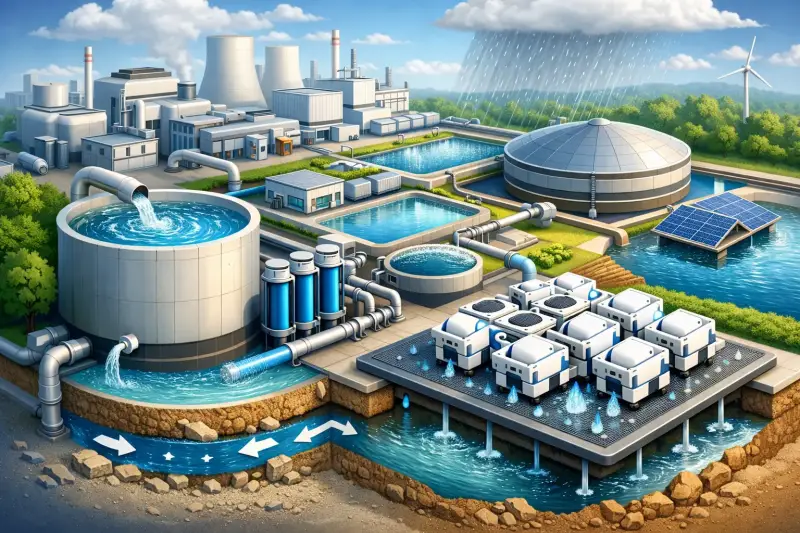
A water constraint can halt a production line as decisively as a power outage. For cement plants, data centers, refineries, food processors, mines, greenhouse operators, and remote industrial facilities, the central question is no longer simply how much water is available at the fence line. It is how industrial sites capture water, condition it to the required quality, and keep the supply stable when municipal allocations, drought conditions, discharge limits, or energy prices change.
The answer is not a single machine. Industrial water capture is a systems-design problem involving mass balance, heat integration, separation technology, storage, and the quality specification at each point of use. The most economic solution is usually the one that treats water as a recoverable process output rather than a purchased utility.
How Industrial Sites Capture Water: Start With the Water Balance
A serious project begins by mapping every water flow: incoming water, steam losses, cooling-tower evaporation, boiler blowdown, wastewater discharge, product moisture, and water contained in combustion exhaust. That map must separate volume from quality. A site may have enough recoverable water for washdown or cooling makeup while still requiring high-purity water for boilers, electrolyzers, semiconductor processes, or reverse osmosis polishing.
This distinction changes capital allocation. It is often inefficient to purify every recovered gallon to potable or demineralized quality. A better design uses a water-quality cascade: high-quality water is reserved for critical duty, while recovered condensate, treated wastewater, or lower-grade process water serves cooling, dust suppression, irrigation, flushing, and other tolerant loads.
The engineering target is therefore not maximum capture in isolation. It is the lowest lifecycle cost per usable gallon, with the reliability required by the operation.
Capture Water From Combustion Exhaust
Hydrocarbon and hydrogen fuels contain a frequently underused water source: water vapor created during combustion. When hydrogen burns, its principal combustion product is water. Natural gas combustion also creates substantial water vapor because methane contains four hydrogen atoms per molecule. In conventional exhaust systems, much of this vapor leaves through the stack because condensing it can create corrosion, plume, and contaminant-management challenges.
A water-recovery system cools exhaust below its dew point, condenses the vapor, separates the liquid, and polishes it for its intended use. The available quantity depends on fuel composition, fuel input, excess-air level, exhaust temperature, ambient conditions, and the amount of heat that can be economically removed. The water is not automatically process-ready. Flue gas can carry acidic compounds, particulates, trace metals, unburned hydrocarbons, or combustion byproducts, depending on the fuel and upstream equipment.
That is why combustion-water capture requires more than a condenser. The practical train may include particulate removal, corrosion-resistant heat exchange, condensate neutralization, degassing, filtration, activated carbon, membrane treatment, and final disinfection or demineralization. Fuel choice matters as well. Hydrogen and ammonia pathways have different exhaust chemistry and different controls requirements. An ammonia-capable system must prevent ammonia slip from becoming a water-quality problem.
The opportunity becomes more compelling when the power architecture provides predictable thermal conditions. A controlled combustion environment and a stable operating point make it easier to design heat exchangers, condensers, and treatment equipment around known flow and temperature ranges instead of repeated partial-load swings.
Extract Water From Ambient Air
Atmospheric water generation is another route, but it must be evaluated with thermodynamic discipline. Air contains water vapor, yet the energy required to collect it rises sharply as humidity falls. In humid climates, direct cooling and condensation can be practical when there is a useful cold source or waste heat is available elsewhere in the process. In hot, arid regions, conventional atmospheric water generators can become electricity-intensive unless they are integrated with a high-value cooling duty.
There are two principal approaches. Refrigeration-based systems cool air below its dew point and collect condensate. Desiccant systems use a hygroscopic material to absorb moisture, then regenerate that material with heat to release concentrated water vapor for condensation. The latter can be attractive where low-grade heat is available, but it adds material handling, regeneration controls, and maintenance considerations.
For data centers, cold storage, and industrial cooling facilities, water-from-air can be part of a broader thermal strategy. If a power system produces a controlled cold stream while also rejecting recoverable heat, the site can combine cooling, dehumidification, and water recovery rather than buying electricity for each function separately. The design question is whether the captured water offsets enough purchased water and discharge cost to justify the added equipment.
Reclaim Process Water and Wastewater
The largest on-site water source is often not air or exhaust. It is the water already circulating through the facility. Cooling-tower blowdown, boiler blowdown, equipment wash water, condensate return, mine water, membrane concentrate, and process effluent can all be candidates for reuse.
Treatment selection follows the contaminant profile. Suspended solids point toward clarification, media filtration, dissolved-air flotation, or ultrafiltration. Dissolved salts may require reverse osmosis, electrodialysis, evaporation, or crystallization. Oils and organics can call for separation, biological treatment, oxidation, carbon adsorption, or specialized membranes. High-silica, high-hardness, or high-organic streams demand particular attention because they can rapidly foul membranes and heat-transfer surfaces.
Recovery has a trade-off. Higher recovery generally reduces intake and discharge, but it concentrates the remaining contaminants. Zero-liquid-discharge systems can minimize wastewater disposal, yet their evaporation and crystallization stages are capital- and energy-intensive. They make most sense where discharge is restricted, freshwater is scarce, or waste disposal costs are structurally high.
Use Reverse Osmosis for Brackish Water and Seawater
Where a site has access to brackish groundwater or seawater, reverse osmosis can create a dependable supply independent of municipal networks. It is a mature technology, but its economics depend heavily on intake quality, pretreatment, membrane fouling control, energy recovery, and concentrate disposal.
For coastal industrial clusters, desalination becomes more attractive when its electrical load is supplied by reliable on-site generation and when its output serves multiple nearby users. For inland facilities, brackish-water treatment may be more practical than seawater desalination, but concentrate handling remains a defining permitting and operating issue.
Design Water Capture as an Energy System
Water capture is inseparable from energy conversion. Cooling a vapor stream to condense water consumes or redirects thermal capacity. Driving a reverse-osmosis pump requires electrical or mechanical power. Regenerating a desiccant requires heat. Treating wastewater requires pumping, aeration, separation, and controls.
This is where conventional site design often loses value. Power generation, cooling, water treatment, and industrial motion are procured as separate packages, each optimized locally. The result can be unnecessary conversion losses, oversized electrical infrastructure, and missed heat-recovery opportunities.
A direct-drive architecture changes the design space by coupling energy conversion more directly to industrial work. Hydro Puls Systems positions its HPDD platform as an Autonomous Energy Heart that can provide power, hydraulic work, heat, cooling potential, and combustion-derived water within one integrated architecture. For a water-production facility, that means evaluating the generator, high-pressure pumps, thermal recovery equipment, and treatment train as one system rather than as disconnected loads.
The correct configuration depends on the site. A humid data center may prioritize condensate and cooling integration. A cement facility may focus on dust control, process-water reuse, and carbon-capture-related water demand. A remote mining or defense installation may value supply autonomy and storage resilience above the lowest possible treatment cost.
Select the Capture Route by Delivered Water Value
Project teams should compare options using delivered water value, not only capture volume. The decision should account for four variables: source reliability, treatment intensity, energy consumption, and avoided cost.
Avoided cost includes more than the municipal water bill. It can include wastewater discharge fees, trucking, downtime exposure, permit constraints, cooling losses, and the cost of expanding an external water connection. A lower-volume source with stable quality can be more valuable than a larger source requiring constant chemical treatment and membrane replacement.
Storage also deserves early attention. Water production and water demand rarely follow the same hourly profile. Tanks provide operational flexibility, emergency reserve, and a buffer that allows generation or treatment equipment to run nearer its efficient design point. For critical operations, redundancy should cover pumps, controls, treatment barriers, and power supply - not merely water storage.
The most productive next step is a site-specific water-and-energy balance built from measured flows, temperatures, chemistry, duty cycles, and discharge data. Once those numbers are visible, water stops being an uncontrolled operating risk and becomes an engineered output the facility can produce, reuse, and protect.