

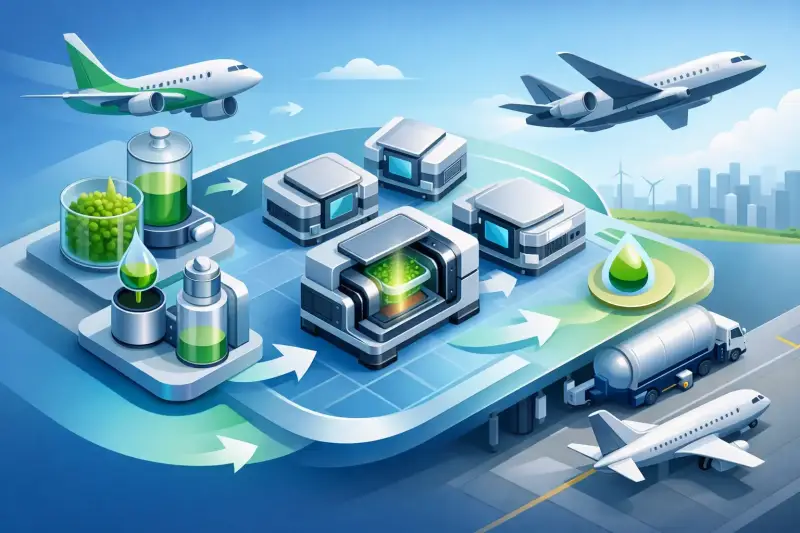
Aviation does not have the option of simply plugging into a larger grid. Long-range flight requires dense, dispatchable energy carried onboard, which makes SAF - sustainable aviation fuel - a critical transition pathway for commercial aviation, cargo, defense, and specialized aviation markets. Yet the limiting factor is not only fuel chemistry or feedstock availability. It is the industrial energy architecture behind production.
SAF plants must transform carbon, hydrogen, electricity, heat, water, and process gases into a tightly specified fuel product. Every avoidable compression loss, part-load penalty, thermal rejection point, and indirect drive train erodes project economics. For developers and investors, the question is therefore more demanding than whether a pathway can make qualifying fuel: can it make SAF with a conversion architecture designed for stable output, modular deployment, and low parasitic consumption?
SAF Is an Energy-System Challenge
The aviation sector can use several approved and emerging routes to sustainable fuel. Hydroprocessed esters and fatty acids, alcohol-to-jet, Fischer-Tropsch synthesis, and power-to-liquid systems all begin with different feedstocks. They do, however, share an operational reality: each route depends on dependable energy inputs and carefully managed process conditions.
Hydrogen production requires power. Carbon capture and conditioning require electricity, heat, vacuum, compression, or all four. Synthesis loops need pressure control and thermal management. Product upgrading needs process heat and hydrogen. If renewable electricity is variable, conventional equipment often compensates by cycling, throttling, or relying on oversized balance-of-plant systems. That is an expensive way to operate an industrial chemical plant.
The central engineering issue is not merely how much renewable energy is available over a year. It is whether the plant can receive the right form of energy at the right pressure, temperature, and duty cycle every second it operates. Electrical power is essential, but it is not the only valuable output. Hydraulic work, usable heat, cooling, water, and pressurized gas handling can all determine the real energy cost per gallon of fuel.
The cost of indirect conversion
Conventional generation architectures frequently convert thermal energy into shaft power through rotating machinery, then into electricity, then back into mechanical or thermal work across pumps, compressors, fans, chillers, and process equipment. Each interface introduces losses, controls, capital equipment, and maintenance exposure.
This is especially material in e-fuel and carbon-to-fuel projects. A plant may generate electricity to run an electrolyzer, use additional electricity to compress hydrogen and carbon dioxide, consume more power for air separation or direct air capture, and then reject heat that another process unit requires. The individual components may be mature, but the total system is often not optimized as one thermodynamic machine.
A viable SAF platform must address this system-level loss cascade. It must also tolerate changing feedstock conditions and energy availability without turning every operating deviation into a production penalty.
A Direct-Drive Architecture for SAF Production
Hydro Puls Systems approaches this challenge from a different first principle: decouple the energy core from the load while directly delivering hydraulic power, thermal energy, cooling potential, water, and electrical generation where the process needs them. The Hydro Puls Direct Drive architecture is designed around pulse-based isolated combustion and hydraulic energy transfer rather than a conventional crankshaft-led power train.
The objective is not to replace every electrical machine in a SAF facility. Electrical systems remain necessary for controls, electrolysis, instrumentation, and many plant loads. The objective is to reduce unnecessary conversion steps and create a controllable autonomous energy core that can remain in an efficient operating range while industrial demand moves around it.
For a SAF facility, direct hydraulic coupling is relevant wherever high-force, variable-duty mechanical work is required. Pumps, fans, compressors, fluid-handling equipment, and generator systems do not all need to be served through the same electrical pathway. A hydraulic architecture can provide high torque at low rotational speed, permit power buffering, and separate the behavior of the primary energy unit from short-term load changes.
That separation matters. Chemical processes generally prefer stable conditions. Power systems with intermittent generation and conventional engines operating at partial load often do not provide them efficiently. An energy core designed to operate near its thermodynamic sweet spot can provide a steadier foundation for synthesis, capture, upgrading, and utility operations.
Heat, cooling, and water are co-products, not afterthoughts
SAF economics are commonly discussed through feedstock cost, electricity price, and fuel yield. Those are decisive variables, but they do not tell the whole story. The plant also has to manage thermal streams, water demand, and cooling loads.
Low-grade and medium-grade heat can support feedstock conditioning, distillation duties, drying, preheating, or adjacent industrial operations, depending on the chosen pathway. Cooling can support gas conditioning, process control, refrigeration demand, and equipment protection. Water is particularly strategic where electrolysis, cleaning cycles, cooling systems, or remote project locations create supply constraints.
An integrated energy system should be assessed on its complete output stack, not solely on electrical nameplate capacity. A megawatt of electricity that also enables useful heat, cooling, water recovery, and direct mechanical work can carry a different project value than a megawatt delivered as electricity alone. The correct calculation depends on the pathway, site utilities, ambient conditions, product slate, and local fuel and power pricing.
Where SAF Projects Can Gain the Most
The strongest fit is not identical across all SAF pathways. HEFA facilities may prioritize reliable hydrogen, process heat, and upgrading utilities. Fischer-Tropsch plants can place greater emphasis on synthesis-gas conditioning, compression, thermal integration, and continuous operation. Power-to-liquid projects may focus on the combined energy burden of hydrogen production, carbon capture, water management, and synthesis.
Projects paired with direct air capture deserve special scrutiny. Capturing dilute carbon dioxide from ambient air can involve meaningful heat, electrical, and airflow requirements. If the facility treats carbon capture as an isolated electrical load, its energy penalty can become dominant. If capture, hydrogen generation, water recovery, cooling, and fuel synthesis are engineered as one integrated industrial system, more of the input energy can be directed toward fuel molecules rather than internal losses.
The same logic applies to airport-adjacent fuel hubs, remote aviation operations, defense logistics, and regions with constrained grids. Modular plants may offer a route to staged deployment, but only when the modules avoid duplicating too much auxiliary equipment. A compact energy core capable of serving multiple utility functions can improve the case for distributed production, though project developers must still evaluate fuel certification, feedstock logistics, safety systems, storage, and offtake agreements.
What Technical Buyers Should Demand
A serious SAF energy proposal should not stop at a fuel yield claim or a headline electrical efficiency. Buyers should require a whole-system accounting of energy flows. That includes the energy consumed by compression, pumping, cooling, thermal management, controls, water treatment, capture equipment, and power conditioning.
They should also test performance at real operating points, not just idealized design conditions. What happens when the hydrogen unit ramps? How does the system respond when capture demand changes? Can the primary energy unit remain stable while pumps, fans, and generators see variable loads? What equipment is eliminated, downsized, or retained? These questions expose whether an architecture is genuinely integrated or simply a collection of components connected by cables and pipes.
For investors, the practical measures are equally clear: installed capital per unit of annual fuel capacity, availability, maintenance intervals, fuel flexibility, utility consumption, and revenue from co-products. A pathway with attractive chemistry can still fail commercially if it requires excessive balance-of-plant equipment or depends on ideal operating conditions that the site cannot maintain.
SAF Will Be Won at the Plant Level
Aviation needs certified low-carbon molecules, but it also needs industrial systems that can make those molecules repeatedly, economically, and at scale. That will require more than better feedstocks and additional renewable generation. It requires energy infrastructure engineered around the physical needs of fuel production rather than inherited assumptions from conventional power plants.
The most consequential SAF projects will treat heat, pressure, hydraulic work, water, cooling, carbon, and electrical power as connected assets. When developers make that shift early in front-end engineering, they can evaluate a larger design space - and avoid locking decades of operating cost into an inefficient conversion chain.