

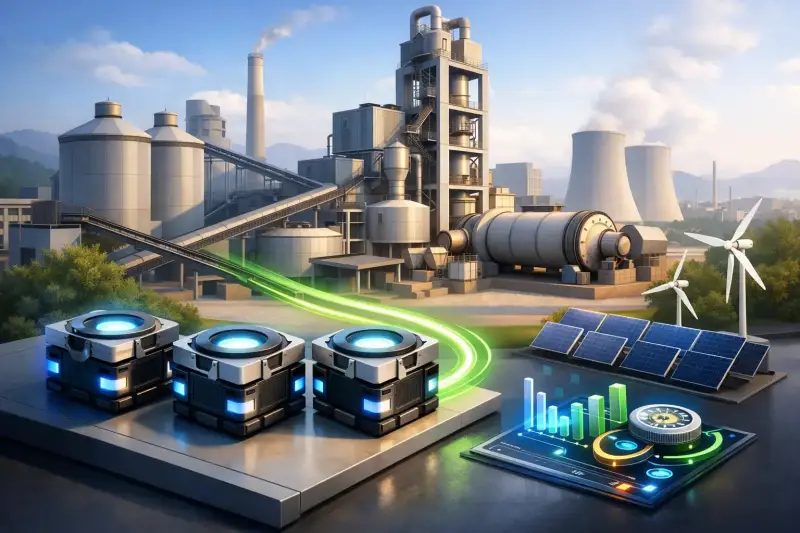
🏗️ Cement Plant Energy Optimization: Beyond the Kiln to Systems Engineering.
A cement plant does not have an energy problem in just one department. It has a system-design problem expressed through rising fuel bills, peak-demand penalties, unstable kiln operations, wasted exhaust heat, and grinding circuits consuming power long after marginal throughput gains disappear.
Optimizing a cement plant begins when these losses are treated as one integrated thermodynamic and mechanical architecture rather than separate utility projects.
1. Map the True Energy Landscape
Optimization doesn't start with selecting equipment; it starts with the process map:
The Kiln Line: Concentrates the largest thermal load. However, optimizing specific fuel consumption in isolation can impose severe electrical penalties on ID fans, cooler fans, or downstream milling.
False Air & Thermal Losses: Air leakage increases gas volume without adding value, wasting fan power and destabilizing preheater temperatures.
Useful Baseline: The correct unit of analysis is the integrated plant: energy per ton of cementitious product, adjusted for alternative fuels, clinker factor, and peak electrical demand.
2. Cut Parasitic Electrical Demand
Motors are rarely the root problem; the work they are forced to perform is:
Fan Throttling: Throttling fans turns electricity into pressure loss. Variable-frequency drives, duct improvements, and pressure-profile tuning yield rapid paybacks through fan-law effects.
Grinding Discipline: Mill power must be balanced against particle-size distribution and separator efficiency. Higher throughput is counterproductive if it leads to overgrinding or peak-demand surcharges.
3. Rebuild Around Multi-Output Energy Architecture
Traditional cement plants suffer from fragmented energy conversion: fuel drives the kiln, grid power drives motors, and waste heat is often underutilized.
A modern approach treats the plant as a multi-output energy system where a single energy core delivers electricity, high-grade heat, and direct mechanical power:
Direct Hydraulic Decoupling: Cement manufacturing is full of mechanical work (pumps, crushers, fans, mills). Converting thermal energy to electricity, then to a motor, and finally to mechanical work creates friction and partial-load losses.
Autonomous Energy Hearts: Platforms like Hydro Puls Direct-Drive (HPDD) decouple the energy-conversion core from volatile plant loads. By using pulse-based combustion and hydraulic energy transfer, the core operates continuously in its thermal sweet spot while serving variable site demands.
4. Carbon Capture is an Energy Challenge
Post-combustion capture requires massive heat for solvent regeneration and power for compression. Integrating carbon capture without redesigning the plant’s balance-of-plant energy model protects permits but destroys operating margins.
#CementIndustry #Decarbonization #EnergyEfficiency #ProcessEngineering #HPDD #HeavyIndustry