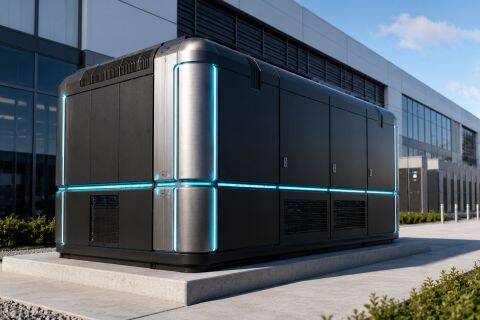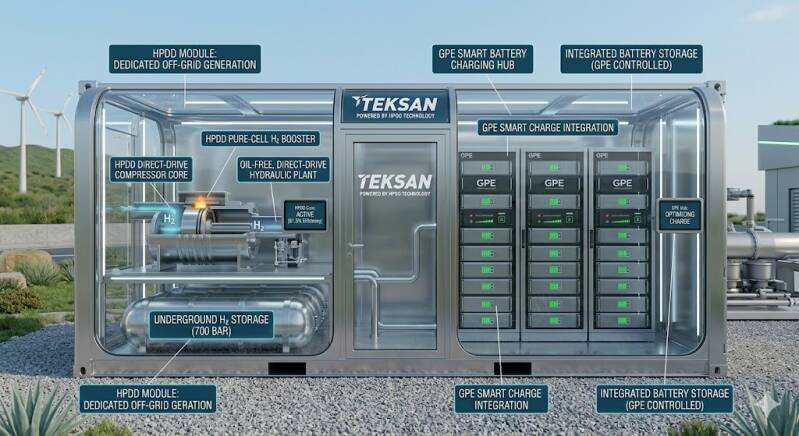
The 'Solid-State' Power Plant of the Future

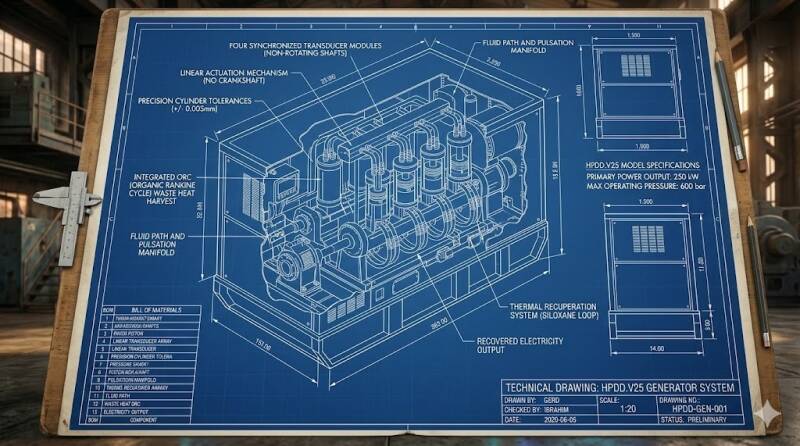
HPDD v26 TRT Mobile Energy modules (solid state)nd Most Efficient Generator in the World
The HPDD v26 introduces the Isothermal Generator: a compact, modular power plant that converts chemical energy directly into high-grade hydraulic or electrical energy with an unprecedented efficiency of 62%+.
Why the HPDD Generator is the New Standard:
- Vibration-Free & Whisper-Quiet: Thanks to the frictionless 5-micron gap and the elimination of the crankshaft, the HPDD generator produces virtually zero mechanical vibration. This makes it ideal for use in urban areas, on film sets, or near hospitals.
- Extreme Power Density at 600 Bar: While standard generators rely on mechanical rotation, the HPDD directly feeds a 600-bar hydraulic backbone. This makes it the perfect power source for mobile workshops, heavy hydraulic tools, or industrial emergency backup systems.
- Isothermal Efficiency (Inconel 718): By maintaining a constant wall temperature of 230°C, energy loss to cooling is virtually eliminated. Every drop of fuel (Hydrogen, Biogas, or E-fuels) is converted with maximum precision. At operating temperature, the core expands exactly 109 µm, ensuring a perfect, non-contact seal.
- Instant Full Power: Thanks to the integrated High-Pressure Accumulator, the HPDD generator handles peak loads that would stall a conventional diesel engine. These "Energy Pods" continuously replenish the buffer at their most efficient operating point.
Applications:
- Construction Sites: Powerful, silent energy for cranes and heavy machinery without local emissions (when using H_2).
- Events: Reliable power without the constant roar of a diesel engine.
- Micro-Grids: Link multiple HPDD units in a "Swarm" to provide decentralized energy for entire neighborhoods or industrial complexes.
Specifications:
- Core: Modular HPDD Transducer (Inconel 718)
- Output: 600-Bar Hydraulic / Optional Electrical Conversion
- Efficiency: 62%+ Constant Thermal Efficiency
- Fuel: Hydrogen, Bio-fuels, Synthetic fuels
- Dimensions: Up to 50% more compact than comparable diesel generators
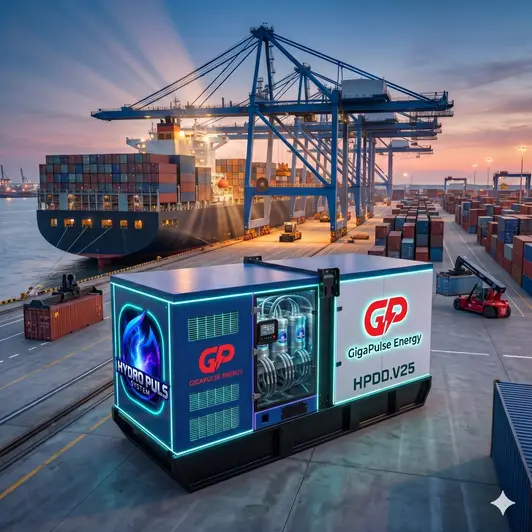
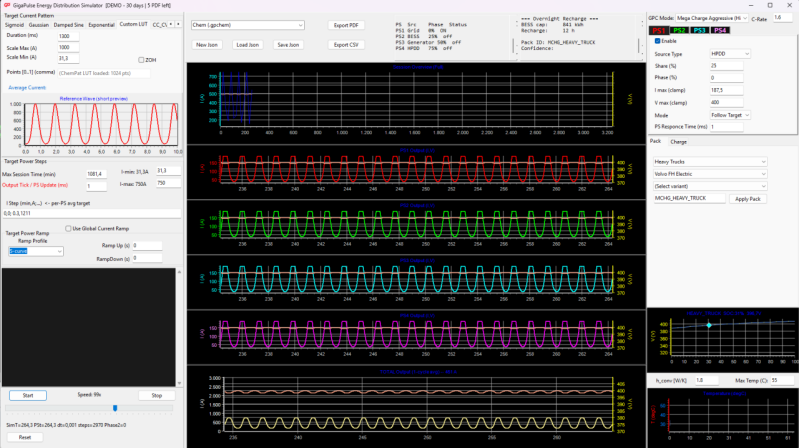
The HPDD v26 TRT is engineered for sub-millisecond grid-forming capabilities, with its 1.0 ms transient response empirically verified within the GigaPulse Energy Distribution simulation environment.


Frequently Asked Questions: Stationary Power & Generators
How does the HPDD compare to traditional diesel generators?
Traditional generators are loud, emit high levels of $NO_{x}$ and $CO_{2}$, and require frequent oil and filter changes. The HPDD is zero-emission (when running on Hydrogen or Ammonia), near-silent, and virtually maintenance-free for 20,000+ hours. It offers a much higher net efficiency (up to 62%), significantly reducing fuel costs over the lifecycle of the unit.
Can the HPDD handle fluctuating power demands (Load Following)?
This is where the HPDD excels. Traditional engines lose massive efficiency when not running at their "sweet spot." Because the HPDD is a software-defined transducer, it can adjust its frequency and power output in milliseconds. Whether you need 5% or 100% power, the system maintains peak efficiency without "wet stacking" or carbon buildup.
Is it safe to store Ammonia for backup power in urban areas?
Ammonia ($NH_{3}$) is a globally traded commodity with established safety protocols. It is actually safer in many ways than hydrogen because it is not highly flammable and is easily detected by smell even at harmless concentrations. For hospitals and datacenters, Ammonia provides a high-density energy liquid that can be stored for years without degrading, unlike diesel.
What is the noise profile of an HPDD generator?
Noise pollution is a major issue for emergency generators in residential areas. The HPDD operates as a high-frequency solid-state device. It eliminates the low-frequency vibrations and "thumping" of traditional pistons. This makes it suitable for rooftop installations or indoor use with minimal acoustic insulation.
Can the system be used for Microgrids or Grid Stabilization?
Absolutely. The HPDD is designed for Vehicle-to-Grid (V2G) and stationary grid support. Its rapid response time allows it to act as a "stabilizer" for renewable energy sources like solar and wind. When the sun sets or the wind drops, the HPDD kicks in instantly to bridge the gap with zero carbon footprint.
How does the "Zero-Friction" design benefit backup systems?
The biggest risk for backup generators is "failure to start" due to degraded oil or seized parts after long periods of inactivity. The HPDD has no crankshaft and no oil system. Its frictionless 5-micron gap design and Inconel components ensure that the system starts perfectly every time, even after months of standing idle, without the need for pre-heating or lubrication cycles.