

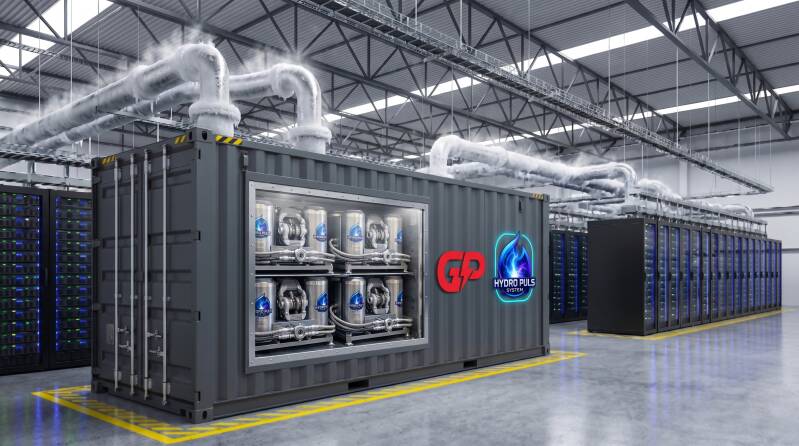
A data center is no longer just a computing facility. It is a massive thermodynamic cooling and power challenge.
When a facility faces multi-year delays due to grid transmission constraints, it is not just a scheduling delay. It is a severe revenue risk, a deployment risk, and a market position risk all at once.
Top digital infrastructure strategies can no longer afford to chase single-component efficiency metrics. The future requires engineering a controllable, multi-output ecosystem that handles power generation, ultra-dense cooling, and energy constraints as interconnected assets.
Here are the 4 architectural pillars driving next-generation data center infrastructure:
1. Grid Independence as a Core Operational Value
Relying solely on centralized power utilities has become a multi-year bottleneck. The solution shifts toward modular, dispatchable, off-grid energy platforms. By deploying an autonomous on-site power matrix, hyperscalers and operators can bypass grid queuing entirely, accelerating facility deployment timelines from years to months.
2. Eliminating Parasitic Chiller Loads (The 0.0 kW Cooling Target)
Traditional data center cooling relies on massive, power-hungry mechanical refrigeration plants that drain the primary grid. Next-generation architectures use compressible flow physics—such as supersonic De Laval expansion—to natively co-generate sub-zero cooling loops down to -25°C directly from the power generation phase. Turning exhaust exergy into immediate server-rack cooling drops the parasitic cooling load to a net zero.
3. Turning Water Management from a Liability into an Asset
Data centers face intense regulatory and environmental scrutiny over their massive water consumption. Serious infrastructure design must integrate active condensation matrices. By trapping and cooling the moisture-rich exhaust stream of localized generation, a facility can harvest thousands of liters of pure, mineral-free technical utility water per hour, completely eliminating external water procurement dependencies.
4. Cascade Optimization over Isolated Devices
Many underperforming infrastructure projects fail because they were assembled as a loose collection of independent devices—buying power from one vendor, chillers from another, and backup assets from a third. True optimization occurs when every single energy stream is cascaded into a productive use. Power generation drives the servers, expansion exergy drives the cryogenics, and thermal deltas drive the water recovery.
The Bottom Line: Commercial-scale validation under continuous data center workloads is the ultimate benchmark. If these metrics are achieved together, it represents far more than just a new alternative power source. It delivers a fundamentally different, highly resilient model for building the next generation of AI and cloud infrastructure.
#DataCenterInfrastructure #GridIndependence #AIPower #SustainableTech #EcosystemEngineering