

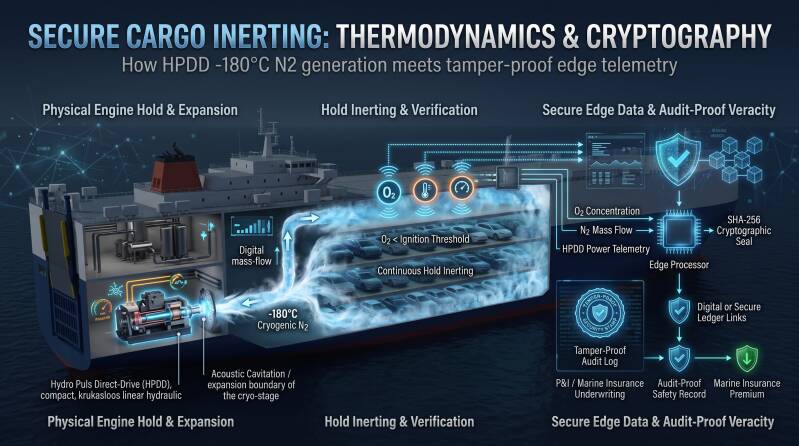
Mitigating EV thermal runaway on PCTC and Ro-Ro vessels demands more than elegant thermodynamics.
It requires irrefutable, continuous proof for underwriters and cargo owners.
Previously, I outlined how the Hydro Puls Direct-Drive (HPDD) harnesses core thermodynamic expansion to generate free, continuous cryogenic nitrogen (N2). This active inerting strategy drops cargo hold oxygen below ignition thresholds without the severe parasitic power drain of standalone PSA skids.
Following that, Catalin Hogea raised a decisive industry reality:
P&I Clubs and charterers overseeing billions in high-value automotive cargo will never underwrite risk based on passive design claims alone. They require unassailable verification that deck atmospheres remained non-flammable every nautical mile of the voyage.
The breakthrough happens where propulsion thermodynamics meets edge cryptography:
1️⃣ Physical Inerting:
Continuous, zero-parasitic N2 displacement dynamically tied to HPDD cycle energy.
2️⃣ Deterministic Edge Telemetry:
Critical physical telemetry, O2 depression levels, N2 mass flux, and shaft load dynamics, is cryptographically hashed (SHA-256) directly at the physical hardware interface. (Thanks Catalin)
3️⃣ Audit-Proof Risk Underwriting:
Upon reaching port, vessel operators provide an immutable, tamper-proof record certifying the cargo space never entered the ignition envelope.
This bridges the gap between active hazard mitigation and commercial finance: turning propulsion physics into a deterministic compliance asset that measurably reduces marine insurance risk profiles.
How is your fleet currently addressing the verification boundary between cargo fire safety and insurance compliance?
#Maritime #Shipping #RoRo #PCTC #EVLogistics #CargoSafety #MarineInsurance #ThermalRunaway #Decarbonization #CleanTech #HPDD #EdgeComputing