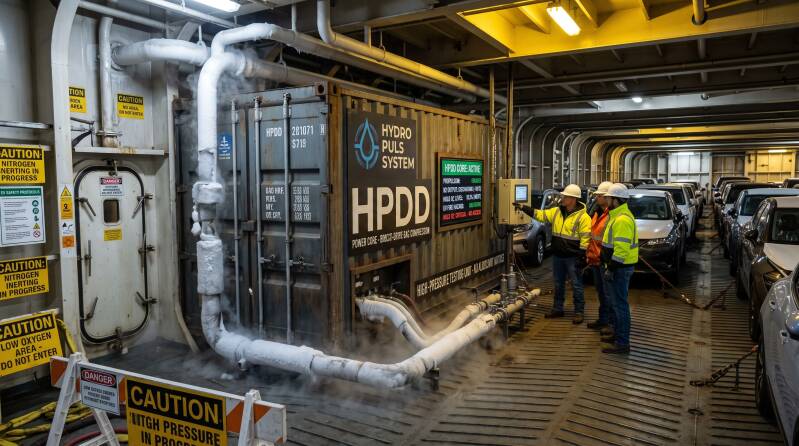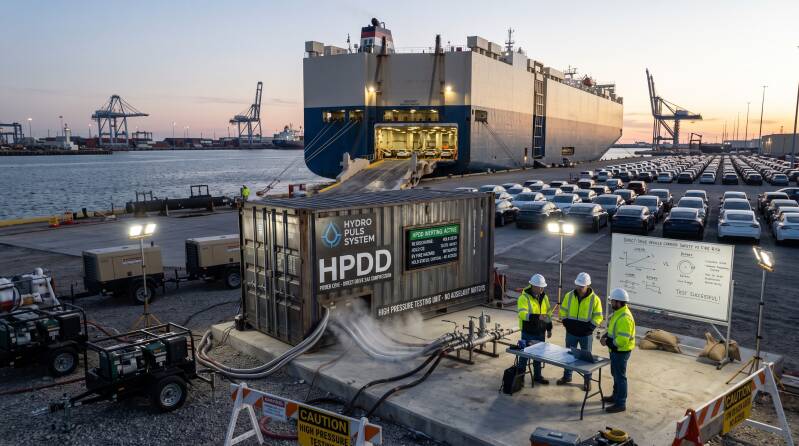
The deep-sea transit of finished vehicles (PCTCs & Ro-Ro carriers) is facing a critical operational risk: the rapid increase in electric vehicle (EV) cargo demands a paradigm shift in shipboard fire safety.
A lithium-ion battery entering thermal runaway is notoriously difficult to contain with traditional marine methods (such as seawater drenchers or high-pressure CO2). The cells generate their own chemical oxygen, produce flammable off-gases, burn at extreme temperatures, and risk rapid fire spread across tightly packed vehicle decks.
The ultimate physical countermeasure? Continuous and proactive deck inerting using nitrogen (N2).
By maintaining oxygen levels below 10–12%, open ignition and flame propagation become physically impossible. Furthermore, dry gaseous nitrogen causes zero corrosion and zero electrical damage to high-value factory-new vehicles.
The historic barrier? Generating the millions of cubic meters of nitrogen required to flood massive cargo holds typically demands heavy, energy-intensive PSA or membrane skids, burning substantial amounts of auxiliary fuel and penalizing overall vessel efficiency.
The Hydro Puls Direct-Drive (HPDD) fundamentally resolves this economic trade-off:
It provides the ship's primary propulsion power while generating cryogenic nitrogen (N2) at -180°C as an entirely free, unpenalized byproduct.
Why HPDD delivers this safety architecture at zero extra fuel cost:
1️⃣ Crankshaft-Free Direct Propulsion:
HPDD drives the vessel's propulsion shaft and thrusters via a linear, hydrostatic direct-drive architecture, slashing mechanical friction and conversion losses.
2️⃣ 100% Free Nitrogen (N2) as an Inherent Byproduct:
Due to the closed-loop thermodynamic expansion cycle within the HPDD core, cryogenic nitrogen at -180°C is generated as a natural, automatic output of producing shaft power. Zero supplementary fuel burn, zero dedicated generators, and zero auxiliary parasitic penalty. The nitrogen is natively produced and immediately usable.
3️⃣ Active Hold Inerting & Instant Thermal Quenching:
This zero-cost nitrogen stream continuously inertises car decks to eliminate combustion risk. Should a localized battery fault occur, the extreme cold (-180°C) can be deployed directly to quench the hotspot, absorbing heat rapidly, stopping thermal runaway in its tracks, and isolating adjacent vehicles.
Why burn expensive bunker fuel for propulsion and pay a separate efficiency penalty for cargo safety, when a single integrated direct-drive architecture delivers propulsion and provides complete EV fire inerting as a free byproduct?
#MaritimeEngineering #CarCarrier #PCTC #RoRo #EVSafety #LithiumIon #HPDD #HydroPulsDirectDrive #FirePrevention #Decarbonization #MaritimeSecurity