

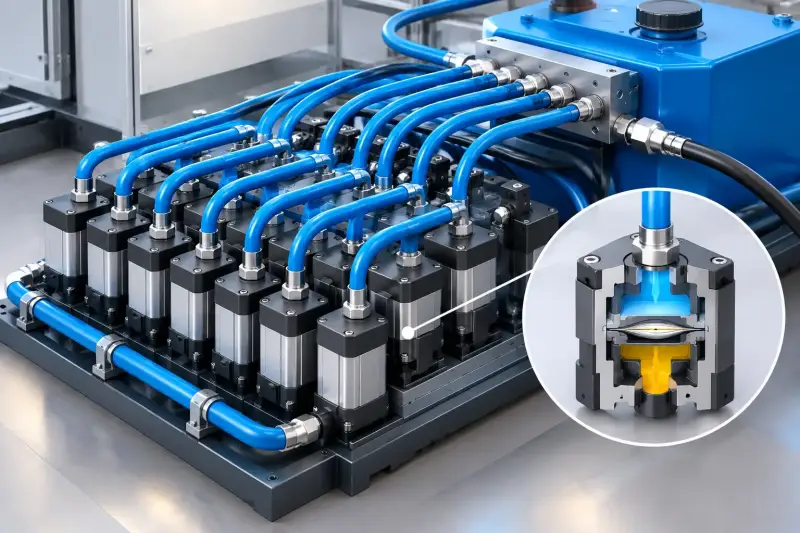
A hydraulic drivetrain rarely fails first in the field; the root causes are usually designed into the system.
Sizing prime movers only for peak power, choosing pumps purely from nominal flow, or treating thermal management as an afterthought inevitably leads to instability.
Successful integration demands that generation, conversion, storage, motion, and protection are engineered as one unified operating architecture.
In heavy industry, cement grinding, reverse osmosis, large pumping stations, and process plants, hydraulic transmission decouples the primary energy source from a volatile industrial load.
The prime mover remains near its peak operating efficiency while accumulators and hydraulic compliance absorb transient surges. Hydro Puls Systems implements this via the Hydro Puls Direct-Drive (HPDD) architecture: isolated combustion pulses transfer force fluidically, cutting out traditional crankshafts and multi-stage mechanical gearboxes.
Key Engineering Principles
Start With the Load Cycle, Not the Pump: Establish continuous and peak power, breakaway torque, ramp rates, allowable speed deviations, and rotating inertia.
Never size components against a single catalog point; check the entire envelope, cold start, full production, maximum resistance, emergency stops, and hot restarts.
System-Wide Pressure & Event-Driven Accumulators: Higher operating pressures reduce line dimensions and component mass, but increase sensitivity to fluid cleanliness, fatigue, and shock waves.
Size accumulators around specific operational events (e.g., a 10-second peak torque demand, controlled deceleration, or primary pulse dampening), accounting for real gas behavior, temperature shifts, and effective pressure margins.
Losses and Heat as Core Design Variables: Every throttling event, pressure drop, and seal leakage path generates heat.
Construct a comprehensive thermal balance across all duty cycles. Fluid selection, reservoir deaeration, suction design, and active cooling determine seal life, fluid degradation rates, and cavitation resistance under ambient extremes.
Layered Energy and Process Controls: A single pressure setpoint cannot govern complex dynamics. Implement layered machine-level actuation (valves, displacement) combined with supervisory controls that manage accumulator states, cooling capacity, and deliberate load-shedding. Tracking stored hydraulic energy enables proactive interventions before pressure collapses under demand spikes.
Inherent Safety, Serviceability & Realistic Commissioning: Stored fluid energy remains hazardous after shutdown.
Incorporate clear isolation zones, passive depressurization, and reachable diagnostic test points. Commission beyond steady-state: rigorously test cold starts, cooler failure, sensor dropouts, and controlled restarts under real plant scenarios.
The objective is never maximum catalog pressure or lightning-fast response for its own sake, but stable mechanical work delivery, minimized parasitic losses, and predictable lifecycle reliability.