Why pump desalinated seawater hundreds of kilometers inland when the atmosphere is an infinite, localized reservoir?
Coastal seawater desalination works well at the shoreline, but deploying it for inland industrial, agricultural, or mining operations hits a brutal economic and infrastructure wall:
❌ Prohibitive CAPEX: Laying hundreds of kilometers of high-grade pipelines through rough terrain demands massive upfront capital.
❌ Massive Pumping Parasitics: Pumping millions of liters uphill burns megawatts of continuous electricity purely to overcome pipe friction and static head.
❌ The Inland Brine Dilemma: Desalination generates concentrated, toxic brine. Disposing of it inland without poisoning local aquifers or soil is virtually impossible.
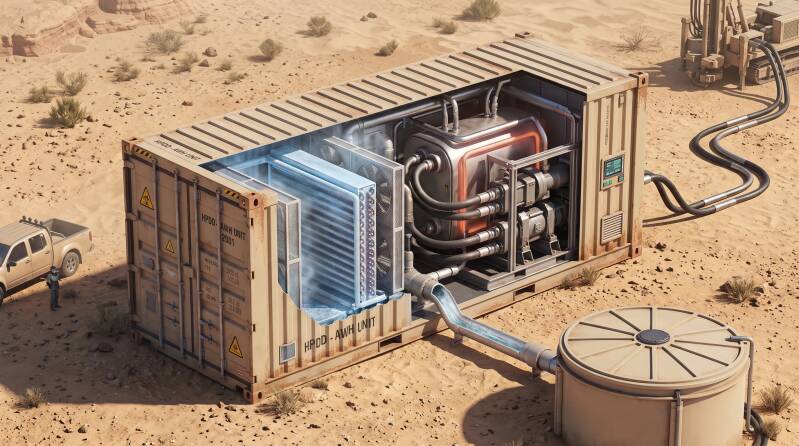
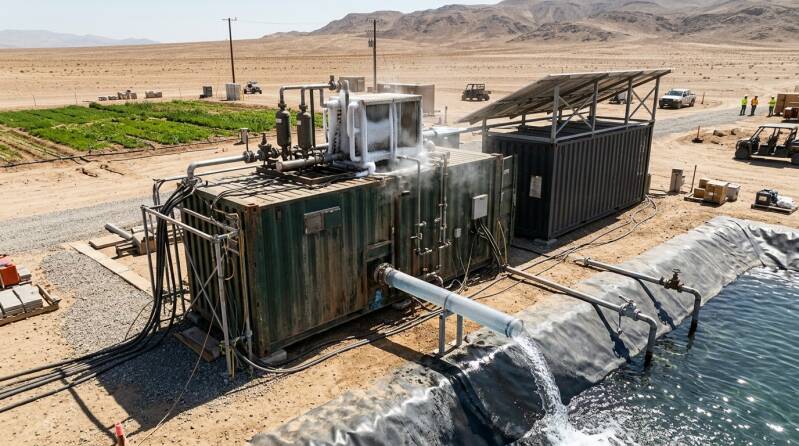
Atmospheric Water Generation (AWG) eliminates the pipeline entirely.
Traditionally, industrial AWG was dismissed due to the excessive electricity required to run mechanical chillers. The Hydro Puls Direct-Drive (HPDD) platform flips this thermodynamic equation by generating water as a synchronized co-product of clean power:
1. Direct Condensing via -25°C Thermal Sink: High thermodynamic fuel expansion continuously discharges dry airflow at -25°C. Routing this stream directly into atmospheric condensation loops provides an immediate, high-potency thermal sink, dropping moisture out of ambient air with near-zero compressor overhead.
2. Direct Reaction Harvesting (>2,300 L/hr): When oxidizing clean energy carriers like Green Ammonia (NH3), the HPDD captures and condenses combustion moisture, yielding over 2,300 liters of pure freshwater per hour (in a standard 10 MW node).
3. 230°C High-Grade Thermal Conditioning: High-temperature process heat remains available to drive secondary thermal phase-change distillation or process heating, extracting maximum utility from every joule.
The result: True regional water and power sovereignty off-grid, with zero pipeline CAPEX, zero grid dependency, and zero brine disposal.
Are you engineering water security for remote mining, desert agriculture, or off-grid industrial assets? Let’s evaluate the thermodynamic and site mass balance.