

DAY 8 / 10: MARITIME REVOLUTION SERIES
Maritime Safety & Classification Standards (DNV / Lloyd's Register)
Engine room fires and high-pressure oil spray ignitions remain leading causes of vessel loss. Meeting strict DNV and Lloyd's Register benchmarks traditionally requires complex fire-suppression networks.
Day 8 explores how Hydro Puls Direct-Drive (HPDD) achieves intrinsic, physics-based safety.
---
### Eradicating Engine Room Fire Hazards
* 100% Oil-Free Core: Operating without lubricating oil completely eliminates flammable oil lines and pressurized spray hazards.
* Zero Ignition Sources: Removing combustible fluids eliminates the root cause of machinery space fires.
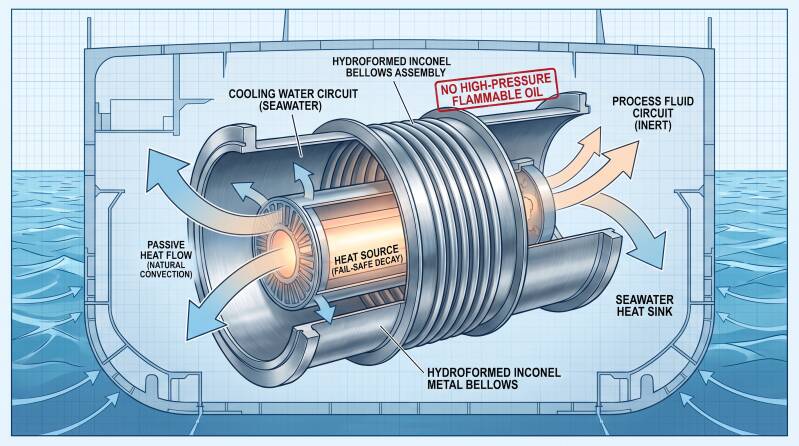
* Sealed Containment: The power loop operates inside an inert, oxygen-depleted enclosure, preventing combustion during abnormal events.
---
### Hydroformed Inconel Bellows: Absolute Isolation
* Zero Cross-Contamination: Precision Inconel bellows provide a hermetic physical seal between working fluids and hydraulic circuits.
* High-Nickel Longevity: Resists extreme thermal cycling and marine corrosion without micro-fissuring.
* Decadal Fatigue Limits: Guarantees dynamic barrier containment over tens of thousands of operating hours.
---
### Passive Decay Heat Removal (Blackout-Proof)
* Natural Convection Loops: Dedicated thermo-siphons utilize natural physical convection to route decay heat straight into seawater.
* Zero Electrical Power Needed: Operates reliably without backup gensets, pumps, or operator action.
* True Blackout Resilience: Safely stabilizes into a passive cold shutdown during complete dead-ship conditions.
HPDD replaces complex active safeguards with intrinsic physics, delivering a rock-solid safety case for marine classification.
Stay tuned for Day 9: "Lifecycle Economics: 20,000 Hours of Maintenance-Free Reliability."
#MaritimeSafety #MarineEngineering #NavalArchitecture #HydroPuls #HPDD #DNV #LloydsRegister #CleanShipping #MaritimeTech #AssetIntegrity #DeepTech