

The Zero-Emission Data Center Energy Core: Beyond Traditional Heat Recovery
The explosive growth of high-performance computing (HPC) and artificial intelligence (AI) workloads is pushing regional electrical grids and municipal infrastructure to their absolute limits. As data centers scale toward gigawatt capacity, the industry faces intensive scrutiny over power consumption, water depletion, and thermal pollution.
Traditional sustainability strategies treat cooling and heat recovery as secondary appendages, retrofitted onto legacy infrastructure. This fractured approach limits efficiency, introduces massive parasitic pumping loads, and wastes high-grade thermal exergy.
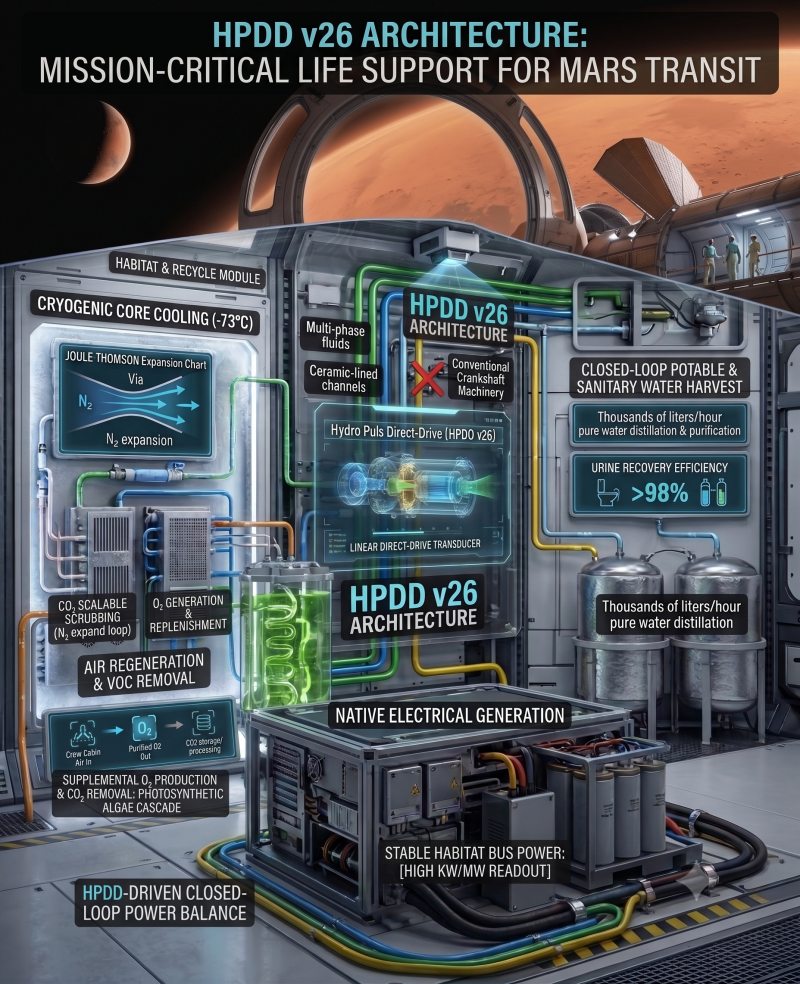
The HPDD-NEXUS by Hydro Puls Systems BV rewrites the rules of data center infrastructure. By replacing traditional crankshaft machinery with a software-defined, direct-drive thermal transformer, we collapse power generation, cryogenic cooling, and resource reclamation into a single, hermetically sealed energy core.
The Exergy Problem: Why Conventional Liquid Cooling Falls Short
In the standard data center playbook, the heat recovery window closes the moment the cooling architecture is selected. Once the coolant temperatures and cooling distribution unit (CDU) parameters are locked in, the thermal grade is fixed. Operators are left with low-grade enthalpy that is difficult to monetize, forcing municipalities to view data centers as infrastructure liabilities rather than community assets.
The HPDD-NEXUS eliminates this structural bottleneck. Instead of managing cooling and power as disconnected silos, our platform operates as a closed-loop multi-utility system under a strict Six Sigma quality threshold. It does not simply capture waste heat; it orchestrates the entire thermodynamic cycle to ensure that no energy or mass is rejected into the environment.
How the Closed-Loop HPDD-NEXUS Architecture Works
Our next-generation energy core manages power, cooling, and water reclamation simultaneously through a perfectly balanced, zero-variance mass ledger.
### 1. Integrated Cryogenic Rack Cooling
The platform utilizes a continuous, high-pressure inert nitrogen expansion loop to deliver deep cooling directly to high-density server racks. By utilizing gas dynamics rather than traditional mechanical chillers, the system slashes parasitic facility power demands and eliminates the need for volatile chemical refrigerants.
### 2. 100% Thermal Capture via Ceramic Pinch Networks
Instead of allowing thermal energy to escape into the atmosphere through cooling towers, the HPDD-NEXUS captures 100 percent of internal heat. An integrated ceramic Pinch Heat Integration Network recovers high-grade thermal energy, direct-coupling it back into the power circuit to generate clean electricity for the data center grid.
### 3. Continuous Distilled Water Harvesting
Operating under a perfect steady-state with zero net mass variance, the system natively condenses and harvests thousands of liters of pure distilled process water per hour from internal fluid matrices. This high-purity water can be routed directly to regional agricultural irrigation or processed as high-value drinking water, transforming a traditional water-consuming facility into a net water producer.
Absolute Environmental Containment: Zero Emissions, Zero Outlets
The true distinction of the HPDD-NEXUS platform is its absolute containment profile.
-
Zero Carbon Emissions: The system runs on a fully enclosed thermodynamic loop, producing absolute zero carbon dioxide or greenhouse gas emissions during operation.
-
Zero Atmospheric Venting: There are no exhaust stacks, cooling towers, or relief vents releasing thermal plumes or particulate matter into the local community.
-
Absolute Zero Liquid Discharge (ZLD): Every drop of process fluid and water is captured, recycled, or upgraded into an engineering asset. Nothing is discharged into nature.
The Institutional Business Case for Next-Generation Data Centers
By integrating the HPDD-NEXUS energy core at the siting and architectural stage, developers and utilities shift data center assets away from environmental liabilities into highly predictable, ESG-compliant infrastructure anchors.
This software-defined thermodynamic platform removes the mechanical part-load penalties of legacy systems, delivering the rigid operational certainty required to satisfy strict institutional underwriting. The HPDD-NEXUS converts data center thermal overhead into a bankable, recurring multi-utility cash flow, unlocking long-term value for the next generation of digital infrastructure asset management.
Patented technology under standalone PCT track, assigned corporate entity: Hydro Puls Systems BV (Wemmel, Belgium).
Meta Description for Google (SEO Summary):
Discover how the HPDD-NEXUS by Hydro Puls Systems turns data centers into zero-emission energy cores, combining cryogenic cooling, power generation, and water harvesting.