Ask any plant operator where engine efficiency disappears, and the answer is rarely inside the idealized thermodynamic cycle. It disappears in the real machine - during transients, partial-load operation, parasitic losses, friction spikes, unstable combustion, and the constant mechanical compromise required to follow a changing load. That is why constant speed combustion engine efficiency remains one of the most consequential design questions in industrial power.
At constant speed, an engine can be tuned around a narrow operating window where combustion phasing, air handling, lubrication, thermal balance, and energy recovery all work near their intended optimum. The advantage is not theoretical. It is architectural. When speed remains fixed and the load is managed elsewhere in the system, the engine no longer spends its life chasing disturbances. It can stay in its engineered sweet spot and produce more useful work from each unit of fuel.
Why constant speed combustion engine efficiency is structurally higher
Most combustion engines are forced into a broad operating envelope. Road vehicles, mobile equipment, and many gensets must ramp speed and torque continuously. That flexibility comes at a cost. The machine is designed for many operating points, yet genuinely optimized for only a few.
A constant-speed configuration changes the problem. Instead of asking the engine to satisfy every momentary demand directly, the system holds rotational speed stable and uses storage, hydraulic transfer, electrical buffering, gearing, or power electronics to absorb variation. This matters because brake specific fuel consumption typically worsens as the engine moves away from its best-load island. Even small departures in air-fuel ratio control, ignition timing, injection quality, or turbo matching can push the system off peak efficiency.
Steady-state operation also reduces thermal cycling. Cylinder walls, valves, manifolds, and aftertreatment stay closer to stable temperature bands. That lowers heat management penalties and helps sustain predictable combustion quality. For industrial buyers, this is not a small gain hidden in a lab graph. It directly affects fuel cost, maintenance intervals, emissions behavior, and dispatch economics.
The physics behind the gain
Constant speed combustion engine efficiency improves for three first-principles reasons.
The first is combustion stability. Combustion wants repeatability. Fixed speed and narrow operating conditions allow tighter optimization of ignition timing, injection pressure, air motion, and burn duration. Whether the fuel is diesel, gas, hydrogen-capable blends, or future ammonia pathways with pilot strategies, repeatability translates into more complete conversion of chemical energy into cylinder pressure at the right crank angle or pressure event.
The second is lower parasitic loss drift. Pumps, fans, accessory drives, and air handling systems consume power. In variable-speed machines, those losses move with operating condition and can become disproportionately large at off-design points. A constant-speed architecture makes those losses more predictable and often easier to minimize through fixed-ratio design and narrower control bands.
The third is friction management. Mechanical friction is not constant. It changes with speed, temperature, lubrication state, ring dynamics, bearing loads, and reciprocating imbalance. If the machine is held near its optimum speed, friction can be managed around a stable minimum rather than tolerated across a wide and inefficient range.
This is the larger lesson: engine efficiency is not only a combustion question. It is a systems question.
Constant speed does not mean constant efficiency under all loads
This is where weak analysis usually starts to fail. Holding speed constant does not automatically guarantee high efficiency. If the engine remains mechanically tied to a fluctuating demand without any meaningful buffer, it can still suffer from poor loading. A lightly loaded engine at constant speed may burn fuel inefficiently because pumping losses, heat losses, and baseline parasitics consume too large a share of the energy released.
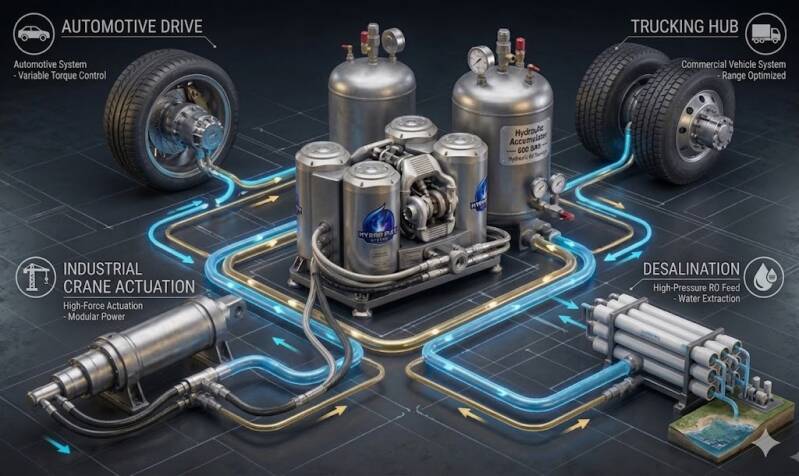
The highest value appears when constant speed is paired with load decoupling. That could mean hydraulic energy transfer, pressurized accumulators, generator-battery buffering, thermal storage in CHP systems, or application-specific intermediate systems. The engine then runs at stable conditions while the downstream system handles dynamic demand.
For this reason, the most advanced constant-speed platforms should not be judged by engine internals alone. They should be judged by whether the architecture protects the prime mover from load volatility.
Where conventional engines hit a ceiling
Traditional crankshaft-driven engines carry legacy constraints. They convert combustion into rotary motion through a mechanism that imposes side loads, frictional losses, vibration, and geometric compromises between torque production and mechanical durability. They also tend to connect combustion events tightly to the immediate load requirement.
That coupling is acceptable in many legacy applications, but it is not ideal for maximum industrial efficiency. Once load following dominates the design, the engine can no longer remain in its best thermodynamic and mechanical state. It must trade fuel efficiency for responsiveness.
This is one reason modern industrial power is shifting toward architectures that separate energy conversion from final work. In advanced systems, combustion does not have to be chained directly to wheels, propellers, compressors, pumps, or fluctuating electrical demand. It can operate as a controlled energy core, while another medium manages delivery.
Why hydraulic and pulse-based architectures change the equation
The next step beyond conventional constant-speed thinking is not simply a better governor. It is a different energy path.
When combustion occurs in isolated, repeatable events and the energy is transferred hydraulically rather than through a conventional crankshaft train, the system gains a new degree of control. Combustion can be tuned for pressure generation and thermal conversion, while the hydraulic side can be tuned for torque delivery, storage, smoothing, and direct coupling to industrial work. This reduces the requirement for the combustion core to chase every demand transient.
That design logic is especially relevant in heavy industry, shipping, distributed generation, CHP, off-grid systems, and mobility platforms where loads are highly variable but uptime and fuel economy are mission-critical. A platform such as Hydro Puls Systems positions this not as an incremental engine upgrade, but as a new class of thermal transformer. The claim matters because the efficiency opportunity lies in decoupling itself.
In practical terms, a pulse-based isolated combustion architecture can hold combustion conditions stable while hydraulic energy transfer absorbs disturbance. That means fewer compromises between combustion quality and delivered work. It also creates room for lower friction, lower parasitic loss, and direct coupling to pumps, propulsors, or generator systems without forcing the combustion unit to operate inefficiently.
Applications where constant speed combustion engine efficiency matters most
The value is highest where fuel cost, reliability, and heat recovery all matter at once. Combined heat and power is a prime example. In CHP, the engine is not judged only by shaft output. It is judged by total site economics. A constant-speed combustion core can provide stable electricity while delivering predictable thermal output for greenhouses, district heat, industrial process heat, or desalination support.
In marine and heavy transport applications, the gain comes from managing propulsion demand without dragging the combustion unit through a wide map of inefficient operating points. In off-grid and remote infrastructure, constant-speed operation supports better fuel planning, steadier maintenance behavior, and easier integration with storage and hybrid systems.
For hydrogen transition strategies, steady-state operation may become even more valuable. Alternative fuels often demand tighter control of combustion behavior, ignition characteristics, flame speed, and thermal loading. A narrow operating envelope makes that control challenge more manageable than a highly transient one.
The trade-offs executives and engineers should actually examine
There is no serious engineering case without trade-offs. Constant-speed systems can require additional subsystems for buffering, hydraulic management, electrical conditioning, or storage. That can increase initial complexity and shift where capital is spent. The correct question is not whether the architecture is simpler on paper. It is whether the full system delivers lower lifecycle cost and better output quality.
Another trade-off is sizing. If the engine is optimized around a sweet spot, the surrounding system has to be designed carefully enough to keep it there. Poor integration can erase the benefit. Strong integration can multiply it.
There is also an application boundary. If a duty cycle truly requires direct, continuous, wide-range speed variation with minimal intermediate buffering, a classic variable-speed approach may still be practical. But many industrial systems only appear to need that flexibility because they were designed around legacy engines. Once the full energy architecture is reconsidered, constant-speed operation often becomes the more rational choice.
What buyers should ask when evaluating efficiency claims
Any vendor can claim high efficiency. The serious questions are sharper. At what load band is the value measured? Is it shaft efficiency, generator efficiency, total CHP efficiency, or site-level energy utilization? How much performance degradation occurs during transient demand? What parasitic loads are included? How stable is the combustion event over time and fuel changes? And most important, does the architecture isolate the prime mover from variability or merely control around it?
That last question separates optimized machines from category-defining ones.
Constant speed combustion engine efficiency is not just about holding RPM steady. It is about designing an energy system that protects the combustion process from the chaos of real-world demand. The deeper that decoupling goes, the greater the opportunity to move beyond the limitations of conventional engines and toward a more stable, fuel-flexible, industrially superior power core. For organizations planning the next decade of power infrastructure, that is not a marginal improvement. It is a design fork worth taking seriously.