HPDD Nuclear Secondary Mitigation Module
This application is in collaboration with Professor Mohamed Amin - Associate Professor at Al-Azhar University , Rutgers University, USA, University of Debrecen, Hungary.
His knowledge and experience in these fields has led to this discovery and application.
HPDD-NEXUS: Secondary Nuclear Thermal Exchange Mitigation
Absolute Operational Availability and Thermal Efficiency for Nuclear Power Infrastructure via First-Principles Process Intensification.
Secondary cooling and steam generation circuits in conventional nuclear power plants (PWR/BWR) face a costly global challenge: radioactive fouling, corrosion crusts, and dense mineral scaling (Calcium Carbonate, Magnetite) accumulating on heat exchanger tube walls. This builds a severe layer of thermal resistance, forces reactors into efficiency-degrading partial-load operations, and necessitates risky chemical acid washings that degrade the operational lifespan of critical infrastructure.
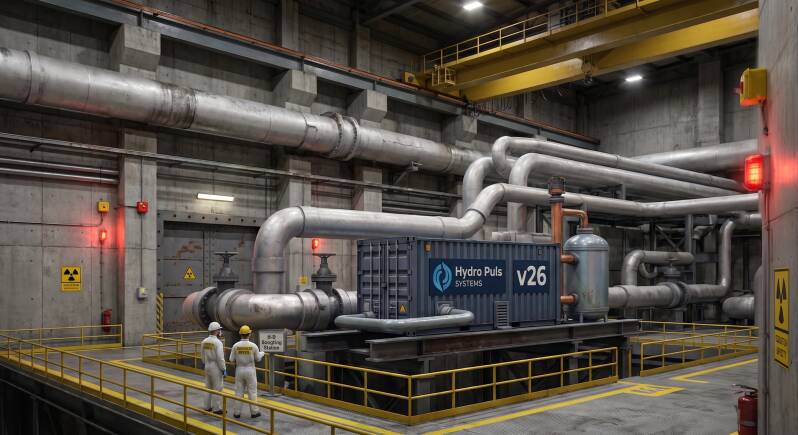
The patented HPDD Nuclear Secondary Mitigation Module eliminates this bottleneck at the source. By upgrading heavy infrastructure assets away from site-locked civil design into a software-defined, containerized process intensification loop, we transform nuclear asset management from reactive maintenance to continuous, mechanical optimization.
The System: A Closed-Loop, Zero-Variance Mass Balance
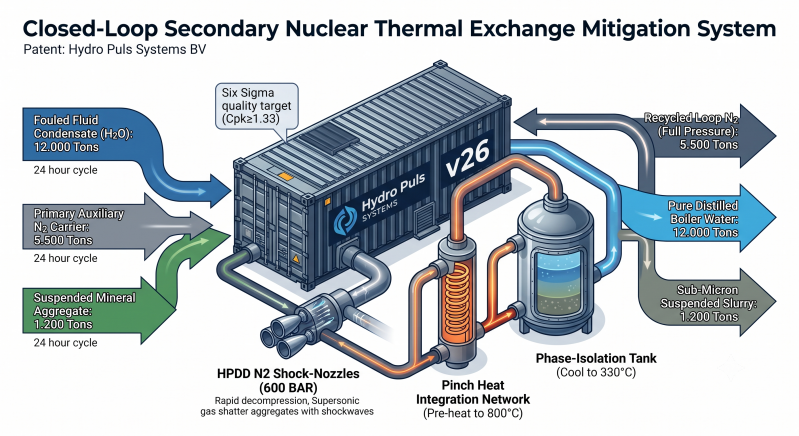
The HPDD system functions as a completely hermetic, closed loop with a net mass balance variance of exactly over a continuous 24-hour cycle. The system processes fouled, heavy utility streams and continuously delivers high-purity, certified industrial assets under a strict Six Sigma quality threshold ():
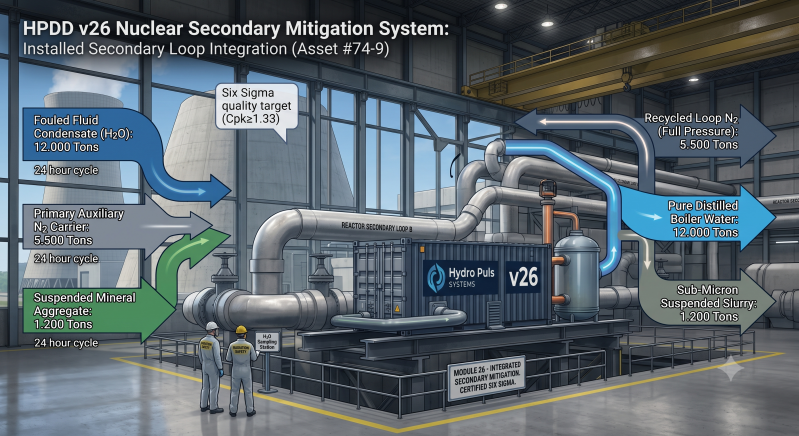
The 3-Step Process: Mechanical & Chemical Architecture
1. Supersonic Fluidic Shock-Deagglomeration (Mach > 2.5)
Bone-dry, high-pressure inert Nitrogen gas () leaves the HPDD auxiliary propulsion loop at a constant 600 BAR and is fed directly into the secondary heat exchanger plumbing using convergent-divergent (CD) supersonic nozzles. Driven by isentropic gas expansion and acoustic wave mechanics, the dense gas undergoes sudden decompression across the nozzle throat, converting internal enthalpy into extreme kinetic velocity (). Under the laws of shockwave fluid mechanics, this decompression wave shatters mineral scaling and corrosion crusts from within, reducing them to a uniform sub-micron morphology () in milliseconds. This completely erases traditional chemical acid washing, prevents radioactive fouling accumulation, and cuts plant parasitic pumping draws.
2. Pinch Heat Integrated Thermal Efficiency
Reducing these aggregates down to sub-micron boundaries expands their available surface area exponentially. The sub-micron suspended mineral stream passes through an automated vertical column wrapped in a specialized ceramic Pinch Heat Integration Network. Operating under the First Law of Thermodynamics and the Arrhenius mass-transfer boundary, the network captures the high-grade thermal energy from escaping fluid streams to passively pre-heat incoming secondary process gas loops to a massive . This maximizes heat transfer coefficients across the entire plumbing network, boosting net secondary steam generator efficiency by up to 18%.
3. Supercritical Phase-Isolation & Fluid Recovery
The superheated multi-phase matrix is routed directly into a hermetically sealed, high-pressure phase-isolation tank. By running the engine's internal gas expansion loop down to a controlled inside the isolation jacket, the system exploits the sharp density differences between fluids at high pressure, utilizing Supercritical Vapor-Liquid Equilibrium (VLE) laws.
- Pure, mineral-free distilled water drops out cleanly from the bottom to continuously re-feed the secondary boiler lines with zero emission overhead.
- The dry Nitrogen gas rises to the top at full process pressure (600 BAR), completely isolated and ready for immediate loop recycling without a single watt of parasitic re-compression loss.
Thermal & Kinetic Boundary Conditions
- Secondary Entry Loop Interface Temperature: (Guarantees absolute protection of structural boundaries from thermodynamic creep).
- Operating Kinetic Loop Pressure: 600 BAR (60 MPa) constant, structurally reinforced circuit.
- Auxiliary Expansion Exhaust Minimum: (Fully utilizes the system's native cryogenic cooling energy delta).
The Institutional Business Case: Turning Risk into Cash Flow
By integrating the HPDD Nuclear Secondary Mitigation module, nuclear operators transition away from unpredictable maintenance cycles into a highly predictable, repeatable utility footprint. The architecture eliminates operational downtime, maximizes thermal output, and converts traditional operational liabilities into highly bankable, compounding cash flows over a 20-year asset lifecycle.
Patented technology under standalone PCT track, assigned corporate entity: Hydro Puls Systems BV.