

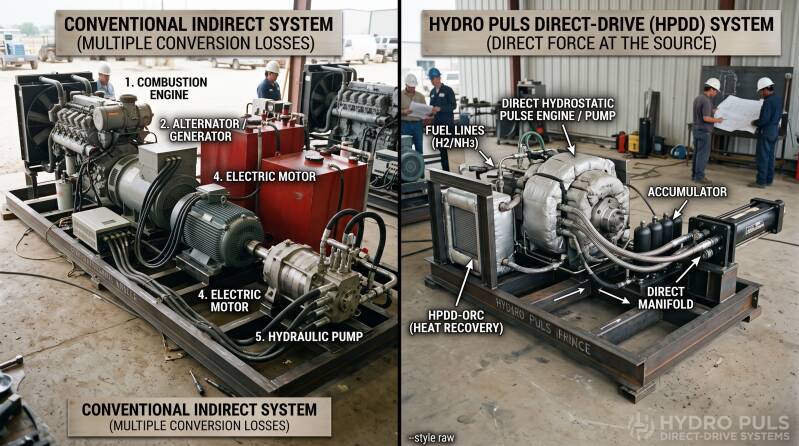
Take an honest look at the standard "electrified" hydraulic powertrain:
Chemical Fuel / Energy Source
⬇️ (Thermal dissipation)
1. Combustion Engine
⬇️ (Mechanical drag & shaft friction)
2. Alternator / Generator
⬇️ (AC/DC inverter & power electronic losses)
3. Power Electronics & Cabling
⬇️ (Electromagnetic losses & heat)
4. Electric Motor
⬇️ (Coupling misalignment & bearing drag)
5. Hydraulic Pump
⬇️ (Line friction & manifold throttling)
🎯 Pressurized Fluid at the Actuator.
Every single link in this chain demands dedicated cooling, adds dry weight, introduces critical failure points, and drains net exergy. By the time fluid actually moves the load, a massive portion of the primary energy has dissolved into ambient heat.
Now consider the Hydro Puls Direct-Drive (HPDD) architecture:
Fuel (H₂ / NH₃ / Syngas)
⬇️ (Single direct expansion stroke)
🎯 600-Bar Hydrostatic Pressure directly at the source.
No generator. No heavy electric drive motor. No multi-stage pump skid or reduction gearbox.
By coupling the combustion pulse directly to fluid displacement, HPDD bypasses the entire mechanical-electrical-hydraulic cascade. Remaining thermal energy is routed through an integrated HPDD-ORC loop, converting waste heat into auxiliary power.
The result: up to 63% system efficiency, a fraction of the structural footprint, and uncompromised hydrostatic stiffness.
True innovation is not about stacking intermediate conversion stages, it is about cutting out the redundant links.