

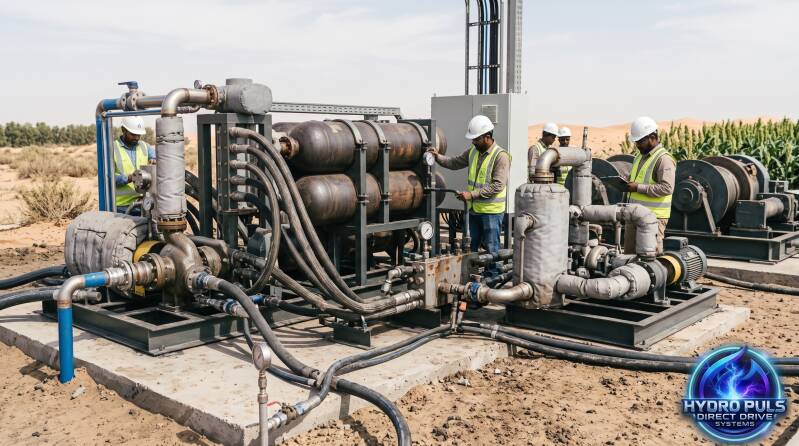
The Hydraulic Anatomy of HPDD: From 600 Bar Generation to Industrial Standard (With 100% Heat Recovery)
We often highlight HPDD’s 63% system efficiency and 600-bar hydrostatic capability. But what does the actual fluidic and energetic pathway look like in operation?
Here is how hydraulic power flows through the Hydro Puls Direct-Drive architecture:
1️⃣ The Initial 600-Bar Impulse
Everything starts at the source.
The direct-drive combustion pulse converts chemical energy into an instantaneous hydrostatic force of 600 bar in a single stroke.
No multi-stage pumps, no intermediate rotating shafts, and zero mechanical gear train drag.
2️⃣ The High-Pressure Buffer: Accumulator Decoupling
This raw 600-bar fluid stream feeds directly into an engineered high-pressure accumulator array. Acting as the system's hydraulic flywheel, it absorbs pulse dynamics, dampens pressure ripple, and provides a continuous, highly stable fluid volume.
3️⃣ Controlled Stepping to Industrial Standards
From the accumulator, line pressure is systematically stepped down and regulated to match the exact requirements of standard industrial infrastructure (such as 210 bar or 315 bar for conventional cylinders, hydraulic motors, or heavy presses).
You get 600-bar power density at the core, delivered at standard working pressures without retooling your plant.
4️⃣ Closing the Loop: The HPDD-ORC Oil Cooler
Under high cyclic loads, fluid shear and throttling inevitably generate heat in the oil. In legacy hydraulics, radiators and electric fan coolers bleed this energy into the atmosphere as pure waste.
In HPDD, the oil cooler is an Organic Rankine Cycle (ORC) evaporator. Instead of dumping thermal energy, the HPDD-ORC sub-loop captures oil heat and converts it directly back into useful mechanical or electrical power.
The result is a unified fluid power ecosystem: extreme source pressure, seamless downstream compatibility, and zero wasted exergy.