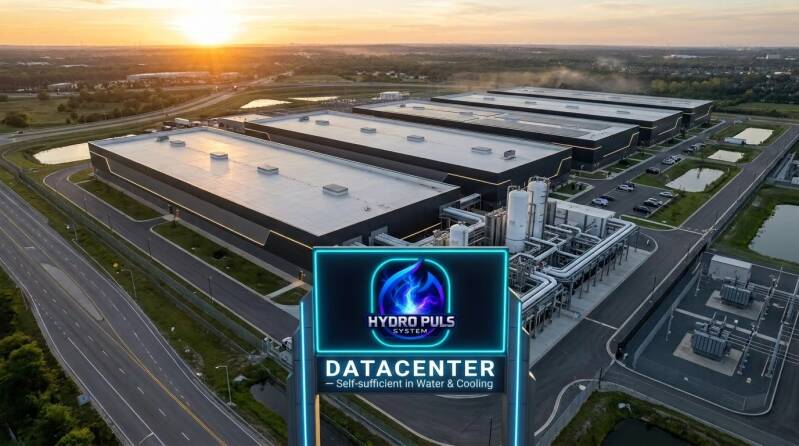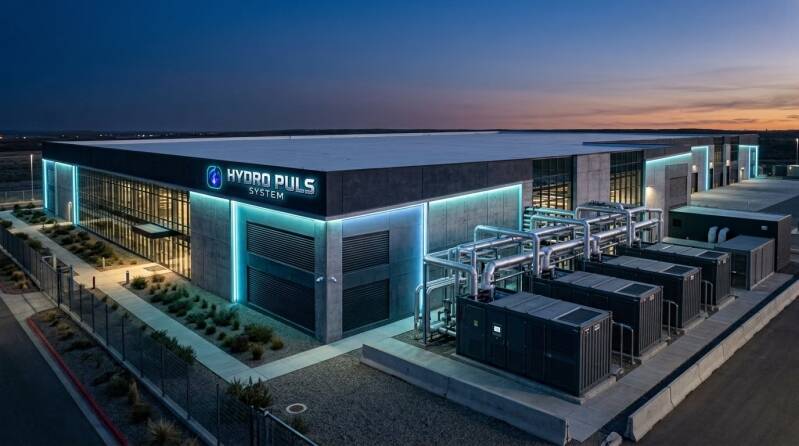
Datacenter energy consumption is measured by PUE (Power Usage Effectiveness):
The ratio between the total facility energy consumption and the energy consumed solely by the IT equipment (PUE = Total Facility Power / IT Power).
Here is how the energy consumption and efficiency of an HPDD-based architecture compare to a conventional datacenter installation:
1. Conventional Installation (Mechanical Chillers + Grid Power)
In a standard modern datacenter (without direct cryogenic sources), the energy distribution is structured as follows:
• Cooling Chain:
Servers generate heat. This thermal load is rejected via fans into computer racks, chilled-water loops, and ultimately into mechanical compression chillers and cooling towers.
• Electrical Consumption for Cooling:
A mechanical chiller typically operates with a COP (Coefficient of Performance) between 3.0 and 4.5. For every 1 kW of server heat rejected, the cooling plant consumes roughly 0.25 to 0.35 kW of additional electricity.
• PUE Rating:
- Traditional datacenter: 1.30 to 1.50 (30% to 50% extra power demand on top of the IT load, driven primarily by cooling and pumps).
- Advanced datacenter with free-air economizers (limited to cold climates): 1.15 to 1.20.
• Grid Conversion Losses:
Grid Power -> Transformers -> UPS Battery Systems -> Power Distribution Units. Each conversion stage loses 2% to 5%.
2. HPDD Architecture (Integrated Fluidic Cascade + Cryogenic Cold)
When a datacenter is coupled with the Hydro Puls Direct-Drive architecture, the paradigm shifts from consuming energy for cooling to harvesting native process exergy:
• Elimination of Compression Chillers ("Free Cold"):
The HPDD system yields primary cold streams through its expanded and cryogenic nitrogen cycles. Transferring this cooling capacity directly into the internal server chilled-water loop via a closed cryogenic heat exchanger completely eliminates power-hungry mechanical chillers.
• Pump and Auxiliary Load:
Instead of hundreds of kilowatts driven by refrigeration compressors, only circulation pumps for the secondary fluid loop are required. This reduces parasitic cooling loads from ~30% down to <3% to 5% of the total IT load.
• Resulting PUE:
Because the active cooling load demands virtually zero electrical energy from the grid, the facility PUE drops to 1.03 to 1.06 (the theoretical floor, dictated purely by internal pumps and transformer losses).
• Multi-Vector Polygeneration:
- While conventional emergency diesel generators sit idle or dump 60% of their fuel energy as waste heat when running, the HPDD core continuously delivers decentralized power, high hydrostatic pressure, and cold flux simultaneously.
- The exhausted pure, dry nitrogen gas can be directed into the server halls for hypoxic fire prevention (maintaining a 15% oxygen atmosphere) without dedicated nitrogen generators consuming auxiliary power.
The Core Difference:
A conventional facility must purchase substantial electricity to force heat out of the building.
An HPDD-coupled installation harnesses cryogenic exergy directly through high-efficiency heat exchangers.
As a result, the datacenter cuts overall facility power demand by 20% to 25% and compresses the cooling system's electricity consumption by over 85% to 90%.