

DAY 4 / 10: MARITIME REVOLUTION SERIES
Clean Hull Architecture: Redefining Cargo Ship Layouts
For over a century, naval architecture has been dictated by massive two-stroke diesels, towering engine rooms, and vast bunker tanks that eat into revenue payload.
Day 4 explores how the Small Modular Reactor (SMR) + Hydro Puls Direct-Drive (HPDD) platform shatters legacy hull constraints.
Volumetric Footprint Revolution
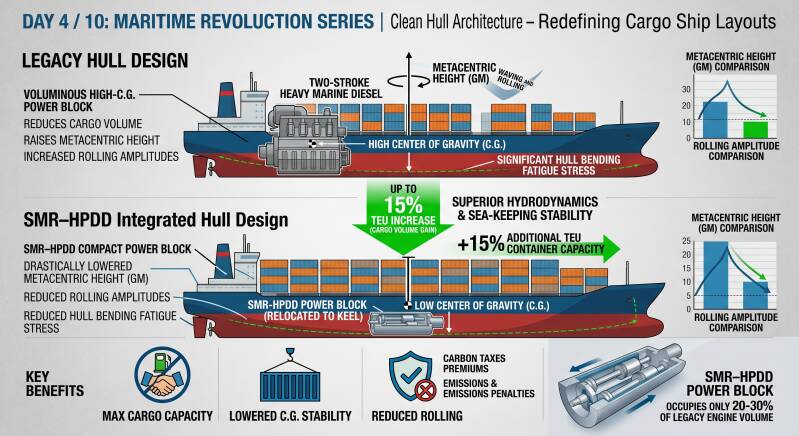
* 70–80% Space Reduction: The SMR–HPDD assembly occupies just 20–30% of the volume of equivalent low-speed diesels.
* Double-Bottom Relocation: The low-profile modular package fits into the lower double-bottom/keel envelope.
* No Exhaust Casings: Zero exhaust eliminates bulky vertical funnels and scrubber trunking through prime deck space.
Hydrodynamics & Vessel Stability
* Lower Center of Gravity (KG): Moving the mass downward optimizes metacentric height and damps roll amplitudes in rough seas.
* Lower Bending Fatigue: Distributing compact power blocks reduces hull girder stresses and hogging/sagging moments during ocean storms.
* Leaner Hull Lines: Enables hydrodynamically sleek hull forms with lower wave resistance.
Up to 15% Additional TEU Capacity
* Instant Cargo Gains: Container ships gain up to 15% more TEU volume on the same overall hull dimensions.
* Deadweight Conversion: Reclaiming thousands of tons of bunker fuel translates directly into revenue-generating payload.
* Higher Deck Stacking: Enhanced transverse stability permits higher, safer on-deck container tiers.
Stay tuned for Day 5: "Extreme Storm Resilience: Eliminating Propeller Shock & Dynamic Load Spikes."
#MaritimeTech #OceanShipping #NavalArchitecture #HydroPuls #HPDD #SMR #CleanShipping #ShipDesign #ContainerShipping #DeepTech #MarineEngineering