

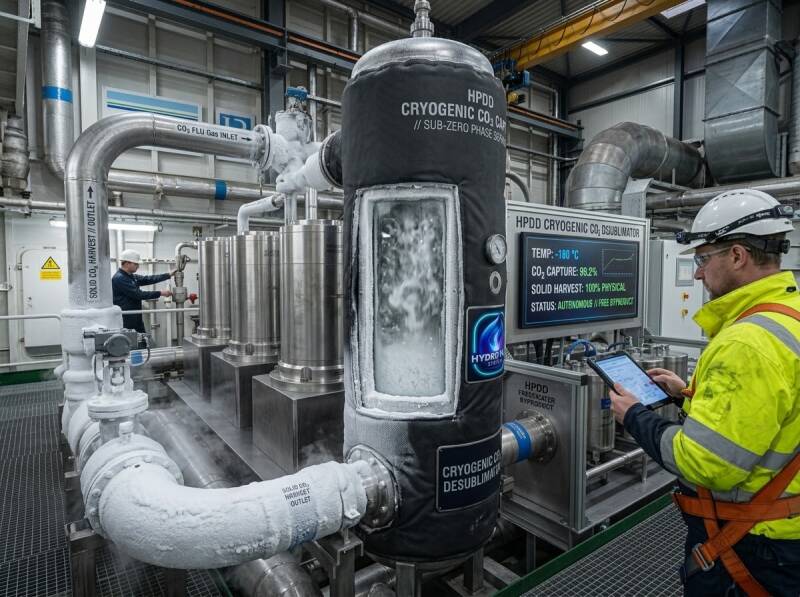
Cryogenic Carbon Capture: Transforming Emissions Abatement from Chemistry to Pure Thermodynamics
For decades, industrial carbon capture has remained chained to chemical amine scrubbing (such as MEA). While chemically proven, these systems carry massive operational vulnerabilities: thousands of liters of corrosive solvents, high degradation rates into toxic nitrosamines, and massive regeneration towers. More critically, reboiling and stripping amines consumes up to 25–30% of a facility’s total thermal output purely as parasitic reboiler steam load.
Cryogenic carbon capture flips this paradigm by substituting toxic chemical absorption with pure phase equilibria, unlocked without the traditional refrigeration energy penalty:
• Deep -180°C Cooling Delivered as a Free Byproduct:
Traditional cryogenic capture was historically dismissed due to the massive electrical power required to run sub-zero chillers.
Within the Hydro Puls Direct-Drive (HPDD) architecture, -180°C cryogenic cooling is generated naturally and continuously as an intrinsic thermodynamic byproduct of isentropic expansion during power generation.
There are zero auxiliary chiller skids, zero external liquid nitrogen deliveries, and zero added OPEX for cold generation.
• Zero Solvents or Hazardous Waste:
The separation medium is 100% physical. No chemical degradation, no solvent makeup costs, and zero toxic secondary emissions.
• Eliminating the Parasitic Thermal Penalty:
Instead of boiling liquid chemicals to release captured gas, the process utilizes the direct thermodynamic work potential already native to the conversion core. The parasitic thermal reboiler penalty is completely designed out of the plant.
• Direct Desublimation to Solid Phase:
At atmospheric pressure, CO2 skips the liquid phase entirely, desublimating directly from gas into solid dry-ice crystals at -78.5°C. Operating at the available -180°C envelope suppresses CO2 vapor pressure to near absolute zero, driving single-pass capture efficiencies exceeding 99% directly from flue gas or process streams.
• Solving the "Frosting" Bottleneck:
The historical barrier to cryogenic capture has always been surface fouling, dry ice freezing directly onto heat-transfer walls and insulating the system.
By coupling -180°C expansion with HPDD's acoustic pulse transients and high aerodynamic shear, crystallization occurs exclusively in the core gas stream (bulk desublimation).
Pure CO2 snow precipitates continuously out of the reactor volume without wall adhesion or clogging.
• Pipeline- and Transport-Ready Product:
Once precipitated as a dense solid phase, the CO2 can be mildly pressurized and melted into high-purity liquid CO2.
This completely bypasses the capital-intensive multi-stage gas compressors traditionally required to compress and liquefy gaseous emissions for sequestration or utilization.
Carbon capture no longer requires an expansive chemical refinery bolted onto an exhaust stack.
By harnessing the free -180°C byproduct of HPDD power generation, carbon abatement collapses into a compact, modular physical separator that turns gaseous industrial liabilities into pure, high-value commercial feedstock at virtually zero marginal operating cost.