

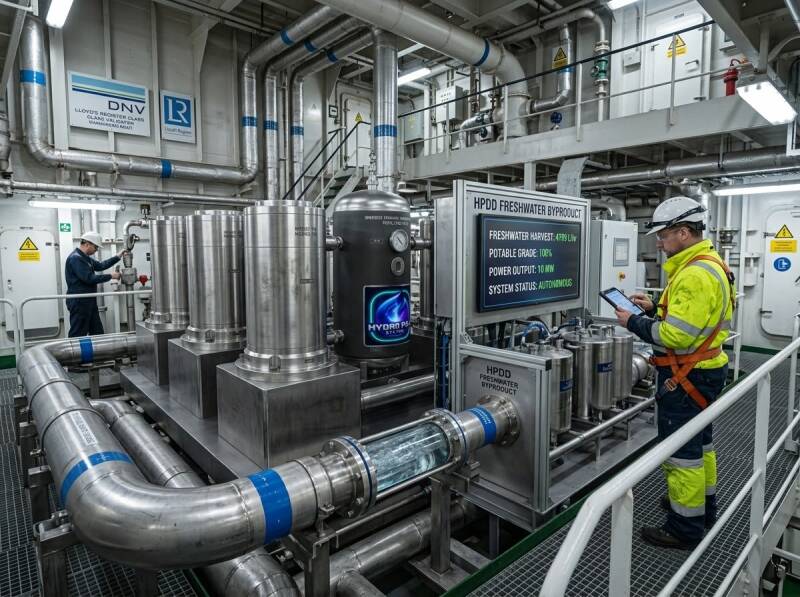
Why dedicated onboard desalination plants may soon be obsolete: How HPDD delivers 4,800 liters of pure water per hour as a byproduct.
For deep-sea vessels and commercial cruise liners, onboard freshwater generation is a persistent operational bottleneck.
Conventional watermakers, primarily Reverse Osmosis (RO) racks or vacuum thermal evaporators, consume valuable machinery space, draw heavy auxiliary electrical loads, require ongoing chemical dosing, and suffer from continual membrane scaling and biological fouling.
Within the Hydro Puls Direct-Drive (HPDD) architecture, ultra-pure water is not produced through an energy-intensive secondary treatment plant. It emerges naturally as an intrinsic thermodynamic byproduct of the power conversion cycle itself.
The numbers for maritime operators:
* 💧 144 liters of pure water per hour per standard 300 kW HPDD module.
* 💧 4,799 liters of pure water per hour on a combined 10 MW powertrain installation—translating to over 115,000 liters of potable-grade water every single day.
* ⚡ Zero parasitic energy expenditure: Water separation is governed strictly by natural phase equilibrium within the closed loop, requiring no auxiliary high-pressure pumps or thermal re-boilers.
Operational Impact Across Commercial Fleets
* Elimination of the Onboard Desalination Footprint (CAPEX & Space):
Bulky RO skids, high-pressure booster pumps, seawater intake pretreatment trains, and dedicated chemical storage can be designed out of the hull entirely. This directly frees up internal volume and sheds deadweight.
* Slashing Cruise Liner Hotel Load (OPEX):
Cruise ships face massive daily freshwater demands for passenger accommodations, galleys, laundry, and boiler feed loops. Sourcing 4.8 m³/hour of distilled-quality water directly from main power generation eliminates a substantial slice of conventional hotel power demand.
* Zero Membranes, Zero Antiscalants:
Because the water phase separates cleanly through thermodynamic condensation, operational headaches like membrane replacement, acid washing, and bio-fouling shutdowns are eliminated at the source.
Maritime efficiency reaches its highest potential when auxiliary utilities are no longer treated as parasitic cost centers, but as integrated thermodynamic outputs of clean propulsion.