

DAY 3 / 10: MARITIME REVOLUTION SERIES
The Commercial Case: 25 Years Without Bunkering
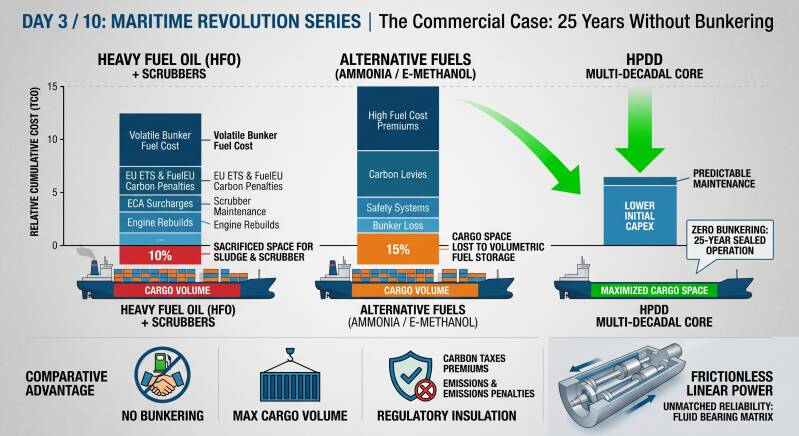
For decades, commercial shipowners have operated at the mercy of global bunker desks, volatile crack spreads, and mounting regulatory penalties. Marine propulsion economics are increasingly dictated by fuel premiums and compliance costs.
Day 3 of our series breaks down the commercial equation of the HPDD-marine: achieving a 25-year unrefueled operational lifecycle and rewriting the maritime Total Cost of Ownership (TCO).
1. Heavy Fuel Oil (HFO) + Scrubbers:
• OPEX Reality: Low baseline fuel cost wiped out by skyrocketing carbon taxes, ECA non-compliance surcharges, and heavy scrubber sludge handling costs.
• Maintenance Overhead: Continuous mechanical degradation, lubricating oil consumption, and major engine rebuild cycles every 25,000–30,000 hours.
2. Alternative Fuels (Green Ammonia / E-Methanol):
• OPEX Reality: Massive 3x to 5x cost premiums per energy unit compared to fossil baselines.
• Cargo Sacrifice: Volumetric energy density penalties demand oversized bunker tanks, slashing revenue-generating cargo holds by up to 10–15%.
• Safety Overhead: Complex toxicity management, cryogenic containment, and high bunkering infrastructure risks.
3. The HPDD Multi-Decadal Core:
• Zero Bunkering Exposure: Engineered for continuous 25-year sealed operational endurance, completely removing fuel supply chain dependency and bunker price volatility from the balance sheet.
• Maximize Deadweight & Volume: Eliminating massive bunker tanks, fuel treatment rooms, steam boilers, and exhaust scrubbers unlocks immediate cargo space and improves displacement efficiency.
• Maintenance Interval Standard: Built on frictionless opposed-piston dynamics and hydrodynamic fluid-bearing matrices, eliminating core metal-to-metal wear and slashing 25-year lifecycle maintenance down to scheduled peripheral checks.
Insulation from Regulatory and Port Penalties
Operating with true zero exhaust and closed-loop containment transforms compliance from a cost center into a margin generator:
• Complete ECA & Port Fee Optimization: True zero-emission and zero-spill architecture secures maximum environmental fee discounts and clean-corridor green port incentives across global hubs.
• No Carbon Price Indexing: Complete independence from global carbon pricing schemes, maritime ETS allocations, and volatile transition-fuel subsidies.
• Predictable 25-Year Cashflows: Fixed, transparent capital asset economics without fuel hedging risks or unexpected bunker surcharges.
Decarbonizing ocean shipping is no longer about betting on which high-cost transition fuel will dominate global bunkering hubs, it is about removing bunkering dependency altogether.
Stay tuned for Day 4: "Frictionless Linear Propulsion: Eliminating the Marine Gearbox/Crankshaft."
MaritimeTech #OceanShipping #HydroPuls #HPDD #CleanShipping #MarineEngineering #Decarbonization #Shipowning #NavalArchitecture #DeepTech